Skip to content
Briefings are running a touch slower this week while we rebuild the foundations.See roadmap
Iran Conflict 2026
4JUN

HMS Dragon sails before the ceasefire

3 min read
11:25UTC

The Royal Navy confirmed on its own website on Monday 11 May that HMS Dragon, a Type 45 destroyer, is forward-deploying to the Middle East for a future multinational Hormuz security mission. The UK and France hosted the first Strait of Hormuz coalition defence ministers' meeting alongside the announcement.

ConflictDeveloping
Key takeaway

Britain put HMS Dragon publicly on the Hormuz mission and lifted Northwood to ministerial level alongside France.

The Royal Navy officially confirmed on its own website on Monday 11 May that HMS Dragon, a Type 45 destroyer carrying the Sea Viper missile system and Wildcat helicopters armed with Marlet missiles, is forward-deploying to the Middle East for a future multinational Strait of Hormuz security mission 1. The Royal Navy phrased the activation trigger as following a sustainable ceasefire. Dragon left Portsmouth in March and had been operating off Cyprus before redeployment.

The statement is the first first-party UK Ministry of Defence (MOD) confirmation of the deployment. Earlier reports cited anonymous Jerusalem Post and MoD sourcing . Putting Dragon on the official Royal Navy news page rather than leaving the story to leaks removes deniability: HMS Dragon is now publicly tied to a Hormuz mission, and the political cost of withdrawing the ship without a ceasefire trigger has risen accordingly.

The United Kingdom and France are hosting the first Strait of Hormuz coalition defence ministers' meeting alongside the announcement. That lifts the Northwood planning track, in operational mode since the late April working sessions , to ministerial level. Forward-deploying a Type 45 ahead of the political decision rather than waiting for it is the standard procedure for an opposed-transit mission that needs surface combatant range from day one. Sea Viper gives Dragon area air defence against the IRGC's ballistic and cruise inventory; Marlet handles small-craft swarming. The capability matches the threat envelope the Northwood working text assumes.

CENTCOM's parallel blockade planning has no European participation by design, which makes the European architecture of this coalition its defining feature. The UK-France hosting positions Europe as the lead architect of post-war Hormuz security, with the political work running on a separate track from any US strike order Trump might sign on his Friday return from Beijing.

Deep Analysis

In plain English

The Royal Navy officially confirmed on 11 May that HMS Dragon; one of Britain's most capable warships, a Type 45 destroyer; is already in the Middle East area. It went there in preparation for a possible mission to protect ships passing through the Strait of Hormuz. It will not actually start that mission until there is a ceasefire between the US and Iran. But the ship is already in the region, so it can act quickly once conditions allow. At the same time, the UK and France hosted a meeting of defence ministers from the coalition of countries planning to join this mission. Before this meeting, the Hormuz mission was being planned by military staff at Northwood. Now it has political sign-off from defence ministers, which brings it closer to actual deployment.

Deep Analysis
Root Causes

HMS Dragon left Portsmouth in March 2026 and had been operating off Cyprus before the redeployment. The March departure precedes the current ceasefire talks, meaning the ship was already positioned for potential Middle East operations before the current diplomatic window opened. The official confirmation's timing on 11 May; the same day Trump declared the ceasefire on life support; suggests the Royal Navy coordinated its press release with the diplomatic messaging.

The UK-France coalition defence ministers' meeting marks the first time the Northwood planning has received explicit political sanction at ministerial level. Prior to 11 May, the 51-nation coalition was approved at the Paris conference level but the rules of engagement had only been worked at military-staff level. Ministerial elevation shortens the command chain between a ceasefire trigger and actual deployment orders.

What could happen next?
  • Consequence

    Royal Navy confirmation moves HMS Dragon from a leaked intelligence item to an official signal. Iran's IRGC must now plan around a forward-deployed Type 45 as a known variable, not a rumour.

    Immediate · 0.85
  • Precedent

    Ministerial-level sign-off on coalition rules of engagement creates a political commitment that is harder to reverse than staff-level planning, increasing the credibility of the ceasefire-trigger deployment.

    Short term · 0.75
  • Risk

    If Trump returns from Beijing on 15 May without a deal and verbally threatens military action, HMS Dragon's forward position and undefined rules of engagement could create fratricide risk between the coalition mission and any unilateral US kinetic operation.

    Short term · 0.55
First Reported In

Update #95 · OFAC opens the Hong Kong door

Royal Navy· 12 May 2026
Read original
Different Perspectives
China
China
Beijing's MOFCOM Blocking Rules constrain OFAC enforcement on the mainland; China has not corroborated Trump's verbal account of any bilateral summit, and the rial's failure to hold its Rubio bounce, combined with the IRGC's stablecoin rail closure, increases Chinese yuan-denominated oil-payment exposure through Hormuz.
Israel
Israel
IDF Chief Zamir said on 3 June there is no ceasefire for his forces even as Israel signed the Washington Lebanon framework requiring Hezbollah withdrawal south of the Litani; a UNIFIL peacekeeper was killed by mortar near Marjayoun on the same day, exposing the gap between the diplomatic framework and a ground advance that has not stopped.
Bahrain
Bahrain
The IRGC struck Bahrain on 3 June as its sirens sounded and its PAC-3 magazine neared exhaustion; excluded from Rubio's 2 May emergency resupply, Bahrain received a 50-round Federal Register notice on 1 June on an 18-month delivery timeline, meaning it is defending the US Fifth Fleet headquarters on the last rounds it has.
Qatar
Qatar
Qatar offered $6bn under OFAC Licence L-2 restrictions and sent Ghalibaf's delegation home empty-handed; the $6bn ceiling is a legal constraint, not a negotiating floor, and Rubio's no-sanctions-relief testimony means Qatar cannot revise it without White House action that has not been requested.
Kuwait
Kuwait
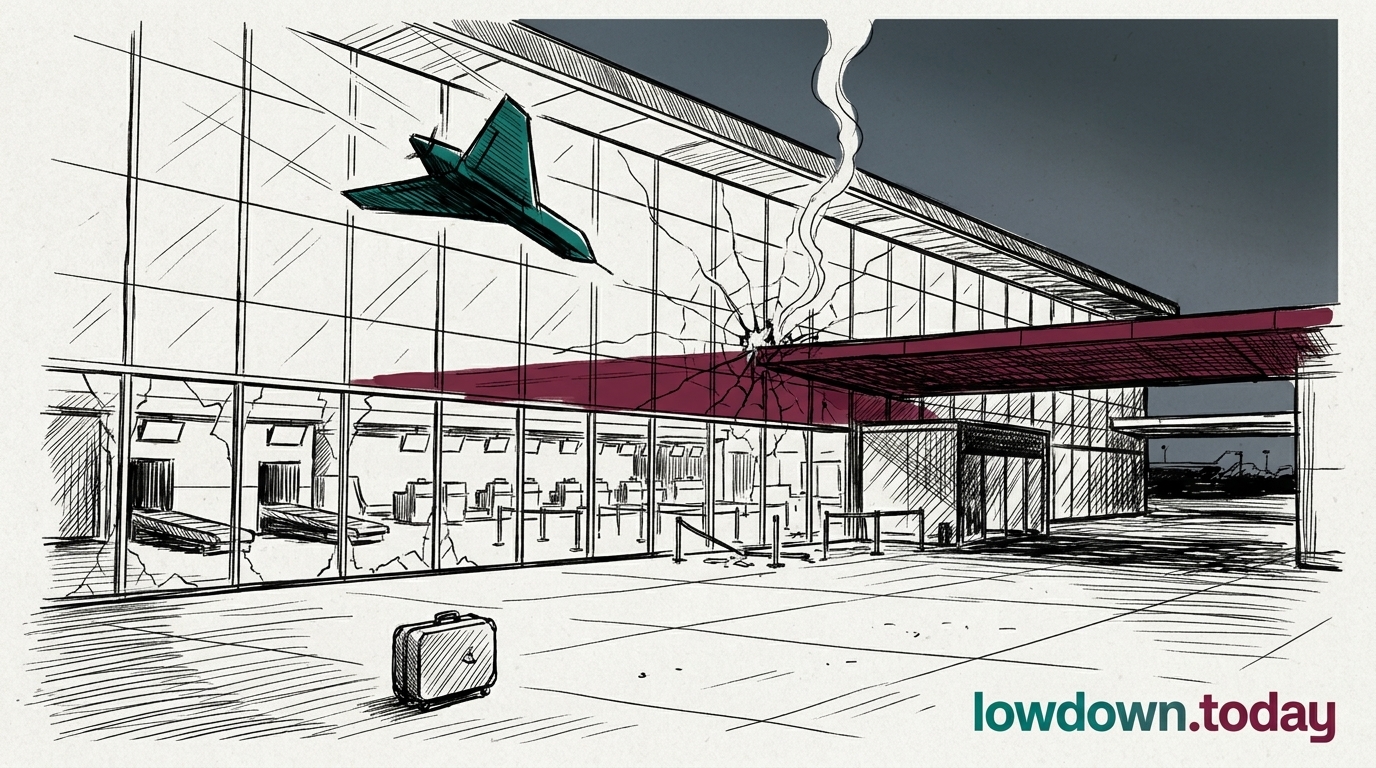
Kuwait expelled two Iranian diplomats within 24 hours of the airport strike, the strongest and fastest Kuwaiti diplomatic move of the conflict, while keeping the full mission in place to preserve a communication channel; it has now invoked Article 51 self-defence, filed a formal protest, and expelled diplomats, exhausting its formal toolkit short of full rupture.
United States
United States
Trump narrated a weekend deal while the channel Rubio described under oath, Khamenei's written-only couriers with a 3-to-5-day lag, cannot answer at that speed; CENTCOM called the airport strike deliberate, calculated and unjustified. The House 215-208 vote gave Congress its first on-record war-powers position against the deployment Trump has run without a signed instrument for 96 days.