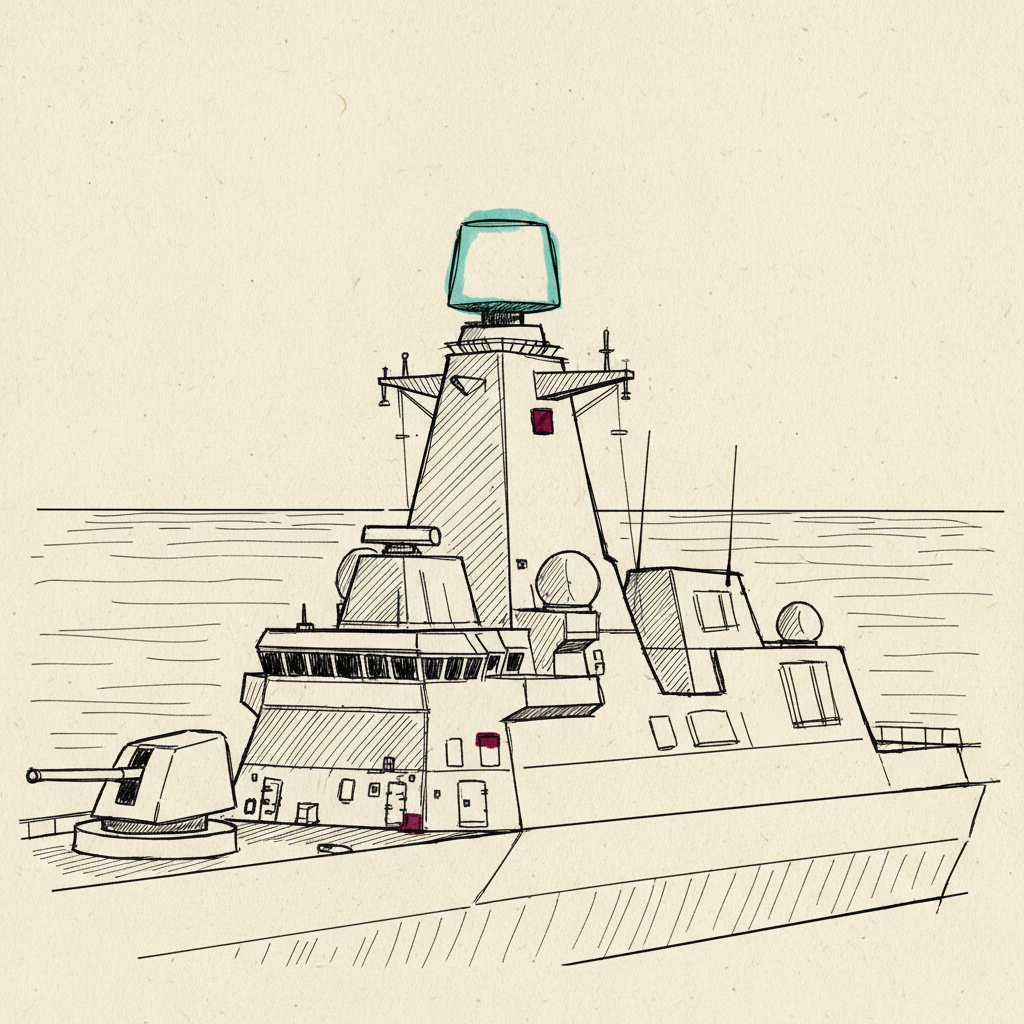
Sea Viper
Royal Navy long-range surface-to-air missile system on Type 45 destroyers; Aster 30 and Sampson radar.
Last refreshed: 28 July 2026 · Appears in 2 active topics
Can Sea Viper handle Iran's full anti-ship missile inventory, or just the slower variants?
Timeline for Sea Viper
UK sends £115M to Hormuz drones
Drones: Industry & DefenceMentioned in: UK names Typhoons, HMS Dragon for Hormuz
Iran Conflict 2026Mentioned in: HMS Dragon sails before the ceasefire
Iran Conflict 2026Mentioned in: HMS Dragon sails for Hormuz without rules of engagement
Iran Conflict 2026Background
Sea Viper is the missile system that makes a Type 45 deployment to Hormuz strategically significant rather than merely symbolic. Its Aster 30 variant is rated against ballistic and cruise missile threats at ranges up to 120 kilometres and altitudes up to 20 kilometres, matching the performance envelope of the Iranian ballistic and anti-ship Cruise Missiles that underpin Tehran's Hormuz deterrence posture. A single Sea Viper-equipped ship can simultaneously engage multiple inbound threats; against a saturation attack with sufficient volume it would be overwhelmed, but against the realistic sorties Iran could generate against a single convoy, it provides credible protection.
Sea Viper (PAAMS — Principal Anti-Air Missile System) is a joint development by the UK, France, and Italy, integrating the Aster 15 (short-medium range) and Aster 30 (long range) missiles with the Sampson AESA multifunction radar and the Type 1046 command system. The Royal Navy variant is designated PAAMS(S); the French and Italian navies operate PAAMS(E) on the Forbin and Horizon classes respectively. Each Type 45 carries 48 vertical launch cells loaded with a mix of Aster 15 and Aster 30 rounds. The system achieved its initial operating capability with the Royal Navy in 2012 alongside HMS Dragon's commissioning.
Sea Viper was designed after the Falklands conflict exposed the Royal Navy's vulnerability to air attack. The Sea Dart missile system it replaced could engage targets at range but struggled with low-altitude SEA-skimming threats. Aster 15 addresses that gap with its active radar seeker and AGILE dart-phase manoeuvre. In the context of May 2026, the system's primary relevance is not against manned aircraft but against the Iranian inventory of anti-ship ballistic missiles (including variants of the Fateh-110 family) and the subsonic and supersonic anti-ship Cruise Missiles the IRGCN has demonstrated in exercises.
What is the Sea Viper missile system?
Can Sea Viper intercept ballistic missiles?

