Skip to content
You can now search across every topic, entity and event.What's new
European Tech Sovereignty
27MAY

55 ships cross the strait Iran shut

3 min read
15:19UTC

CENTCOM logged 55 merchant vessels carrying about 17 million barrels through Hormuz on 21 June, the day after the IRGC declared it closed; three India-linked supertankers moved Gulf crude through Oman's waters.

TechnologyDeveloping
Key takeaway

Iran declared Hormuz closed; 55 ships and 17 million barrels crossed it the next day.

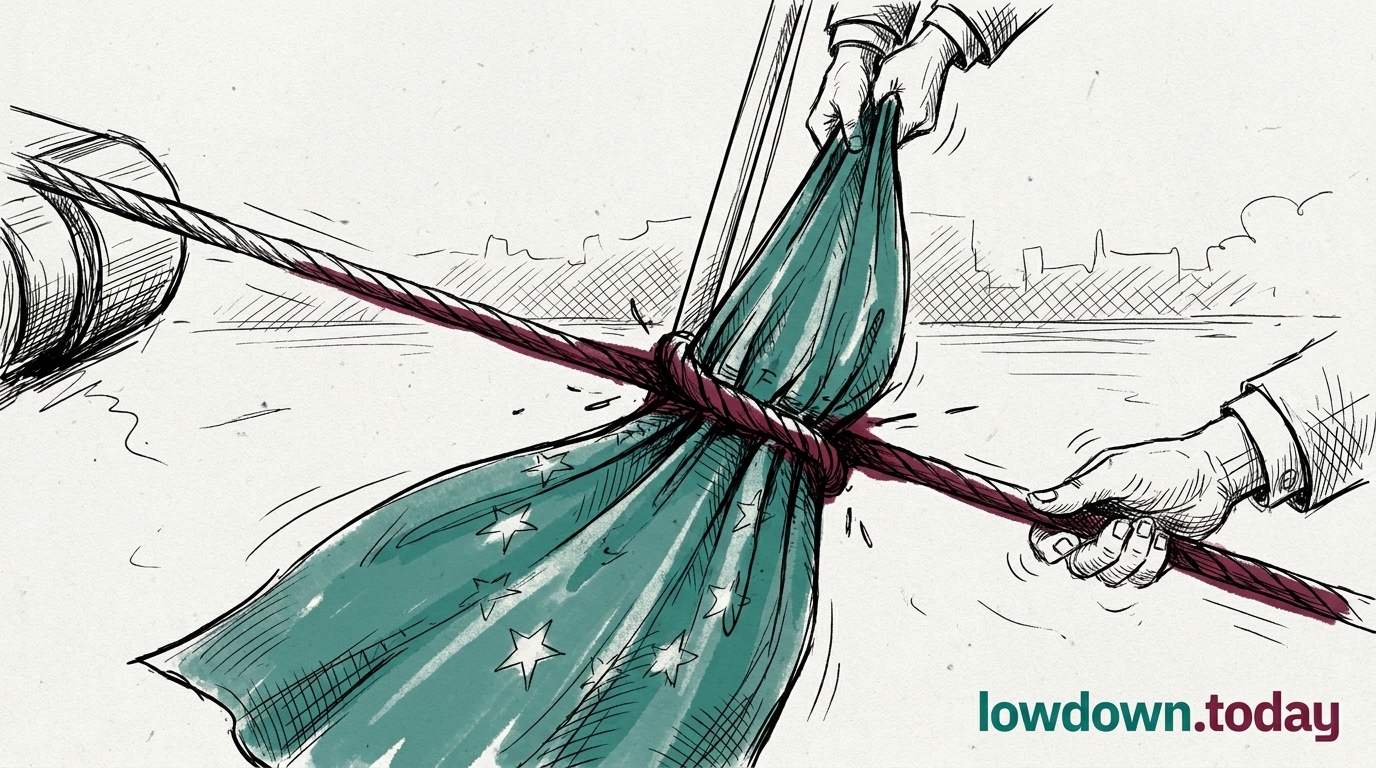
US Central Command (CENTCOM), the US military command for the Middle East, logged 55 merchant vessels carrying roughly 17 million barrels through the Strait of Hormuz on 21 June, against a pre-war daily rate of 94 1. That is well over half the normal traffic on the day after Iran's Islamic Revolutionary Guard Corps (IRGC) declared the waterway closed through its Khatam al-Anbia headquarters , citing the Lebanon strikes as a breach of the 16 June memorandum.

Three India-linked supertankers, the Desh Vibhor, Desh Vaibhav and Sanmar Herald, re-emerged in the Gulf of Oman carrying Iraqi and Kuwaiti crude, not Iranian. They moved through Oman's territorial waters, the lane the Joint Maritime Information Center, a US-led naval coordination cell, cleared as safe while warning of mines in the strait's traffic-separation scheme . The cargo is the tell: Gulf producers are moving their own oil through a chokepoint Iran says it has sealed.

The shipping intelligence firm Windward said the Iranian statement and the vessel data "were pointing in different directions", and Vance said he had "seen no evidence the strait is closed". The IRGC has run this play before, charging a dollar a barrel since April rather than physically interdicting traffic. A real closure would cut Iran's own China-bound exports and invite the strikes Trump threatened, so the declaration works as a bargaining lever and a price floor, not an interdiction.

Deep Analysis

In plain English

Iran declared the Strait of Hormuz closed to shipping. But on the same day, 55 cargo ships carrying roughly 17 million barrels of oil went through anyway, using a different route through Oman's nearby waters that the US military confirmed as safe. Think of it like this: Iran put up a "road closed" sign on the motorway, but traffic found a side road through a neighbour's land. Iran does not control that side road (Oman's territorial waters), so the sign has no force there. The gap between what Iran declared and what actually happened is why oil prices fell rather than rose.

Deep Analysis
Root Causes

Iran's closure declaration carries no enforcement mechanism against vessels routing through Oman's territorial waters. UNCLOS Article 17 grants innocent passage in territorial seas; the IRGC has no legal basis to interdict ships in Omani waters without Oman's consent. Oman's studied neutrality (maintained since 1981 as the primary US-Iran backchannel) makes a request for IRGC interdiction authority in Omani waters structurally impossible.

The 58% traffic restoration (55 of 94 pre-war daily vessels) reflects mine-risk suppression rather than insurance cover return. The BIMCO CONWARTIME clause and London P&I exclusions remain triggered; what changed is that the Oman corridor is assessed as mine-free by JMIC, lowering the physical rather than the financial barrier.

Escalation

Stabilising: the Oman corridor's demonstrated functionality reduces the immediate supply-shock risk. Iran's IRGC retains the option to mine the Oman approach or confront Omani-transiting vessels, but doing so would directly challenge Oman's sovereignty and likely trigger a response beyond the US-Iran bilateral.

What could happen next?
  • Consequence

    The Oman territorial-waters corridor, now confirmed as the de facto Hormuz alternative, shifts operative transit sovereignty away from Iran, reducing the IRGC's chokepoint leverage for the 60-day final-agreement negotiation.

  • Risk

    Iran's Persian Gulf Strait Authority insurance mandate (ID:4403) applies to the standard TSS route; vessels using the Oman bypass face legal uncertainty about whether PGSA fees apply post-August, creating a regulatory two-track that could fracture commercial shipping compliance.

First Reported In

Update #135 · Trump's threats peak, his paper stays blank

The National· 22 Jun 2026
Read original
Different Perspectives
United States (Google/Alphabet)
Alphabet lost its final Android appeal on 2 July with no further court to hear it, a result its Computer and Communications Industry Association allies frame as precedent, not deterrence, since the €4.1bn fine changed nothing about Google's Play Store terms across eight years of litigation.
UK Department for Science, Innovation and Technology
DSIT opened its £96m second Sovereign AI wave on 3 July, switching from April's equity stakes to fixed-price contracts because Britain has no domestic hyperscaler or Bpifrance-style lender to fund capacity another way. It is betting on buying outcomes it controls alone rather than joining an EU-wide framework.
German federal government
Berlin backed both German deliverables this week, Infineon's fab and Aleph Alpha's merger, but is finding one far harder to close than the other. It wants enforceable protective rights inside Cohere's cap table before the merger closes, a legal instrument the Bundeskartellamt has no filing to review yet.
European Commission
European Commission
The Commission banked a clean CJEU win on the eight-year Android case on 2 July, removing Google's last comparator argument before President von der Leyen rules on the far larger DMA self-preferencing fine due 27 July. Brussels treats Infineon's early Dresden delivery as proof the Chips Act mechanism works, at the node Europe already led.
Bruegel (EU industry sceptics)
Bruegel economist Mario Mariniello argued the EU sovereignty package mimics US and Chinese strategy while EU cloud providers hold roughly 15% of their home market; using nationality as a proxy for security without fixing the underlying capital and energy gaps that drive the dependency creates €86bn of migration cost without the security benefit it is sold as delivering.
France
France
France published a joint sovereignty definition with Germany at VivaTech and mobilised €13bn under Tibi Phase 3, placing SAP's partnership with Mistral as the working proof that a German enterprise-software giant running a French sovereign model inside public administration is what digital sovereignty looks like in practice.
