Skip to content
Briefings are running a touch slower this week while we rebuild the foundations.See roadmap
European Tech Sovereignty
27MAY

Digital euro stays on its own track

4 min read
15:19UTC

The ECB signed standards agreements on 24 April and confirmed pilot provider selection for June, making the digital euro the one European sovereignty instrument still moving on time.

TechnologyDeveloping
Key takeaway

Europe's only on-time sovereignty project is the one that threatens no American firm.

The ECB (European Central Bank) signed standards agreements with three European payment-standards bodies, ECPC, nexo standards and the Berlin Group, on Friday 24 April 2026 to reuse open technical standards for digital euro payments 1. Piero Cipollone, an ECB Executive Board member, confirmed that selection of the payment-service providers (PSPs, the banks and fintechs that would distribute the digital euro to users) for the 12-month pilot finalises in June 2026 2. The digital euro is the ECB's proposed central-bank digital currency, advanced on the bank's own mandate rather than through a Commission legislative act.

The European Parliament's economy committee is expected to vote before the summer recess, after rapporteurs resolved the online-versus-offline design dispute in March 2026 by adopting a single payment-system design 3. Settlement infrastructure follows: the Pontes initiative, the ECB's DLT (distributed-ledger technology, the shared-record system behind tokenised-asset settlement) solution, is scheduled for the third quarter. Hold limits and bank-compensation models remain the open questions, with full legislative approval targeted by end-2026.

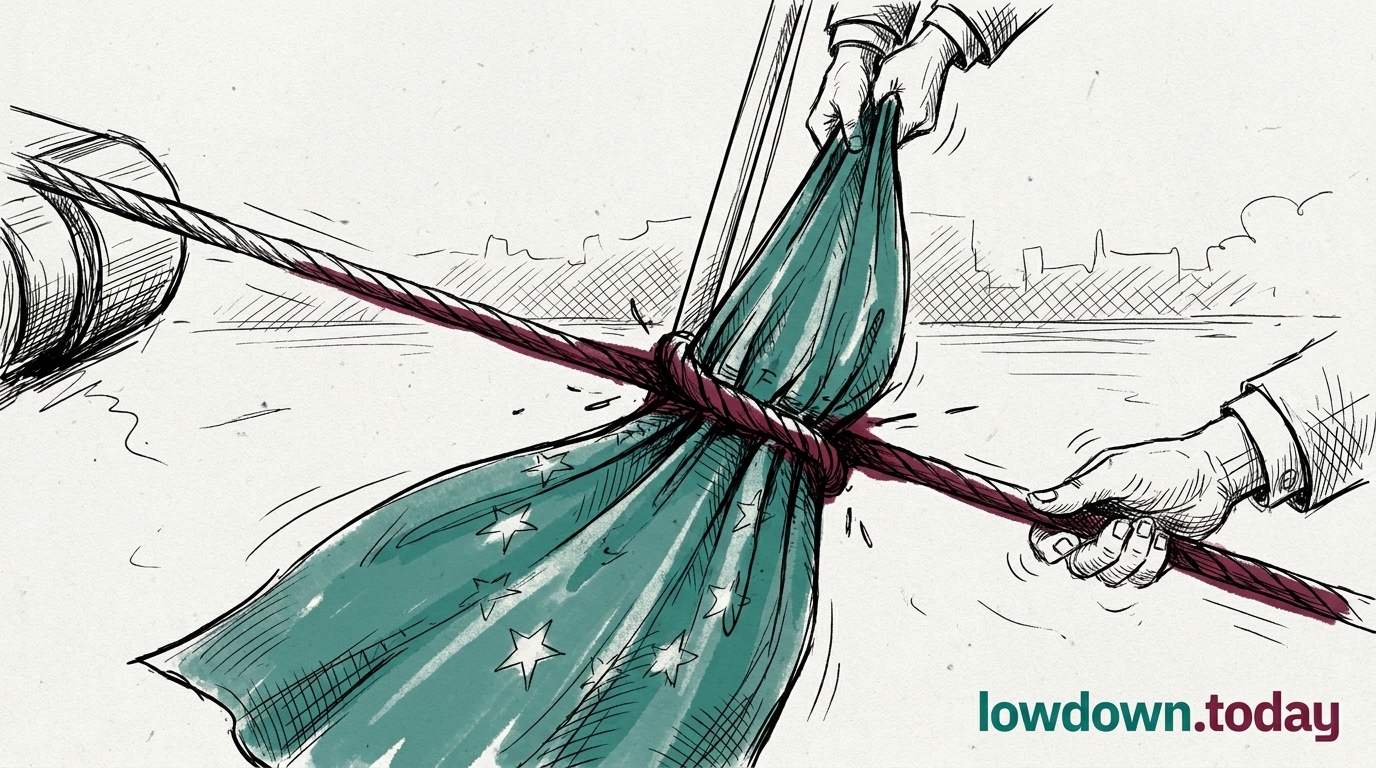
Set the digital euro beside CAIDA and the divergence tracks one variable. Both count as sovereignty instruments. CAIDA must reconcile procurement law against a trade framework and a hostile ambassador, and it slipped a third time this week . The digital euro runs on the ECB's own mandate, restricts no American company, and sits entirely outside the Section 301 trade perimeter that is delaying the cloud law and timing the Google fine . Sovereignty that does not provoke Washington ships; sovereignty that does, slips.

Deep Analysis

In plain English

The digital euro is a new kind of money being developed by the European Central Bank (ECB), the institution that manages the euro currency for 20 European countries. Unlike the euros in your bank account, the digital euro would be directly issued by the ECB, not a commercial bank. Think of it as a digital version of physical cash. Progress was announced in April 2026: the ECB signed technical agreements with three European payment standards bodies to ensure the digital euro will work with existing payment systems. Banks and payment apps would be selected to distribute it to customers by June 2026. A key argument about how much digital euro any one person should be allowed to hold, a question that matters because too much could destabilise commercial banks, had been resolved enough for the design to move forward. The European Parliament is expected to vote on the underlying law before its summer break.

What could happen next?
  • Opportunity

    The digital euro's open-standards approach, if successfully deployed, reduces European payment infrastructure's dependence on Visa and Mastercard card-network rails for domestic euro-denominated transactions.

  • Risk

    Commercial bank resistance to hold limits above €1,000 may produce a legislative compromise that caps the digital euro at a level insufficient for meaningful retail adoption, delivering an infrastructure without an addressable market.

First Reported In

Update #6 · Brussels slips sovereignty law a third time

European Central Bank· 27 May 2026
Read original
Different Perspectives
ASML / European tech industry
ASML's Q2 2026 guidance came in €300m below consensus as China DUV revenue collapsed 17 percentage points; the company's CEO wrote US export-control outcomes directly into 2026 guidance. European tech firms named on the USTR retaliation list alongside SAP, Siemens and Spotify face the same calculus: US trade exposure constrains what Brussels can legislate on their behalf.
France / Anne Le Henanff
Le Henanff chaired the G7 Digital Ministerial at Bercy on 29 May with CAIDA off the agenda, pivoting France's presidency to AI safety principles it had not designed the week around. France backs CAIDA but cannot override Berlin's tariff calculus, so the ministerial produced no new French-led commitment.
Germany / Federal government
Berlin's automotive sector faces up to $200bn in threatened US tariffs, a commercial exposure that dwarfs any benefit CAIDA's public-sector cloud rules would deliver to German digital firms. Federal silence inside the College of Commissioners functions as a block under consensus adoption rules without requiring a formal veto.
USTR / Ambassador Andrew Puzder
Puzder's public warning on 25 May that CAIDA is inconsistent with the EU-US trade framework was the first time Washington made its bilateral pressure visible before a Commission adoption vote rather than after. The USTR Section 301 determination on 24 July provides the enforcement backstop.
European Commission / Henna Virkkunen
Virkkunen framed the third slip as a procedural delay in finalising a 400-page text without addressing Puzder's trade-framework red line publicly. The Commission enforces existing law against Google while losing the legislative timeline on CAIDA, exposing an asymmetric position: enforcement holds; new sovereignty legislation does not.
OpenForum Europe / open-source community
The EUR 350m Sovereign Tech Fund has no Commission host, no budget line, and no commissioner's name attached six weeks after the April conference, while Germany is already paying maintainers to staff international standards bodies. The CRA open-source guidance resolves contributor liability but leaves the financial-donations grey area open with the 11 September reporting clock running.
