Skip to content
You can now search across every topic, entity and event.What's new
European Tech Sovereignty
7MAY

Trump touts a deal he cannot sign

3 min read
10:13UTC

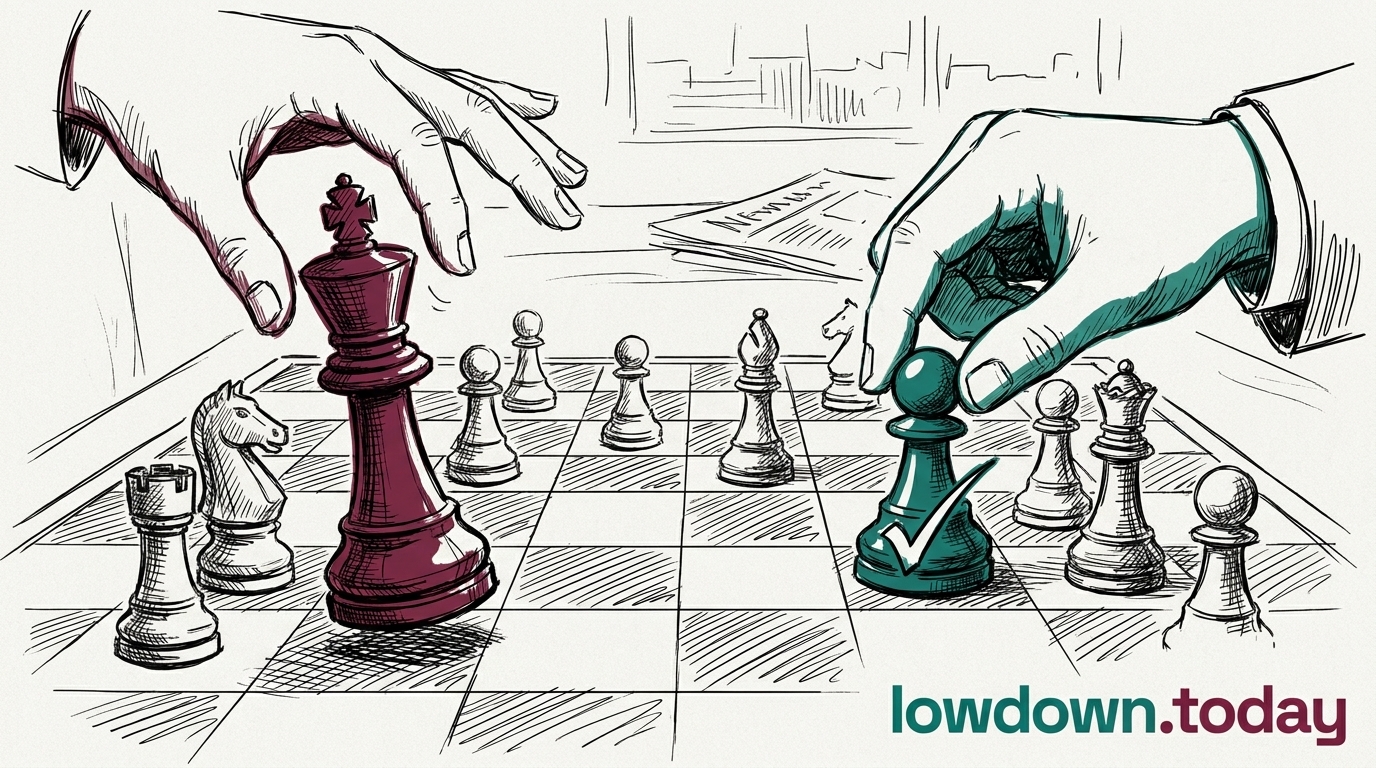
Donald Trump said on 9 June that an Iran deal was in 'the final throes' and could be signed 'in two or three days', and credited the US naval blockade as 'much stronger than bombing'. Neither claim rests on a signed instrument.

TechnologyDeveloping
Key takeaway

Trump promised a deal in days and praised an unsigned blockade, neither backed by a signature.

Donald Trump said on Tuesday 9 June that an Iran deal was in "the final throes", that the Strait of Hormuz would reopen "immediately upon signing, which could be in two or three days", and that the US naval blockade had "turned out to be much stronger than bombing" 1. the strait of Hormuz is the Persian Gulf chokepoint through which roughly a fifth of the world's seaborne oil passes.

The line about the blockade matters more than the timeline. CENTCOM (US Central Command, the Pentagon's Middle East command) runs that blockade on a written military order, not a presidential instrument, and it has redirected 127 vessels and disabled six without an executive signature behind it . On Tuesday Trump elevated that unsigned mechanism above kinetic force in public for the first time, even as the one ally executing kinetic force ignored him.

Trump has floated near-term deals before, telling reporters on 4 June a deal could close "this weekend" before his own Secretary of State, Marco Rubio, said on 7-8 June that enrichment matters could take months . For 102 days his words pointed at Tehran. This week the harder words pointed at Israel instead, while the deal stayed a promise rather than a document.

Tehran negotiates through written positions and general-officer shuttles, channels that respond to signed paper, not to interview cadence. A blockade Trump now calls war-winning and a deal he says is days away both rest on the same absence: no signature that would force the War Powers clock or bind either side to terms.

Deep Analysis

In plain English

Since late February, the US Navy has been blocking the Strait of Hormuz, the 33-kilometre chokepoint through which most Gulf oil exports pass. Trump is now publicly saying this blockade has worked better than the earlier bombing campaign, and that an agreement with Iran could be signed within days. The problem is that Iran's government communicates with Washington only through written messages that take three to five days to travel through middlemen. So when Trump says a deal is nearly done, he may be talking about a conversation where the last message from the other side arrived days ago. Financial markets have already priced in 'nearly done' twice this year and reversed both times when nothing was signed.

Deep Analysis
Root Causes

Trump's 'final throes' claim reflects a structural asymmetry in the negotiation: Iran communicates only in writing through intermediaries with a 3-to-5-day courier lag (confirmed by Rubio on 2 June), meaning Trump receives no real-time feedback on whether Tehran accepts the terms he publicly endorses. In that information vacuum, his public statements function as aspirational pressure rather than confirmed progress.

The blockade's effectiveness claim is grounded in real data , CENTCOM reached 127 redirected vessels with six disabled by 2 June , but Trump's framing elides the fact that the blockade operates without a signed presidential instrument, which means it exists in a legal grey zone that any future administration could end by executive order. Crediting it as the decisive weapon before a deal is signed risks creating a removal cost that constrains whatever agreement follows.

What could happen next?
  • Risk

    A third 'deal within days' claim that produces no signature will accelerate market scepticism of any future announcement, potentially delaying the economic relief a genuine deal would provide.

  • Consequence

    Iran's negotiators will read Trump's public credit to the blockade as confirmation that Washington values it as an end-state rather than a transition instrument , which hardens Tehran's demand for full sanctions relief before any reopening.

First Reported In

Update #122 · Trump warns Bibi as Israel strikes anyway

Al Jazeera· 9 Jun 2026
Read original
Causes and effects
This Event
Trump touts a deal he cannot sign
Trump elevated an unsigned military blockade above kinetic force in public for the first time, even as the deal he promised carried no presidential signature.
Different Perspectives
United States (Google/Alphabet)
Alphabet lost its final Android appeal on 2 July with no further court to hear it, a result its Computer and Communications Industry Association allies frame as precedent, not deterrence, since the €4.1bn fine changed nothing about Google's Play Store terms across eight years of litigation.
UK Department for Science, Innovation and Technology
DSIT opened its £96m second Sovereign AI wave on 3 July, switching from April's equity stakes to fixed-price contracts because Britain has no domestic hyperscaler or Bpifrance-style lender to fund capacity another way. It is betting on buying outcomes it controls alone rather than joining an EU-wide framework.
German federal government
Berlin backed both German deliverables this week, Infineon's fab and Aleph Alpha's merger, but is finding one far harder to close than the other. It wants enforceable protective rights inside Cohere's cap table before the merger closes, a legal instrument the Bundeskartellamt has no filing to review yet.
European Commission
European Commission
The Commission banked a clean CJEU win on the eight-year Android case on 2 July, removing Google's last comparator argument before President von der Leyen rules on the far larger DMA self-preferencing fine due 27 July. Brussels treats Infineon's early Dresden delivery as proof the Chips Act mechanism works, at the node Europe already led.
Bruegel (EU industry sceptics)
Bruegel economist Mario Mariniello argued the EU sovereignty package mimics US and Chinese strategy while EU cloud providers hold roughly 15% of their home market; using nationality as a proxy for security without fixing the underlying capital and energy gaps that drive the dependency creates €86bn of migration cost without the security benefit it is sold as delivering.
France
France
France published a joint sovereignty definition with Germany at VivaTech and mobilised €13bn under Tibi Phase 3, placing SAP's partnership with Mistral as the working proof that a German enterprise-software giant running a French sovereign model inside public administration is what digital sovereignty looks like in practice.
