Skip to content
Briefings are running a touch slower this week while we rebuild the foundations.See roadmap
European Tech Sovereignty
23APR

Sovereignty summit, minus the sovereigns

6 min read
09:21UTC

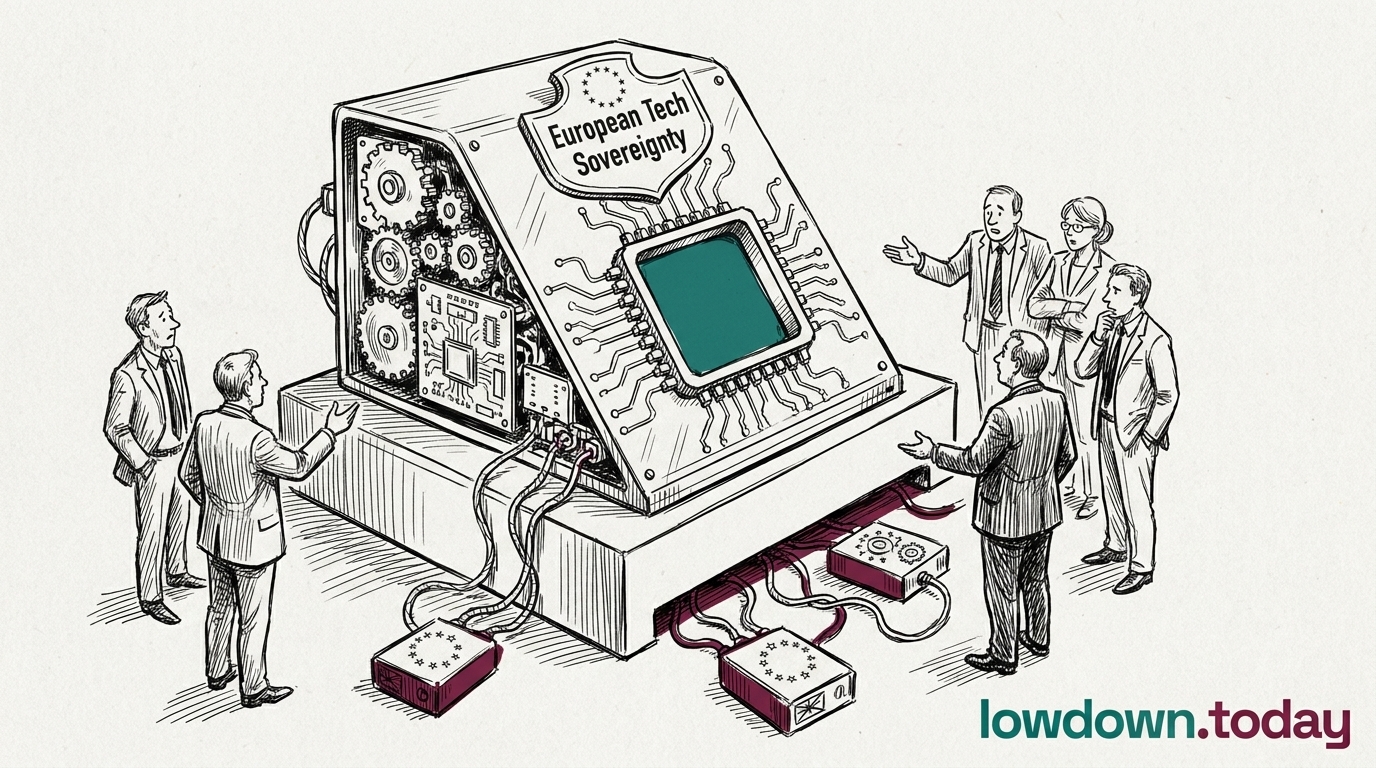
The inaugural Sovereign Tech Europe summit opened in Brussels today with 45 speakers, no European AI model companies, and only cabinet-level Commission presence. In one week the machinery of European sovereignty has become visible: four named cloud providers, seven DSIT investees, an open DMA consultation. Every instrument carries a US dependency somewhere inside it.

Key takeaway

Europe's sovereignty machinery is accelerating; functional sovereignty is not advancing at the same rate.

This briefing mapped
Loading map…
Regulatory
Domestic
Competitive
Economic
Diplomatic

Sovereign Tech Europe convenes 45 speakers in Brussels on 23 April with not a single European AI model company on the programme, and no Commissioner in the room.

Sources profile:This story draws on neutral-leaning sources

The inaugural Sovereign Tech Europe conference opened in Brussels on 23 April 2026, organised by Forum Europe at the Stanhope Hotel under hashtag #EUTechSov26. The agenda listed 45 speakers drawn from the European Commission, national ministries, cloud trade bodies, and think-tanks. No European AI model companies — Mistral AI, Aleph Alpha, or Cohere — appeared on the published speaker list. No Commissioner attended in person; the Commission was represented at cabinet level by Xavier Coget from the office of Executive Vice-President Henna Virkkunen. France's Minister Delegate Anne Le Hénanff delivered the opening keynote. The conference produced no binding declarations as of publication.

The inaugural edition of a flagship EU sovereignty forum is populated by regulators, cloud trade bodies and think-tanks rather than by the firms that would build the sovereignty the agenda proposes. With the Commission represented at cabinet level rather than by a Commissioner, the forum signals a sovereignty debate still shaped inside Brussels institutions rather than by the builders outside them. 

Sources:Forum Europe

The European Commission's €180m six-year sovereign cloud framework, named between 17 and 20 April, handed one of four provider slots to S3NS, a Thales-Google joint venture that cleared only the minimum SEAL-2 threshold.

Sources profile:This story draws on neutral-leaning sources from United Kingdom and Belgium
United KingdomBelgium

The European Commission named the four provider groupings that won its €180m, six-year sovereign cloud framework between 17 and 20 April 2026. The four awardees are: Post Telecom (Luxembourg consortium with CleverCloud and OVHcloud, SEAL-3); STACKIT owned by the Schwarz Group (Germany, SEAL-3); Scaleway (France, SEAL-3); and Proximus (Belgian consortium with S3NS, Clarence, and Mistral AI, with S3NS at SEAL-2). The inclusion of S3NS, a joint venture between French defence group Thales and Google Cloud, drew immediate criticism from CISPE's Francisco Mingorance, who described the award as 'clearly an own goal' and 'sovereignty washing'.

The first pan-EU institutional sovereign cloud contract now carries a US-anchored joint venture inside its reference provider set. Because member-state tenders will cite this framework as a procurement benchmark over the next six years, the Commission's definition of "sovereign" for a €180m pilot will shape considerably larger downstream contracts. 

Liz Kendall, UK Technology Secretary, formally launched the £500m Sovereign AI Unit on 16 April 2026 and named seven first-cohort investees, every one of them at the infrastructure or foundation-model layer.

Sources profile:This story draws on neutral-leaning sources

Liz Kendall, UK Secretary of State for Work and Pensions, formally launched the £500m Sovereign AI Unit on 16 April 2026 and named seven first-cohort investees: Callosum (multi-model interoperability), Prima Mente (neuroscience foundation models), Doubleword (sovereign inference), Cosine (agentic coding AI), Cursive (foundation-model infrastructure), Odyssey (world models for physical AI), and Twig Bio (AI-enabled bioproducts). Each investee receives up to £20m equity, 1 million GPU-hours on the AI Research Resource, ten fast-tracked visas, and procurement access. The cohort is 100 per cent infrastructure-focused with no application-layer AI firm. Anthropic's London engineering salaries of £225k-£340k exceed what any investee can match.

DSIT has chosen to back the plumbing rather than the product, at a moment when Anthropic's London engineering packages set a salary floor the cohort cannot match. The Sovereign AI Unit's delivery timeline will be measured against a Brussels procurement logic that runs in parallel, and against OpenAI's expanding London footprint next door. 

OpenAI signed an 88,500 square foot lease at King's Cross for more than 500 staff in the same week it paused its Stargate UK data-centre buildout, citing UK industrial electricity prices roughly four times US levels.

Sources profile:This story draws on neutral-leaning sources

OpenAI signed an 88,500 square foot lease at King's Cross, London, the same week it paused its Stargate UK data-centre buildout. The King's Cross site is planned for 500-plus UK staff and was framed by OpenAI as its biggest research base outside San Francisco. The Stargate UK pause was attributed to UK industrial electricity prices running at roughly four times US levels and close to twice French levels, with grid-connection delays of three to eight years against 18-24 months elsewhere. OpenAI said it would restart the data centre when regulation and energy costs permit.

The company is coding London as its largest research base outside San Francisco while locating training compute in jurisdictions with cheaper electrons and faster grid connections. That split undermines the premise of the UK Sovereign AI Unit, which assumes research and compute can be co-located in Britain

The European Commission opened its public consultation on Google's DMA Article 6(11) search-data obligation on 16 April 2026, setting a binding decision for 27 July and a collision with AI Act enforcement on 2 August.

Sources profile:This story draws on neutral-leaning sources from Belgium
Belgium

The European Commission opened its public consultation on Google's DMA Article 6(11) search-data obligation on 16 April 2026. The consultation, referenced DMA.100209, covers proposed measures requiring Alphabet to share anonymised search ranking, query, click, and view data with rival search engines on FRAND (fair, reasonable and non-discriminatory) terms. The consultation window closes on 1 May 2026 with a binding decision expected by 27 July 2026. A parallel consultation (DMA.100220) on Android interoperability with third-party AI services runs alongside the search-data file. The EU AI Act AI Office gains full enforcement powers over GPAI model providers on 2 August 2026, creating a six-day window between the Google DMA decision and AI Act enforcement activation.

Two of the Commission's biggest digital enforcement instruments are about to land six days apart with no published coordination between them. Alphabet's compliance window, rival search engines' access to ranking signals, and GPAI providers' preparation for fines all depend on procedural clarity that has not been released. 

ASML reported €8.8bn in Q1 2026 net sales on 15 April, but China's share of system shipments fell from 36 per cent in Q4 2025 to 19 per cent in a single quarter as tightened US DUV export restrictions bit.

Sources profile:This story draws on mixed-leaning sources from United States
United States

ASML reported Q1 2026 earnings on 15 April 2026: net sales of €8.8bn, net income of €2.8bn, gross margin of 53.0%, and earnings of €7.15 per share. China's share of ASML system sales fell to 19 per cent in Q1 2026 from 36 per cent in Q4 2025, a decline of approximately €1.8bn driven by tightened US DUV export restrictions. ASML raised full-year 2026 guidance to €36-40bn. The stock fell 6 per cent on results day. CEO Christophe Fouquet said the 2026 guidance 'accommodates potential outcomes of ongoing discussions around export controls'. A bipartisan US bill to further tighten DUV sales to Chinese chipmakers was proposed within days of the results.

Europe's only leading-edge lithography supplier has lost roughly €1.8bn of quarterly Chinese revenue that historically cross-subsidised EUV research. A bipartisan US bill to tighten DUV rules further, proposed within days of the results, signals the decoupling is not yet complete. 

The European Commission opened seven Digital Europe Programme calls totalling €63.2m on 21 April 2026, with the largest single call at €24m for European Health Data Space services.

Sources profile:This story draws on neutral-leaning sources from Belgium
Belgium

The European Commission opened seven Digital Europe Programme funding calls totalling €63.2m on 21 April 2026. The calls cover: €24m for European Health Data Space services, €12.5m for advanced digital skills training, €9m for AI-powered medical imaging, €8.5m for regulatory compliance digital solutions, €6m for online information integrity research, €1.8m for programme dissemination, and €1m for the EDIC Support Hub. All calls close on 1 October 2026. The calls target AI applications in health and safety rather than model-layer sovereignty.

EU AI funding is flowing into health, skills and online safety rather than into model-layer sovereignty. The call structure is consistent with a broader pattern in which European public money backs applied AI deployment while frontier-model capacity remains unfunded at the EU level. 

As of 23 April 2026, no formal merger notification had been lodged with the Bundeskartellamt by Cohere or Aleph Alpha, four weeks after the talks were first reported.

Sources profile:This story draws on neutral-leaning sources from Canada
Canada
LeftRight

As of 23 April 2026, no formal merger notification had been lodged with the Bundeskartellamt by Cohere or Aleph Alpha. Multiple German and Canadian outlets described the talks as 'advanced', but no regulatory notification was confirmed as of publication. Berlin's publicly stated conditions — that development services remain in Germany and the merged entity maintain infrastructure sovereignty — remained attached to the deal. The absence of a Bundeskartellamt filing four weeks after the merger talks were first reported on 10 April 2026 indicated that structuring the political conditions into legal form was proving more complex than announcing them.

Berlin's sovereignty conditions on the deal remain publicly attached but legally untested. Until a filing lands, the German government's anchor-customer commitment and its infrastructure-sovereignty requirements exist as political intent rather than as a regulated transaction. 

Takashi Hamada, Deputy-Chief of Mission at the Mission of Japan to the EU, delivers the "View from Beyond Europe" keynote at Sovereign Tech Europe on 23 April, signalling alignment between Tokyo's Economic Security Promotion Act and the Commission's proposed Cloud and AI Development Act.

Sources profile:This story draws on neutral-leaning sources

Japan's Mission to the EU, represented by Deputy-Chief of Mission Takashi Hamada, delivered the 'View from Beyond Europe' keynote at Sovereign Tech Europe on 23 April 2026. Japan's presence at the summit signals coordination of digital-sovereignty framing between Tokyo's Economic Security Promotion Act and the European Commission's Cloud and AI Development Act. A bipartisan group of US lawmakers proposed a bill to tighten DUV export restrictions to Chinese chipmakers further, announced within days of ASML's Q1 2026 results on 15 April.

Brussels fills the non-European voice at its flagship sovereignty forum with an allied diplomat rather than with a European AI firm. That choice confirms Japan and the UK as the friendly external reference points for EU digital sovereignty framing, even where European frontier-model firms remain off the programme. 

Sources:Forum Europe
Closing comments

The week delivered more sovereignty machinery than any prior seven-day period in this topic's coverage, implying the political will to build the instruments is accelerating. The hedges embedded in each instrument, SEAL-2 inclusion, compute-absent UK investees, uncoordinated regulatory timing, imply that functional sovereignty is not advancing at the same rate as the machinery claiming to deliver it.

Different Perspectives
European Commission
European Commission
Brussels awarded the first pan-EU sovereign cloud contract and sent Google the first DMA behavioural-access remedy targeting AI inputs, using enforcement to do the political work that subsidy programmes have not. The 20% Chips Act semiconductor target has gone unmentioned in official communications since Magdeburg and Crolles collapsed.
CISPE / EU cloud industry
CISPE Secretary General Francisco Mingorance called the S3NS inclusion 'clearly an own goal' and 'sovereignty washing', arguing a SEAL-2 award to a Thales-Google JV collapses the tier distinction the framework was designed to enforce. His keynote in Brussels on 'Making Sovereignty Verifiable' signals the next move is an auditability challenge.
EuroStack Initiative Foundation / Cristina Caffarra
Caffarra's afternoon keynote placed a vertical European compute stack, from chip fabrication to model hosting, as the only credible sovereignty architecture, arguing partial sovereignty at any single layer leaves the full stack reachable under the US CLOUD Act. A summit excluding every European frontier-model company cannot resolve the tension between compliance frameworks and industrial ownership.
United States (USTR / OpenAI)
The USTR's live Section 301 investigation names DMA cloud rules as economic warfare; Google reframed the search-data order as an OpenAI-driven proxy fight. OpenAI signed 88,500 sq ft of King's Cross office space for 500-plus UK staff in the same week DSIT unveiled domestic alternatives to reduce dependence on its models.
United Kingdom (DSIT)
DSIT deployed seven Sovereign AI Unit investees at venture-capital speed, with a 100% infrastructure-layer portfolio, same-day visas, and procurement access; OpenAI's permanent London presence is treated as inward investment rather than strategic dependency. The fund leaves the 500 million pound annual cloud-layer lock-in waste the CMA identified entirely unaddressed.
France (Mistral AI / Bpifrance)
France holds the European sovereign AI scale lead through Mistral's 830 million dollar Bpifrance-led debt raise and a Ministry of Defence framework requiring French-infrastructure-only deployment; Mistral's naming as AI partner inside the Proximus cloud consortium adds institutional distribution without diluting the national-champion doctrine.

