Skip to content
You can now search across every topic, entity and event.What's new
European Oil Markets
15JUN

Record oil reserve release fails fast

4 min read
11:33UTC

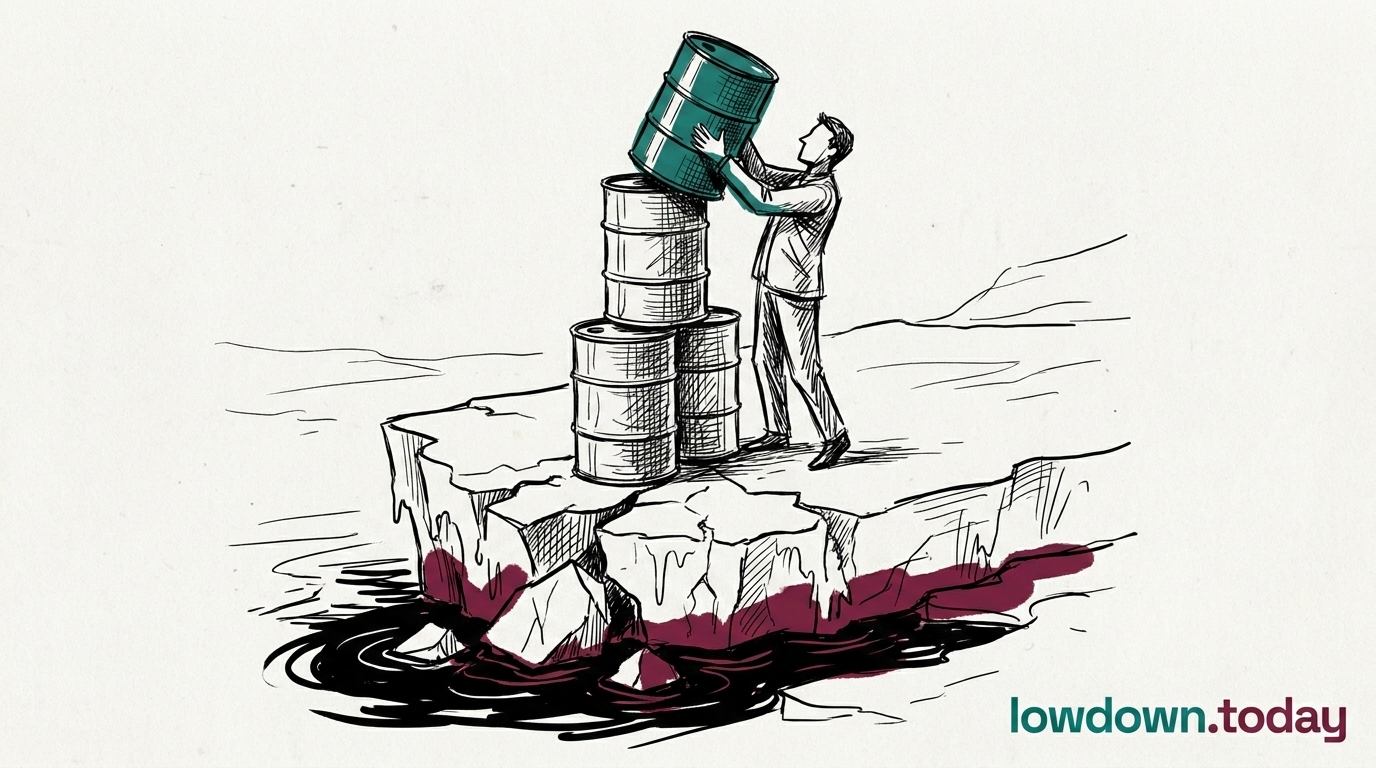
The IEA released 400 million barrels — the biggest coordinated draw in its 50-year existence. Three tanker attacks and Iran's blockade declaration erased the effect before markets closed.

EconomicDeveloping
Key takeaway

Strategic reserves buffer temporary shocks; a sustained intentional blockade has exposed the architecture's design limits.

The International Energy Agency released 400 million barrels from member nations' strategic petroleum reserves on Wednesday — the largest coordinated drawdown in the agency's 50-year history. The previous record, 60 million barrels released during Libya's 2011 civil war, was less than one-sixth the size. The United States committed 172 million barrels from the Strategic Petroleum Reserve — 43% of the total. The action was designed to signal abundant supply and arrest the price rally that has driven Brent from $67.41 on 27 February into the $90–95 range.

The signal lasted hours. Three cargo ship attacks in the strait of Hormuz on Wednesday, combined with the IRGC's declaration that "not a litre of oil" would pass through the strait, erased the effect before US markets closed. Oil traders price barrels available today, not barrels promised over months. The US contribution requires 120 days to deliver at planned discharge rates. Delivery begins next week. The shortage is now.

The failure is structural, not tactical. Strategic petroleum reserves were created after the 1973 Arab Oil Embargo to buffer temporary supply disruptions — a hurricane shutting Gulf of Mexico platforms, a pipeline failure, a brief conflict. The IEA's 2005 release after Hurricane Katrina stabilised markets because the disruption was localised and temporary. The 2011 Libya release worked because Saudi Arabia's spare production capacity replaced most of the lost Libyan output. Neither condition holds here. The disruption is expanding — Kuwait has declared force majeure on all exports , approximately 3.5 million barrels per day of Gulf production is shut in or unable to reach buyers, and Saudi spare capacity exists but cannot transit a strait open only to Chinese-linked vessels . Qatar's energy minister warned of $150 per barrel if Hormuz remains closed . The conditions prompting that warning have not changed. The IEA has deployed its strongest mechanism. The market absorbed it in a single session.


Deep Analysis

In plain English

Western governments built up huge oil stockpiles after the 1973 oil crisis — enough to release in emergencies and prevent prices from spiking. Wednesday's release was the biggest in the system's 50-year history. Oil prices rose anyway within hours, because the problem is not a temporary shortage but an active blockade of the world's most important oil shipping route. Releasing stored oil is like pouring water into a bucket with a hole — until the hole is closed, prices keep rising regardless of what governments tip in from their reserves.

Deep Analysis
Synthesis

The failure of the largest strategic reserve release in history is not merely an energy story — it is the empirical demonstration that the post-1973 international energy security architecture has no effective tool for a sustained, intentional chokepoint blockade. This will accelerate medium-term policy shifts toward demand-side emergency measures, alternative route investment, and a fundamental rethink of IEA reserve adequacy standards and replenishment doctrine.

Root Causes

The IEA and SPR architecture assumes geographically isolated, temporary disruptions affecting one country's supply. A declared blockade of Hormuz — through which approximately 20% of global oil supply transits — is qualitatively different: intentional, affecting multiple supplier states simultaneously, with no predictable end date. The instrument was not architected for this threat profile; its failure is structural, not operational.

Escalation

The US SPR was already at its lowest levels since the early 1980s before this release, following prior drawdowns. Depleting 172 million barrels further reduces the remaining buffer for any subsequent shock — a second Hormuz incident, a domestic refinery disruption, or a winter demand spike. The US has less energy shock-absorption capacity now than at any point in the last four decades.

What could happen next?
2 consequence1 precedent2 risk
  • Consequence

    US SPR reserves are now at their lowest point since the early 1980s, reducing the buffer available for any subsequent energy shock during the conflict's remaining duration.

    Immediate · Assessed
  • Precedent

    The failure of the largest reserve release in IEA history against a sustained blockade will force a fundamental reassessment of SPR adequacy standards and reserve architecture globally.

    Long term · Assessed
  • Risk

    Import-dependent Asian economies — India, South Korea, Japan — face balance-of-payments pressure and potential currency instability if $95+ oil persists beyond 30 days.

    Short term · Assessed
  • Risk

    Commercial inventory depletion from tanker attacks and delivery uncertainty may trigger diesel and jet fuel shortages in non-Hormuz-dependent markets via refinery feedstock disruption.

    Short term · Suggested
  • Consequence

    Governments that have avoided demand-side emergency measures since 1979 may be compelled to implement rationing or industrial fuel allocation if sustained $100+ oil persists beyond 30 days.

    Medium term · Suggested
First Reported In

Update #32 · UN condemns Iran 13-0; ceasefire blocked

CNBC· 12 Mar 2026
Read original
Causes and effects
This Event
Record oil reserve release fails fast
The IEA deployed its most powerful supply-side tool and the market absorbed it in a single trading session. Strategic reserves are designed for temporary disruptions, not sustained blockades of the world's most important oil chokepoint. The mechanism's failure leaves no institutional tool capable of capping prices while the strait remains contested.
Different Perspectives
Sanctions compliance officer reviewing a Lukoil International GmbH bid
OFAC's amended FAQ 1224 gives a compliance desk its first published standard: full severance from Lukoil and a US-jurisdiction blocked account for sale proceeds. The conditions name neither ISAB nor Italy, so a Priolo Gargallo-linked bid answers a different question than a Neftochim Burgas or Petrotel Ploiesti one.
Managed-money funds on Brent Last Day
CFTC data for the week to 21 July showed managed money flipping 74,400 contracts to a net long of 15,665 against 1,410 short on the Brent Last Day contract, code 06765T. A fund that held that short through July has now covered it, and the spent short base raises the bar for the next leg higher.
Saudi crude exporters
Saudi-linked tanker transits through Bab el-Mandeb fell to about 7.5 a day after the 24 July underwriting withdrawal, pushing more barrels onto the longer route round the Cape or through the Yanbu terminal. Every diverted barrel ties up a ship for longer, and a fleet that turns slower charges more.
Tanker owners on the Bab el-Mandeb route
Lloyd's-market syndicates withdrew war-risk cover from Saudi-linked hulls on 24 July, leaving owners of that class of vessel to sail Bab el-Mandeb uninsured or not at all. Tanker transits on the route fell to roughly 7.5 a day, and cover, once withdrawn, does not return on a shipowner's timetable.
Eni
Eni
Eni's board approved second-quarter results on 29 July, swinging refining EBIT to a EUR0.08bn profit from a year-earlier loss even as group profit doubled, and named Red Sea freight cost as a cap on that improvement. A refiner absorbing higher shipping costs on Saudi-linked crude while its numbers improve treats the freight line as a drag, not a crisis.
Asian buyers (India, Japan, China, South Korea)
Asian refiners are absorbing 62% of Yanbu's 3.75m b/d flow, the bulk of Saudi Arabia's rerouted crude now clearing east rather than into the Atlantic basin. That destination split leaves Asian buyers more exposed to any single Yanbu-specific disruption than under the kingdom's normal multi-terminal export pattern.



