Skip to content
You can now search across every topic, entity and event.What's new
European Oil Markets
23JUL

The sanctions that need no signature

3 min read
19:27UTC

The US Treasury has kept sanctioning Iran throughout the war under a pre-war memorandum, freezing nearly half a billion dollars while Trump has signed no new order of his own.

EconomicDeveloping
Key takeaway

US sanctions on Iran keep firing on pre-war authority; only sanctions relief needs a new signature.

The US Treasury has run a named, continuous sanctions campaign against Iran throughout the war, even as the White House has signed no new Iran measure. Treasury calls the campaign Economic Fury, and it operates under National Security Presidential Memorandum 2 (NSPM-2), a pre-war order that delegates designation power to the department rather than requiring a fresh presidential signature 1.

On 27 May the Office of Foreign Assets Control (OFAC), Treasury's sanctions arm, designated Iran's Persian Gulf Strait Authority for extorting Hormuz shipping tolls; on 10 June it blacklisted nine China and Hong Kong entities for arming the Islamic Revolutionary Guard Corps (IRGC) 2. Treasury says the campaign has frozen "nearly half a billion" dollars and disrupted "tens of billions" in regime-linked revenue 3. A direct query of the Federal Register returned zero new Iran filings between 29 June and 2 July 4.

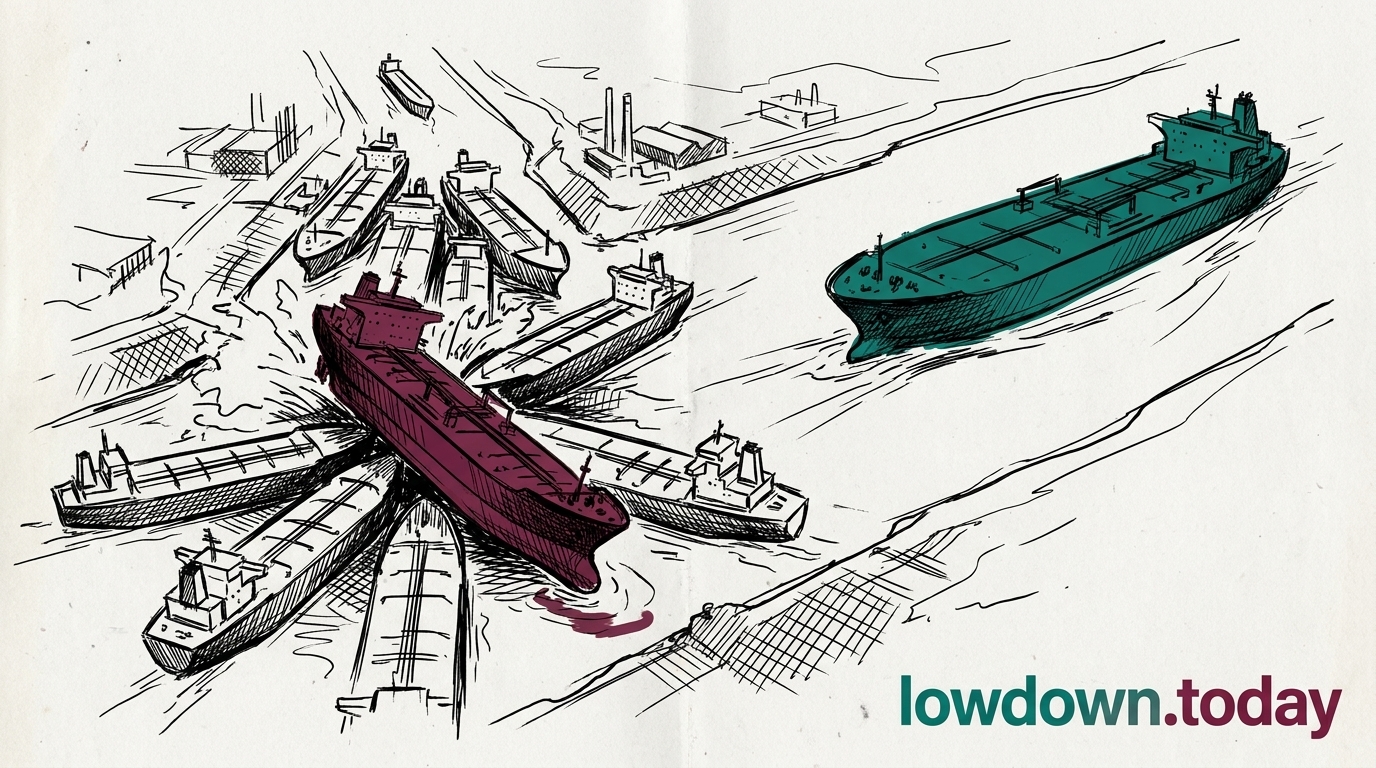
The gap between an empty signing record and live enforcement has a mechanism. NSPM-2 delegates designation authority to OFAC through executive orders that predate the conflict, so Treasury can keep naming targets while any genuinely new instrument stalls. The one Iran action that did need a fresh signature, General Licence X, loosened sanctions rather than tightening them, and its missing escrow and reporting caps handed Chinese buyers a 60-day safe harbour . Relief requires a pen; pressure does not.

Donald Trump's public words and Washington's actions point in opposite directions. On 30 June he demanded cheap petrol on Truth Social and signed nothing ; on 1 July he called the denuclearisation of Iran "moving along well" 5. His earlier order for a Justice Department oil-gouging probe sits in the same column: enforcement motion that does not require settling the war.


Deep Analysis

In plain English

The US Treasury has been sanctioning parts of Iran's economy continuously since before the war even started, under a standing campaign called Economic Fury. It does not need the president to sign anything new each time: officials can add names to the sanctions list on autopilot. In the past six weeks alone, Treasury sanctioned the Iranian body that tries to collect tolls from ships in the Strait of Hormuz, and nine companies in China and Hong Kong accused of helping arm the IRGC, Iran's most powerful military force. Even though no new sanctions appeared in the official US government record for four straight days, that gap does not mean enforcement stopped.

Deep Analysis
Root Causes

Economic Fury runs on National Security Presidential Memorandum 2, a delegation of designation authority to Treasury that predates the war and requires no fresh presidential signature to continue. That is structurally different from General License X, the one Iran sanctions instrument that did need Scott Bessent's active signature to authorise oil sales and dollar payments .

The zero-filing gap between 29 June and 2 July does not mean enforcement paused: OFAC's designation pipeline runs independently of both the Doha talks and the Federal Register's publication cycle, so a quiet week in the public record does not mean a quiet week inside Treasury.

What could happen next?
  • Consequence

    Continued designations during the funeral pause keep economic pressure on Iran even while every diplomatic channel is closed.

  • Risk

    If Tehran reads ongoing designations as evidence Washington is not serious about a deal, it hands hardliners in the Assembly of Experts and IRGC ammunition against the negotiators.

First Reported In

Update #143 · Diplomacy pauses for a funeral under threat

US Department of the Treasury· 2 Jul 2026
Read original
Different Perspectives
US money managers (CFTC-tracked)
US money managers had trimmed WTI net long positioning into July's rally, doubting the Hormuz premium would hold without freight or war-risk confirmation, and the crude stock build reported for the week to 17 July gives that scepticism a fundamentals basis. The 25 July CFTC data will show whether Brent's move above $100 changed their calculus.
Asian distillate buyers (Singapore)
Singapore's distillate holders kept retaining middle-distillate barrels as the East-West arbitrage window narrowed further this week, a pattern that sharpened as Fujairah light distillates hit a record low. Cargoes are being held rather than released west into the tightening Mediterranean market.
Bulgaria
Bulgaria
Bulgaria secured the removal of Lukoil founder Vagit Alekperov and Patriarch Kirill from the 21st package, with President Rumen Radev calling a personal listing 'shooting ourselves in the foot'. Sofia is protecting its position in Lukoil's EUR 3bn compensation claim over the 2023 Neftohim Burgas nationalisation.
Russia
Russia
Russia loses the roughly $14 a barrel of legal headroom the price-cap formula would have released toward $58, even as Urals continues trading below Moscow's $59 budget floor. The shadow-fleet insurance workaround that lets sanctioned crude clear above $44 in practice remains untouched by the freeze itself.
European Union
European Union
The EU adopted its 21st sanctions package on 23 July, freezing the $44 Russia oil cap for 12 months rather than letting the formula drift it toward $58, and listed shadow-fleet support vessels for the first time. The package cleared only after three failed Coreper votes.
Marine war-risk underwriters (Lloyd's-linked syndicates)
War-risk syndicates lifted southern Red Sea hull premiums 150% to about 0.75% of hull value after the 20 July blockade declaration, still a seventh of the roughly 5% Hormuz band. Underwriters reset on realised loss, not declared threat, so the 23 July Encelia and Layla strikes set up the next re-mark.