Skip to content
You can now search across every topic, entity and event.What's new
European Oil Markets
23JUL

Radio warnings close a second strait

3 min read
19:27UTC

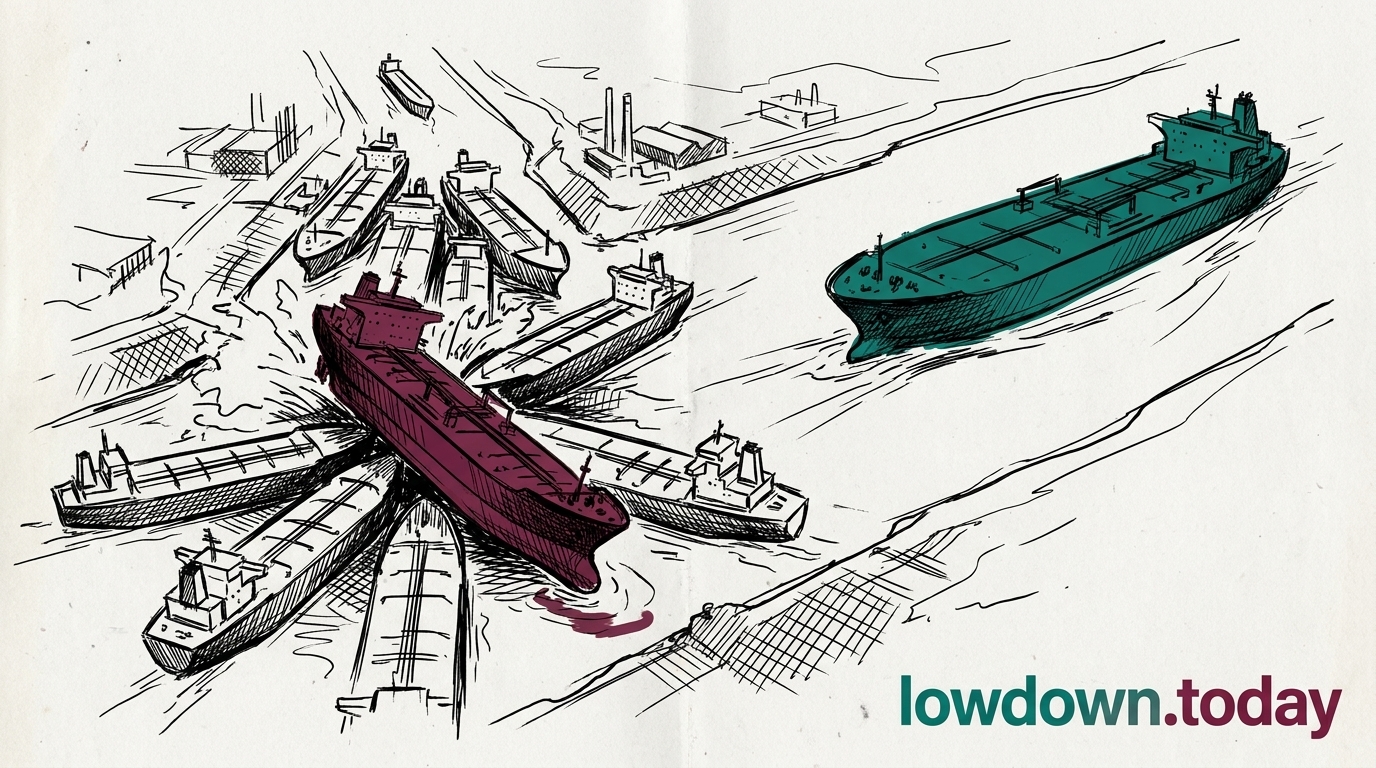
Yahya Sarea declared Bab al-Mandab shut to Saudi shipping on Monday. Six vessels, among them the Chinese supertanker Xin Long Yang, had turned round inside 48 hours without a shot fired.

EconomicDeveloping
Key takeaway

A radio broadcast closed Bab al-Mandab to Saudi shipping inside 48 hours, with no shot fired.

Yahya Sarea, military spokesman for Yemen's Houthis, announced a full maritime embargo on Saudi Arabia on Monday 20 July, effective immediately 1. Houthi forces began hailing vessels on open maritime frequencies near Yemen the same day, telling them the Bab al-Mandab was closed to Saudi traffic 2.

Bab al-Mandab is the strait between Yemen and Djibouti where the Red Sea meets the Gulf of Aden, and roughly a quarter of global container traffic passes through it. Six vessels had reversed course by Tuesday 21 July, according to Lloyd's List ship-tracking data. Among them was the Chinese Very Large Crude Carrier Xin Long Yang, which turned in the Red Sea rather than continue towards a Saudi port 3.

Houthi forces fired nothing, boarded nothing and stopped nothing. Rear Admiral Vasileios Gryparis commands Operation Aspides, the European Union's naval protection mission in the Red Sea. He said the Houthis "remain a threat to navigation despite not having attacked any merchant vessels since September 2025" 4. Holding the Strait of Hormuz shut has cost a great deal more: a naval blockade, Marine boarding parties putting armed personnel on foreign decks , and eleven consecutive nights of bombing.

Sarea framed the embargo as retaliation for Saudi Arabia's blockade of Yemeni ports and a Saudi strike on Sanaa airport. The Houthis say that strike was aimed at an Iranian aircraft carrying their leadership home from Ali Khamenei's funeral 5. Saudi Arabia's foreign ministry called the declaration false and a distraction from the group's "economic mismanagement and public discontent", and said The Kingdom would take "all necessary measures" to protect its ships 6.

Whether the six turnbacks answer the radio calls, the owners' own risk desks or both cannot be separated out from tracking data alone. No war-risk premium specific to Saudi-bound traffic has yet been established either. What can be said is that the traffic changed course within two days of a broadcast, and that nobody had to sail a warship to make it happen.


Deep Analysis

In plain English

The Houthis are an armed group that controls large parts of Yemen. On Monday they announced they would stop Saudi-bound ships from passing through the Bab al-Mandab strait, a narrow sea gap near Yemen that a huge share of world shipping uses to reach the Suez Canal. They have not fired on or boarded any ship. Instead, Houthi forces have been radioing vessels over open radio channels and warning them to turn back. Six ships did, including the Chinese supertanker Xin Long Yang. No vessel has been attacked, boarded or stopped. Shipping companies are cautious because insurance for sailing through this region has already become far more expensive during the wider war, so a warning alone is often enough to make a captain choose the longer, safer route.

Deep Analysis
Root Causes

Rerouting on a radio warning only works because the insurance market had already primed shipowners to treat any new threat as decisive. War-risk premiums for the region were running at 3-10% of hull value before this declaration, against roughly 0.25% before the war, according to Lloyd's List reporting; the Lloyd's Market Association has said capacity technically remains available and it is price and crew willingness, not a shortage of cover, that is doing the suppressing.

That pre-existing cost structure means a six-figure premium swing, not a missile, is enough to turn a tanker around; the Houthis are exploiting a market that was already primed to divert rather than demonstrating new military reach.

What could happen next?
  • Risk

    If the Houthis follow the 2023 Galaxy Leader precedent and escalate from radio warnings to an actual boarding or strike, war-risk premiums for the wider Red Sea corridor would likely reprice sharply, compounding the existing Hormuz premium.

  • Precedent

    A second chokepoint closed by declaration rather than force lowers the bar for further non-kinetic threats against shipping elsewhere in the region.

First Reported In

Update #159 · A second strait closes by radio alone

The War Zone· 22 Jul 2026
Read original
Different Perspectives
US money managers (CFTC-tracked)
US money managers had trimmed WTI net long positioning into July's rally, doubting the Hormuz premium would hold without freight or war-risk confirmation, and the crude stock build reported for the week to 17 July gives that scepticism a fundamentals basis. The 25 July CFTC data will show whether Brent's move above $100 changed their calculus.
Asian distillate buyers (Singapore)
Singapore's distillate holders kept retaining middle-distillate barrels as the East-West arbitrage window narrowed further this week, a pattern that sharpened as Fujairah light distillates hit a record low. Cargoes are being held rather than released west into the tightening Mediterranean market.
Bulgaria
Bulgaria
Bulgaria secured the removal of Lukoil founder Vagit Alekperov and Patriarch Kirill from the 21st package, with President Rumen Radev calling a personal listing 'shooting ourselves in the foot'. Sofia is protecting its position in Lukoil's EUR 3bn compensation claim over the 2023 Neftohim Burgas nationalisation.
Russia
Russia
Russia loses the roughly $14 a barrel of legal headroom the price-cap formula would have released toward $58, even as Urals continues trading below Moscow's $59 budget floor. The shadow-fleet insurance workaround that lets sanctioned crude clear above $44 in practice remains untouched by the freeze itself.
European Union
European Union
The EU adopted its 21st sanctions package on 23 July, freezing the $44 Russia oil cap for 12 months rather than letting the formula drift it toward $58, and listed shadow-fleet support vessels for the first time. The package cleared only after three failed Coreper votes.
Marine war-risk underwriters (Lloyd's-linked syndicates)
War-risk syndicates lifted southern Red Sea hull premiums 150% to about 0.75% of hull value after the 20 July blockade declaration, still a seventh of the roughly 5% Hormuz band. Underwriters reset on realised loss, not declared threat, so the 23 July Encelia and Layla strikes set up the next re-mark.