Skip to content
You can now search across every topic, entity and event.What's new
European Oil Markets
23JUL

Blockade turns Hormuz threat to fact

3 min read
19:27UTC

CENTCOM reimposed a naval blockade on Iranian ports at 20:00 GMT on 14 July, and Brent crude touched $87 a barrel as the market repriced an enforced closure over a declared one.

EconomicAssessed
Key takeaway

The oil market repriced Hormuz the moment US force turned Iran's declared closure into an enforced blockade.

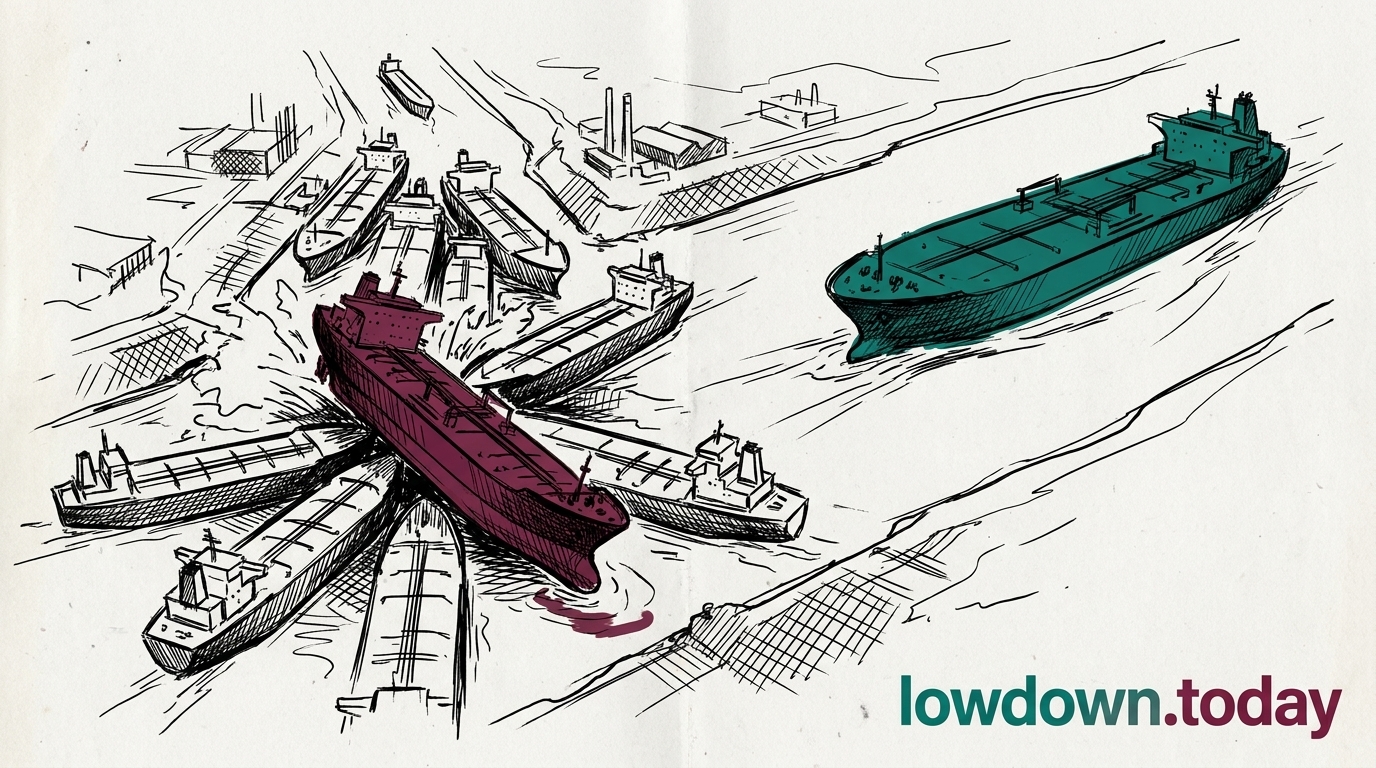
US Central Command (CENTCOM) reimposed a naval blockade on all vessels "to and from Iranian ports and coastal areas" at 20:00 GMT on Tuesday 14 July 1, two days after it had told traffic the Strait of Hormuz stayed open . The chokepoint carries about a fifth of the world's seaborne oil, and Washington answered Iran's own closure declaration by enforcing the closure itself rather than keeping the lane open.

The oil market read the difference at once. Brent Crude, the global benchmark, touched $87 a barrel intraday, its highest since June, before closing up 1.7% at $84.32 2. Prices had actually slipped to about $75.80 after Iran merely declared Hormuz shut on 12 July ; traders treated that announcement as noise and moved only once the United States enforced closure by force.

Enforcement showed in the traffic count too. Hormuz crossings fell to their lowest in two months, with one maritime-data reading cited by RT Arabic putting a single day at six vessels 3, against the roughly 35 tankers that cleared the strait at pre-war range on 2 July. The corridor now answers to a blockade order rather than the 9 July memorandum under which Iran and Oman had agreed to jointly manage its shipping.

One caveat belongs here. the strait has swung open and shut for months, through an April blockade, a June memorandum lifting it, and now this re-closure, so this could be oscillation number five rather than a threshold crossed. What sets it apart is that price, insurers and the casualty list all moved together, which no earlier swing produced, and whether the blockade holds past a week is the test that settles which reading is right.


Deep Analysis

In plain English

This matters because the price only moved once ships actually stopped sailing, not when either government announced a closure. Markets had already been burned twice by declarations that outran reality, so this time it was the six-vessel count, not the 20:00 GMT order, that pushed oil prices higher.

Deep Analysis
Root Causes

The blockade's market bite comes less from military force than from insurer behaviour: London's Protection and Indemnity clubs have kept a Hormuz war-risk exclusion in force since 7 July, so any renewed closure reactivates a standing insurance freeze rather than requiring shipowners to reassess risk from scratch.

A second structural driver is the credibility deficit built up since April, when Iran's own reopening declarations repeatedly failed to match conditions on the water. Washington's 14 July reversal now runs an identical trust gap in the other direction.

Escalation

Up, with the next inflection point being whether Brent holds above $85 through the 17 July expiry of the wind-down licence on Iranian crude sales, which would stack a second supply shock onto the same week.

What could happen next?
  • Consequence

    If the blockade holds longer than the days it took previous closures to collapse, Brent volatility compounds with the 17 July expiry of the wind-down licence on Iranian crude sales.

  • Precedent

    A third flip in Hormuz's declared status inside a month further trains traders to discount verbal announcements from either side until vessel-tracking data confirms them.

First Reported In

Update #154 · US enforces Hormuz closure with blockade

Al Jazeera· 15 Jul 2026
Read original
Causes and effects
Different Perspectives
US money managers (CFTC-tracked)
US money managers had trimmed WTI net long positioning into July's rally, doubting the Hormuz premium would hold without freight or war-risk confirmation, and the crude stock build reported for the week to 17 July gives that scepticism a fundamentals basis. The 25 July CFTC data will show whether Brent's move above $100 changed their calculus.
Asian distillate buyers (Singapore)
Singapore's distillate holders kept retaining middle-distillate barrels as the East-West arbitrage window narrowed further this week, a pattern that sharpened as Fujairah light distillates hit a record low. Cargoes are being held rather than released west into the tightening Mediterranean market.
Bulgaria
Bulgaria
Bulgaria secured the removal of Lukoil founder Vagit Alekperov and Patriarch Kirill from the 21st package, with President Rumen Radev calling a personal listing 'shooting ourselves in the foot'. Sofia is protecting its position in Lukoil's EUR 3bn compensation claim over the 2023 Neftohim Burgas nationalisation.
Russia
Russia
Russia loses the roughly $14 a barrel of legal headroom the price-cap formula would have released toward $58, even as Urals continues trading below Moscow's $59 budget floor. The shadow-fleet insurance workaround that lets sanctioned crude clear above $44 in practice remains untouched by the freeze itself.
European Union
European Union
The EU adopted its 21st sanctions package on 23 July, freezing the $44 Russia oil cap for 12 months rather than letting the formula drift it toward $58, and listed shadow-fleet support vessels for the first time. The package cleared only after three failed Coreper votes.
Marine war-risk underwriters (Lloyd's-linked syndicates)
War-risk syndicates lifted southern Red Sea hull premiums 150% to about 0.75% of hull value after the 20 July blockade declaration, still a seventh of the roughly 5% Hormuz band. Underwriters reset on realised loss, not declared threat, so the 23 July Encelia and Layla strikes set up the next re-mark.