Skip to content
You can now search across every topic, entity and event.What's new
European Oil Markets
6JUL

Brent round-trips 9% down and 7% up in a weekend

3 min read
09:52UTC

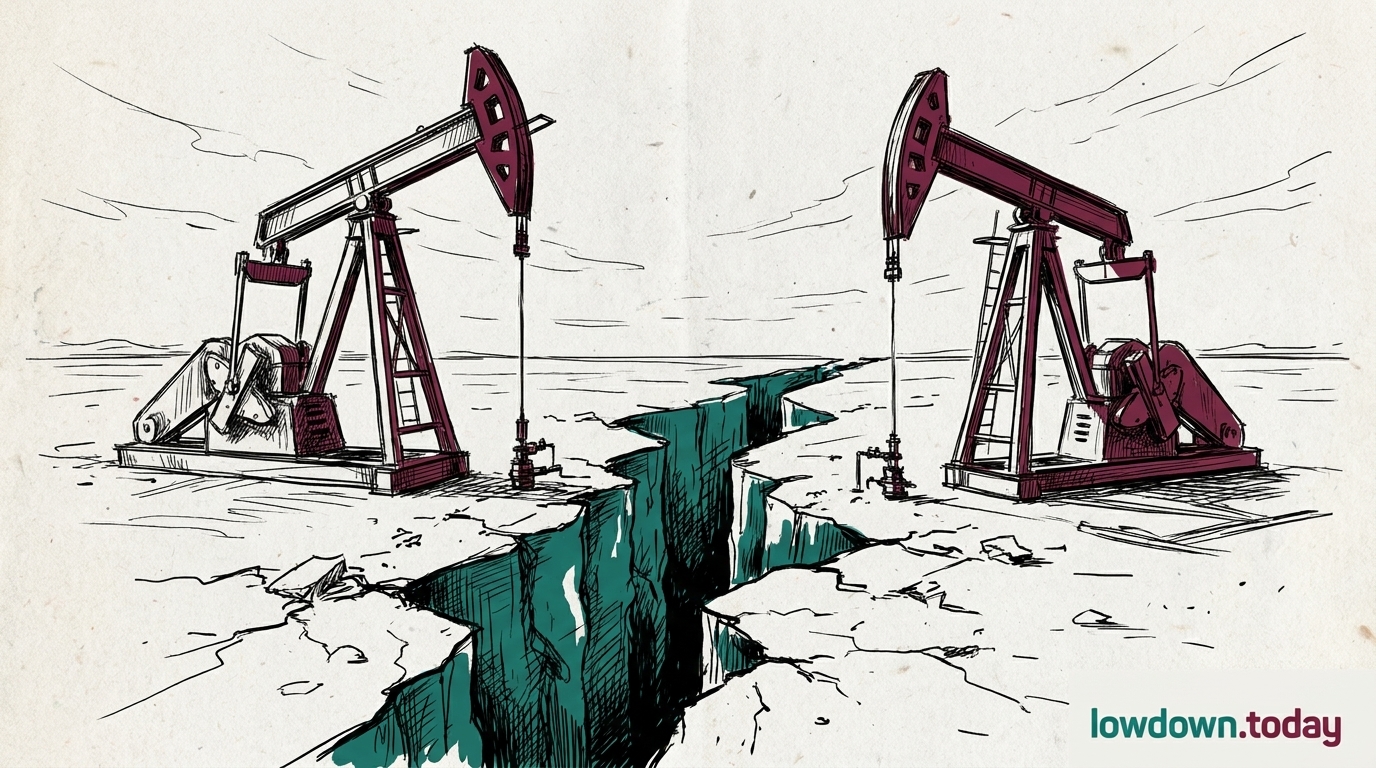
Oil fell nine per cent on Friday after Araghchi's corridor announcement, then rebounded seven per cent on Monday once the IRGC seizures proved the corridor was void.

EconomicDeveloping
Key takeaway

Brent's weekend round-trip priced the distance between an Iranian foreign-ministry clearance and an IRGC clearance.

Brent Crude closed up roughly 7% to $96.88 on Monday 20 April after a 9% drop on Friday 18 April, the sharpest single-day round-trip of the war, per Euronews trading data. Between Friday close and Monday open the underlying supply picture had not changed; the market's read on whose paper bound the strait had.

The Friday drop followed Foreign Minister Abbas Araghchi's civilian corridor announcement and a brief window of reopening optimism. The Monday rebound followed two weekend developments that voided that corridor: the IRGC tanker strikes and the subsequent US seizure of the Iranian-flagged Touska. Traders had priced Friday on an Iranian clearance system they could take at face value; by Monday morning Guard Corps enforcement had falsified that assumption and Brent marked down the recovery as void.

For European drivers that round-trip translates to roughly 4 to 5 pence per litre of flex at the pump on a lag of two to three weeks, once wholesale contracts reprice and retail margin adjusts. For Protection and Indemnity (P&I) insurance clubs, the Friday-to-Monday whipsaw adds war-risk premium on every hull that has transited or will transit Hormuz while the divergence holds, because the clubs price on the most recent kinetic data point, not the most recent diplomatic announcement. A counter-view from energy strategists at Goldman Sachs is that the supply floor under Brent remains the physical volume still moving despite the blockade; that reading is compatible with this round-trip, because the volatility is on the clearance system rather than on confirmed outages.


Deep Analysis

In plain English

Oil prices fell sharply on Friday after Iran's foreign minister announced the Strait of Hormuz was open for shipping. Then they rose almost as sharply on Monday after Iran's Revolutionary Guard fired on Indian ships that had been told they could cross, proving that the foreign minister's announcement did not actually open the strait. In two days, the price of a barrel of oil went down 9% and then back up 7%. That swing had nothing to do with how much oil was actually in the ground or flowing through pipes. Both moves were driven entirely by uncertainty about which Iranian official controls the strait. On Friday the answer appeared to be the diplomat; by Monday it was clear the answer is the general.

Deep Analysis
Root Causes

The 16-percentage-point round-trip traces to a single structural vulnerability in how oil markets process split-authority enforcement: futures markets can only price one authoritative voice per trading session.

Araghchi's Friday corridor announcement cleared as the authoritative signal because it came from the named foreign minister of a sovereign state. The IRGC Navy's Tabnak order, published in Farsi two days earlier, had not been processed as load-bearing by non-Farsi-reading algorithmic trading systems.

By Monday, IRGC enforcement of the Sanmar Herald firing and the Touska seizure made the Tabnak order legible to English-language market infrastructure. Friday's price reflected the civilian signal; Monday's price reflected the Guard Corps enforcement reality. The same physical strait, two trading sessions, two incompatible prices.

What could happen next?
  • Consequence

    Oil markets will reprice every future Iranian civilian announcement against the probability that IRGC enforcement overrides it, adding a permanent institutional-split premium to Hormuz-origin crude.

First Reported In

Update #74 · Two unsigned rulebooks collide at Hormuz

Euronews· 20 Apr 2026
Read original
Causes and effects
This Event
Brent round-trips 9% down and 7% up in a weekend
The market mispriced Iranian authority across the weekend and corrected inside one session. For European consumers that volatility flows through to the pump on a two-to-three week lag, and for P&I clubs it resets the war-risk premium on every Hormuz hull.
Different Perspectives
Indian refiners
Indian refiners
Indian refiners kept lifting discounted Urals as the India/Baltic price split widened past $9-10 a barrel, a gap that only grows as GL X1's Iranian wind-down cuts an alternative discounted grade off the market by 17 July. Cheaper Russian feedstock is being locked in while it lasts.
Chinese refiners
Chinese refiners
Chinese refiners gain leverage as the Urals-Brent discount widens, since Beijing's state buyers already source discounted Russian barrels near the fiscal floor unaffected by Western insurance costs. A wider discount, if it holds past 23 July, lets them lock in cheaper term contracts regardless of the cap's outcome.
US money managers (CFTC-tracked)
Managed money trimmed WTI net length into the rally, positioning that reflects doubt the Hormuz premium survives without freight or war-risk confirmation. The Brent-WTI spread widening almost entirely on the Brent leg supports that scepticism about a broad-based repricing.
OPEC+ (Saudi-led subgroup)
Saudi Arabia is defending market share through a fourth straight 188kbd August hike even as OPEC's own July MOMR cut 2026 demand growth for the fourth consecutive month. At a $108-111 fiscal breakeven, every added barrel costs Riyadh revenue it cannot recoup, so the hike reads as a positioning signal, not a demand bet.
Greek shipping registries
Greece, backed by Cyprus and Malta, is pushing a three-month cap-freeze compromise against the Commission's freeze to January 2027 ahead of the 23 July vote. Athens' and Valletta's combined tanker registrations mean a shorter review gives their insurers more frequent chances to reprice risk on Russian cargoes.
Russia (Deputy PM Alexander Novak)
Novak extended the diesel export restriction to producers on 8 July, the first producer-binding curb of the war, protecting the domestic pump price ahead of any refinery repair timeline. Urals still trades below Russia's $59 budget floor even as Brent gained, so the ban trades export revenue for fiscal stability at home.