Skip to content
You can now search across every topic, entity and event.What's new
European Oil Markets
18MAY

Fujairah hits 1.62 mbpd; ADCOP nears cap

4 min read
17:30UTC

Crude flow through Fujairah reached 1.62 million bpd by late March, a 38% rise within reach of the ADCOP pipeline's 2 million bpd design ceiling, while Khor Fakkan container handling rose 25-fold to 50,000 vessels per week.

EconomicDeveloping
Key takeaway

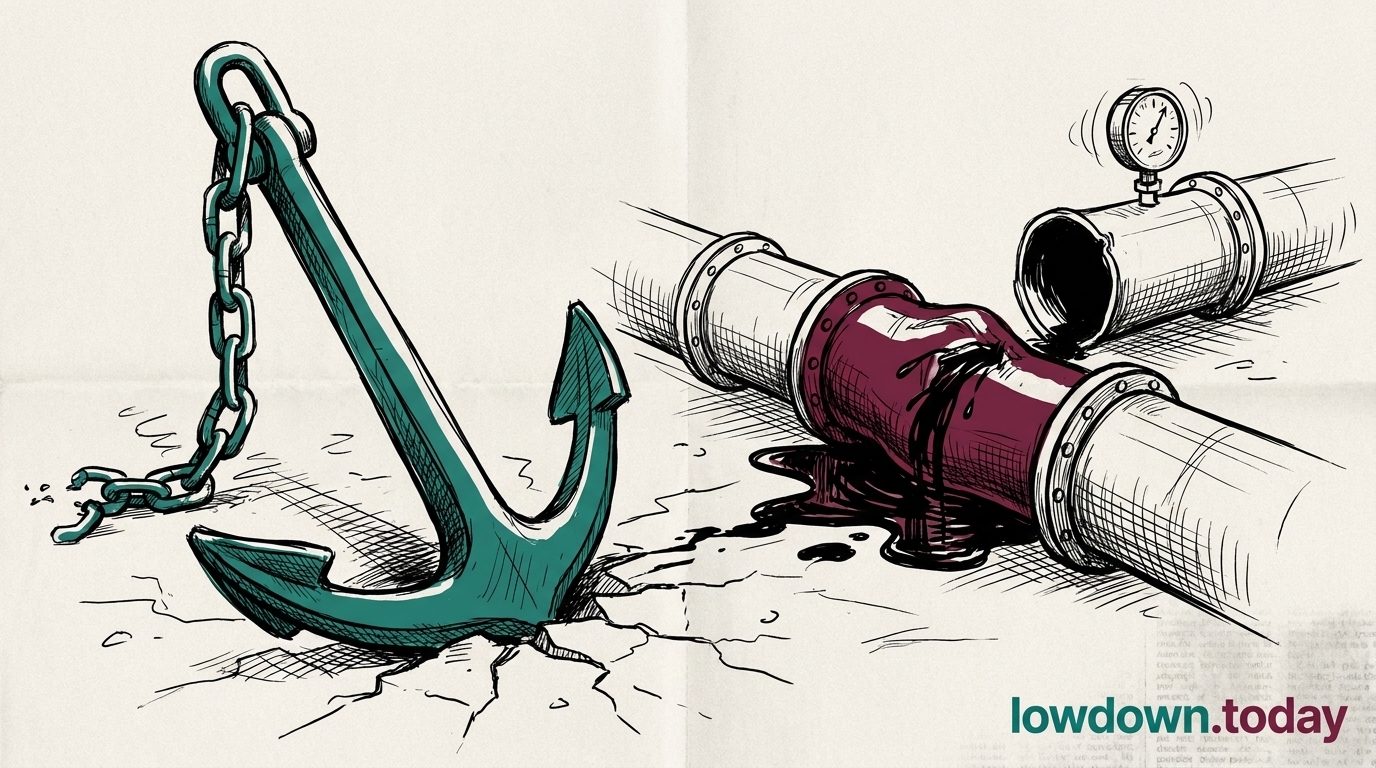
The Hormuz bypass route is approaching its ceiling as the IRGC claims the water above it.

Crude flow through Fujairah rose from 1.17 mbpd in February to 1.62 mbpd by late March 1, a 38% increase that puts the port within reach of the Abu Dhabi Crude Oil Pipeline (ADCOP) design ceiling of 2 mbpd. Khor Fakkan container handling went from 2,000 to 50,000 vessels per week, a 25-fold rise; six container ships were berthed and ten waiting on the day of the report.

Fujairah and Khor Fakkan sit on the United Arab Emirates' eastern coast, on The Gulf of Oman side of the Strait of Hormuz. ADCOP runs 370 km from Habshan, a terminal in Abu Dhabi's interior, to Fujairah, bypassing the strait entirely. When Hormuz is closed or contested, every barrel that previously sailed out of the Persian Gulf has to find another route, and the two UAE eastern ports are the alternative.

That alternative is running out of room. ADCOP's 2 mbpd design ceiling has never been tested at sustained throughput. Pipeline infrastructure operating near design capacity under conflict-zone threat generates compressor and metering stress that maintenance schedules cannot absorb on a normal cycle; real-world ceiling likely sits 200,000 to 300,000 bpd below the published figure. The 1.62 mbpd reading leaves perhaps 80,000 to 180,000 bpd of usable headroom before the pipeline starts forcing maintenance trade-offs. Khor Fakkan's congestion is sharper still: a 25-fold rise in a year cannot be absorbed by adding berths on a weeks-to-months timeline.

The United Arab Emirates (UAE) foreign ministry has not commented directly on the legal pressure. The Islamic Revolutionary Guard Corps (IRGC) published a map on 5 May claiming maritime control zones along the UAE's eastern coastline, the legal escalation that followed the 4 May physical drone strike on the Fujairah Oil Industry Zone . The pattern is kinetic-then-legal: strike a target, then claim sovereignty over the water above it. International maritime law gives the IRGC's coastline claim no recognised standing, yet the 4 May drone strike demonstrated kinetic reach over the same water. If insurance markets price the legal claim, the bypass route's effective capacity falls before its physical capacity does.

A signed MOU would reopen Hormuz and end the toll system, taking the kinetic-then-legal pattern off the board. If Tehran's reply collapses against the 9 May expiry, the 380,000 bpd nominal headroom at Fujairah becomes the constraint that matters: the next significant Hormuz incident exhausts the surface alternative, and crude that cannot move by pipeline or by Khor Fakkan stays unloaded.


Deep Analysis

In plain English

The Strait of Hormuz is blocked, so oil that used to flow through it is going around the long way, through a pipeline in the UAE called ADCOP that runs from inland Abu Dhabi to the port of Fujairah on the UAE's eastern coast. By late March, that bypass route was handling 1.62 million barrels of oil per day. The problem: the pipeline was designed for 2 million barrels per day, and it is within about 380,000 barrels of that limit. Meanwhile, Iran's military struck the Fujairah oil terminal in a drone attack on 4 May and is now claiming legal authority over the sea in front of Fujairah. At current throughput growth rates, the bypass headroom runs out in roughly seven to nine weeks.

What could happen next?
  • Risk

    If the IRGC's 4 May drone strike on Fujairah Oil Industry Zone is followed by further kinetic action at the ADCOP terminal, the physical bypass capacity could drop below 1 million bpd within days, removing the only surface alternative to a blocked Hormuz.

  • Consequence

    Khor Fakkan's 25-fold rise to 50,000 vessels per week cannot be absorbed by berth expansion on any timeline shorter than 18 months; the congestion is a structural constraint, not a transient queue.

First Reported In

Update #91 · MOU in Tehran, missiles in the strait

AGBI· 8 May 2026
Read original
Causes and effects
This Event
Fujairah hits 1.62 mbpd; ADCOP nears cap
The only surface route around a blocked Hormuz is approaching its design ceiling at exactly the moment the IRGC is claiming legal authority over the water above it.
Different Perspectives
Indian refiners
Indian refiners
Indian refiners kept lifting discounted Urals as the India/Baltic price split widened past $9-10 a barrel, a gap that only grows as GL X1's Iranian wind-down cuts an alternative discounted grade off the market by 17 July. Cheaper Russian feedstock is being locked in while it lasts.
Chinese refiners
Chinese refiners
Chinese refiners gain leverage as the Urals-Brent discount widens, since Beijing's state buyers already source discounted Russian barrels near the fiscal floor unaffected by Western insurance costs. A wider discount, if it holds past 23 July, lets them lock in cheaper term contracts regardless of the cap's outcome.
US money managers (CFTC-tracked)
Managed money trimmed WTI net length into the rally, positioning that reflects doubt the Hormuz premium survives without freight or war-risk confirmation. The Brent-WTI spread widening almost entirely on the Brent leg supports that scepticism about a broad-based repricing.
OPEC+ (Saudi-led subgroup)
Saudi Arabia is defending market share through a fourth straight 188kbd August hike even as OPEC's own July MOMR cut 2026 demand growth for the fourth consecutive month. At a $108-111 fiscal breakeven, every added barrel costs Riyadh revenue it cannot recoup, so the hike reads as a positioning signal, not a demand bet.
Greek shipping registries
Greece, backed by Cyprus and Malta, is pushing a three-month cap-freeze compromise against the Commission's freeze to January 2027 ahead of the 23 July vote. Athens' and Valletta's combined tanker registrations mean a shorter review gives their insurers more frequent chances to reprice risk on Russian cargoes.
Russia (Deputy PM Alexander Novak)
Novak extended the diesel export restriction to producers on 8 July, the first producer-binding curb of the war, protecting the domestic pump price ahead of any refinery repair timeline. Urals still trades below Russia's $59 budget floor even as Brent gained, so the ban trades export revenue for fiscal stability at home.