Skip to content
You can now search across every topic, entity and event.What's new
European Energy Markets
31JUL

US fuel up 36%; biggest rise since 1991

4 min read
09:44UTC

American petrol prices have climbed 36% in a single month — the steepest rise in three decades — and the burden falls hardest on households that can least absorb it.

EconomicDeveloping
Key takeaway

At $3.98 nationally, one further supply shock separates the US from the politically toxic $4 threshold.

US petrol reached a national average of $3.98 per gallon on Monday — up 36% from $2.93 before the war began on 28 February. This is the fastest single-month increase in 30 years. California exceeded $5 per gallon. Bank of America Institute data shows household petrol spending rose more than 14% year-over-year 1.

Prices had already climbed to $3.88 nationally just days earlier . The continued rise — despite Sunday's Brent crude crash to $99.94 on Trump's talks announcement — reflects the familiar lag between crude markets and the retail pump. With Brent rebounding to $102–$104 on Monday, erasing roughly a third of Sunday's drop, retail prices have no immediate reason to fall. The International Energy Agency documented an 8-million-barrel-per-day supply loss , the largest on record, and Goldman Sachs's head of oil research Daan Struyven has warned Brent could surpass its 2008 all-time high of $147.50 if Hormuz flows remain depressed for 60 days . The crude market underpinning these pump prices is not stabilising; it is oscillating between diplomatic hope and battlefield reality.

The 36% increase functions as a consumption tax that falls hardest on those who can least absorb it. Lower-income households spend a disproportionate share of disposable income on fuel, drive older and less efficient vehicles, commute longer distances, and cannot shift to remote work. The Bank of America Institute's 14% year-over-year spending figure captures real household strain — not wholesale price movement but money leaving family accounts. American households collectively pay an estimated $300 million more per day at the pump compared to pre-war levels . That cost is not distributed by income bracket; it is distributed by miles driven and gallons burned.

The political pressure is sharpening on multiple fronts. Heritage Foundation president Kevin Roberts warned last week that the war risks producing "stagflation before midterms" . The Pentagon's $200 billion funding request faces bipartisan resistance — Republican leaders reportedly lack the votes within their own caucus , and Representative Lauren Boebert has publicly declared herself "a no on any war supplementals" 2. At $3.98 nationally and climbing, petrol prices translate the war's geopolitical stakes into a concrete cost that compounds with every fill-up — the single economic indicator Americans encounter most frequently, and the one most directly tied to the question of how long this campaign continues.


Deep Analysis

In plain English

Petrol in the US has jumped nearly 40% in a single month — from about $2.93 to $3.98 per gallon on average, with California already above $5. For a typical household with two cars driving 15,000 miles each per year at 28 mpg, that translates to roughly $100–150 extra per month in fuel costs, appearing almost overnight. Lower-income workers tend to drive older, less fuel-efficient vehicles and commute longer distances, meaning they absorb the largest share of this increase as a proportion of take-home pay.

Deep Analysis
Synthesis

The 36% gasoline increase constitutes a parallel domestic front in the conflict — one with direct political consequences that battlefield events lack. Heritage Foundation's stagflation warning and Republican opposition to the $200 billion war supplemental are both downstream of this single number. Gasoline price is functioning as a domestic political clock on US war tolerance, operating independently of military or diplomatic developments abroad.

Root Causes

US Gulf Coast refineries are predominantly calibrated for medium-sour crude grades that Iran and Iraq primarily supply. Switching to alternative feedstocks requires reconfiguration that temporarily reduces throughput, amplifying price transmission from crude to retail faster than in more flexible European refinery systems. This structural inflexibility means geopolitical disruption in the Gulf translates to American pump prices faster than policy-makers typically model.

What could happen next?
  • Consequence

    Each week above $4 nationally increases the probability of measurable consumer demand destruction in discretionary retail and food services.

    Short term · Assessed
  • Risk

    Supply-side gasoline inflation feeds into trucking, food distribution, and air freight costs — producing a second-round inflation wave the Fed cannot address with rate moves.

    Short term · Assessed
  • Consequence

    Lower-income quintile households spending 8–10% of income on gasoline face immediate consumption trade-offs with direct political visibility ahead of midterm elections.

    Immediate · Assessed
  • Risk

    If California exceeds $6/gallon, state-level political pressure for emergency price controls could create market fragmentation with national supply implications.

    Short term · Suggested
First Reported In

Update #47 · 82nd Airborne to Gulf; Trump claims victory

CNBC· 25 Mar 2026
Read original
Causes and effects
Different Perspectives
Spain's LNG terminal operators
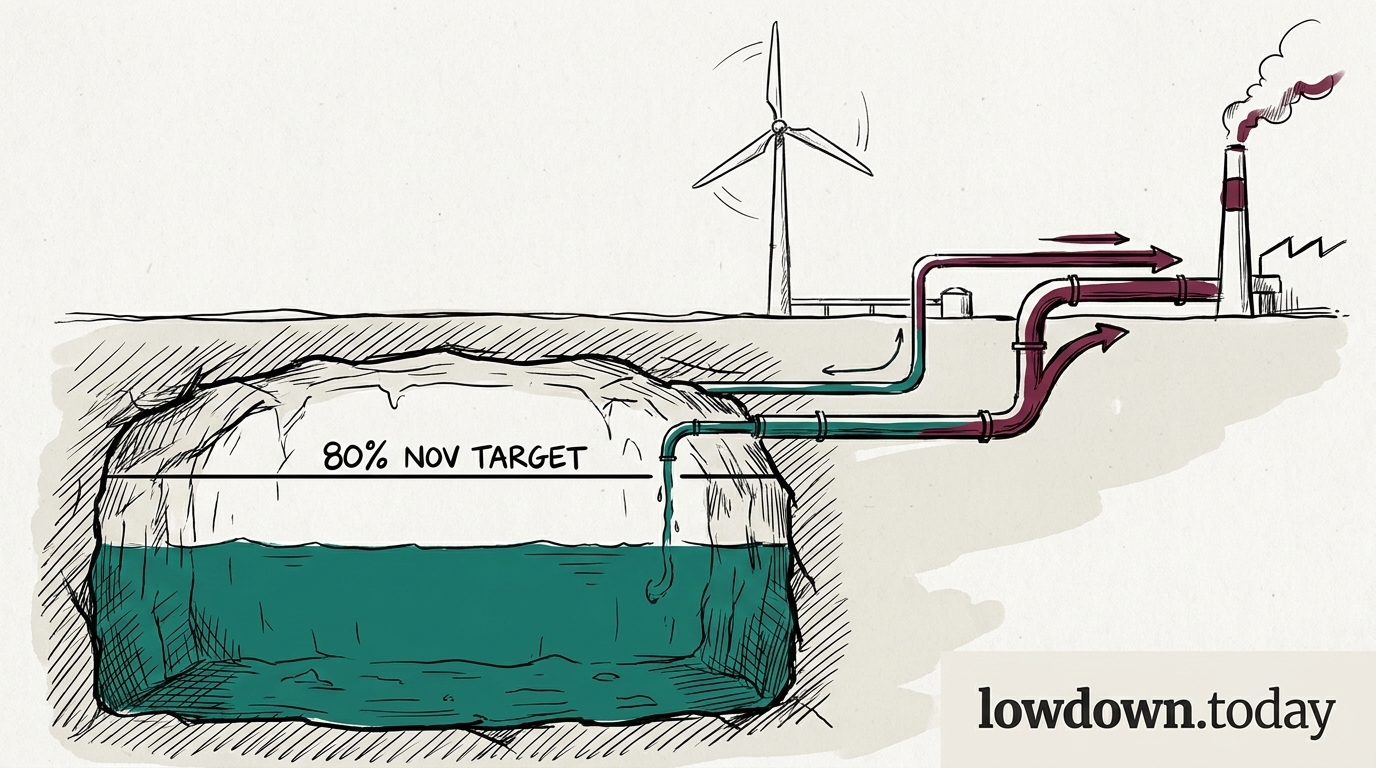
Spain's 9,145 GWh terminal inventory is the largest single stock in the EU LNG network, an option value that can reroute cargoes wherever the winter strip pays best rather than a cavern gas obligation tied to a fixed date. That flexibility matters more as Germany's cavern shortfall pushes more of the winter security question onto import infrastructure.
European Commission
European Commission
Brussels holds the bloc to 90% on a flexible window while Germany, holding roughly a quarter of EU storage capacity, tracks toward missing its own lower 80% figure by 21 points. A national shortfall this size in the anchor market matters more to bloc security than the flexible timetable alone can absorb.
French power exporters and CRE
French day-ahead rose in step with Germany but by less, reopening a EUR 7-17 premium that makes northward export flows commercially attractive again after the EUR 43.09 discount evaporated in days. CRE separately authorised RTE and Enedis to buy flexibility locally, betting the coming winter's binding constraint is grid congestion rather than a shortage of firm capacity.
TTF trading desk
TTF trading desk
A visible national shortfall like Germany's 21-point gap is a directional signal, not noise, for a desk holding the summer-winter spread. TTF's flat EUR 58-60 range through this week's German price swings says the market has not yet chosen to reprice refill risk into the front of the curve.
German cavern and CCGT operators
German caverns kept buying prompt gas at TTF near EUR 58-60 through the inversion; the wind collapse to 2.4 GW then flipped the spark spread to plus EUR 29 and put turbines back in the same queue. Every day turbines win that bid, injection at a third of the 877 GWh/day pace needed falls further behind.
Slovakia
Slovakia
Slovakia says it dropped its hold-out on the 21st sanctions package only after Ursula von der Leyen personally signed written gas-price and supply guarantees. The Council of the European Union's own 17,238-character release on the package names neither Slovakia nor any guarantee, leaving Bratislava's account unconfirmed by the institutional record.



