Consumer Price Index
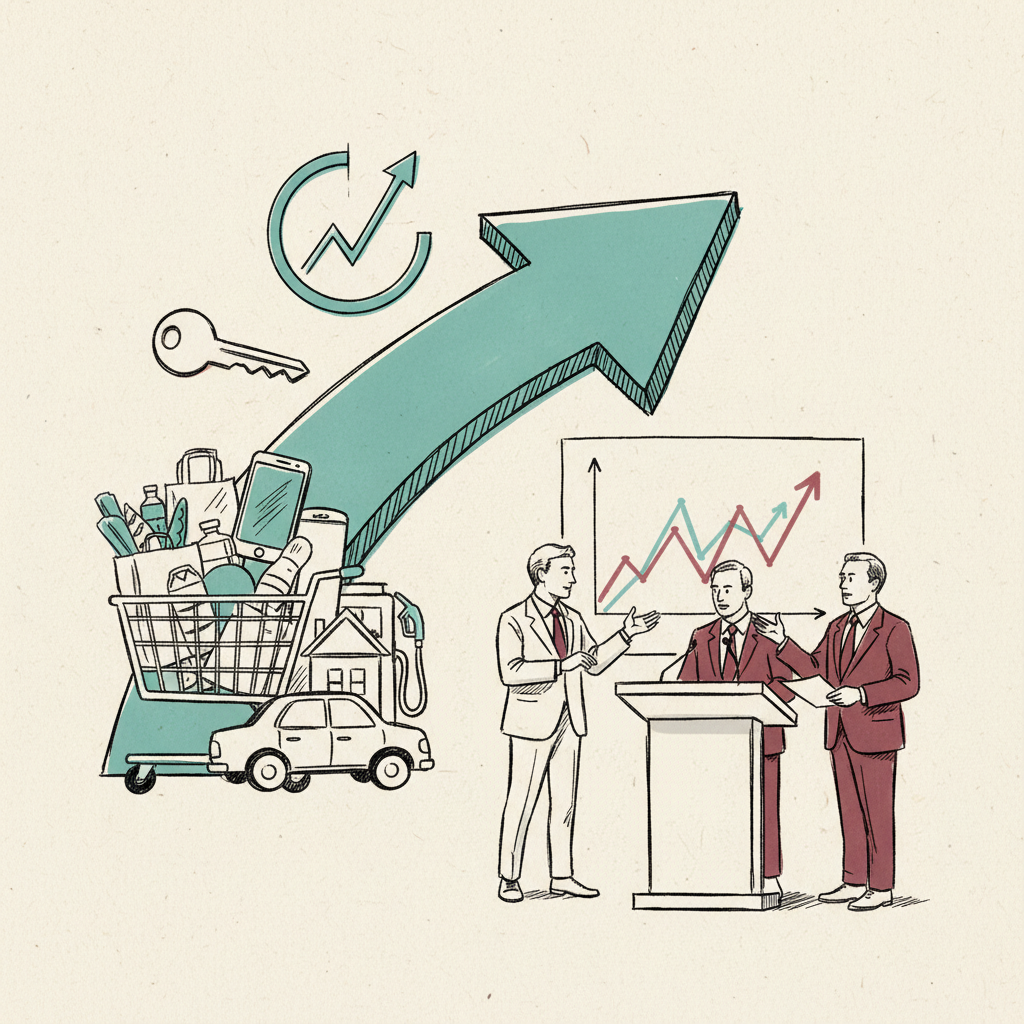
Monthly measure of consumer-goods price change; the primary gauge politicians use to frame cost-of-living policy.
Last refreshed: 28 July 2026 · Appears in 2 active topics
How much has the Hormuz blockade added to US consumer inflation?
Timeline for Consumer Price Index
Mentioned in: Oil surges past $103 on blockade
Iran Conflict 2026Mentioned in: US inflation hits 1967 levels before blockade
Iran Conflict 2026Mentioned in: UK vacancies frozen at 721,000 for six months
AI: Jobs, Power & MoneyMentioned in: US fuel up 36%; biggest rise since 1991
Iran Conflict 2026Mentioned in: Brent at $112: 66% above pre-war price
Iran Conflict 2026Background
The Consumer Price Index (CPI) has moved to the centre of political argument across all three active Lowdown topics. US CPI, published monthly by the Bureau of Labor Statistics, rose 0.9% month-on-month in March 2026 — the largest single-month increase since 1967 — driven by a 21.2% surge in gasoline prices following the blockade of the Strait of Hormuz. Before that blockade, fuel had already risen 36% from pre-war levels: the largest single-month fuel rise since 1991. Goldman Sachs calculates that data-centre electricity demand alone adds approximately 0.1 percentage points to core US inflation annually through 2026-27 — tying AI capital expenditure directly to CPI.
CPI measures the price change of a weighted basket of goods and services bought by a typical urban household. The basket and its weightings are reviewed periodically: housing (shelter) carries the largest weight in US CPI at roughly 36%, followed by food and transport. Headline CPI includes energy and food; core CPI strips them out and is what the Federal Reserve watches most closely when setting interest rates. The UK equivalent is published by the Office for National Statistics, while the Eurozone uses the HICP (Harmonised Index of Consumer Prices). All three are calculated monthly. The University of Michigan Consumer Sentiment Index tracks consumer expectations of future inflation, which feeds into actual price behaviour through wage-setting negotiations.
Cost-of-living is the issue that decides elections. For the US 2026 midterms, CPI is the single most-cited economic indicator in campaign messaging: Republican incumbents face pressure on energy prices inflated by the Iran war, while Democrats frame the same numbers as a national-security consequence of Middle East instability. On the AI and jobs beat, elevated CPI constrains The Fed's room to cut rates — meaning the cost of capital for AI infrastructure stays higher for longer, slowing the very deployment that is reshaping Labour markets. UK vacancies frozen at 721,000 for six consecutive months alongside persistent services inflation show the same wage-price tension in a different labour market.
Why did US inflation jump so sharply in March 2026?
What is the difference between core CPI and headline CPI?
How does inflation affect the 2026 US midterm elections?
Does AI investment make inflation worse?
How does the Hormuz blockade push up prices in the shops?

