Skip to content
You can now search across every topic, entity and event.What's new
European Energy Markets
31JUL

The sanctions that need no signature

3 min read
09:44UTC

The US Treasury has kept sanctioning Iran throughout the war under a pre-war memorandum, freezing nearly half a billion dollars while Trump has signed no new order of his own.

EconomicDeveloping
Key takeaway

US sanctions on Iran keep firing on pre-war authority; only sanctions relief needs a new signature.

The US Treasury has run a named, continuous sanctions campaign against Iran throughout the war, even as the White House has signed no new Iran measure. Treasury calls the campaign Economic Fury, and it operates under National Security Presidential Memorandum 2 (NSPM-2), a pre-war order that delegates designation power to the department rather than requiring a fresh presidential signature 1.

On 27 May the Office of Foreign Assets Control (OFAC), Treasury's sanctions arm, designated Iran's Persian Gulf Strait Authority for extorting Hormuz shipping tolls; on 10 June it blacklisted nine China and Hong Kong entities for arming the Islamic Revolutionary Guard Corps (IRGC) 2. Treasury says the campaign has frozen "nearly half a billion" dollars and disrupted "tens of billions" in regime-linked revenue 3. A direct query of the Federal Register returned zero new Iran filings between 29 June and 2 July 4.

The gap between an empty signing record and live enforcement has a mechanism. NSPM-2 delegates designation authority to OFAC through executive orders that predate the conflict, so Treasury can keep naming targets while any genuinely new instrument stalls. The one Iran action that did need a fresh signature, General Licence X, loosened sanctions rather than tightening them, and its missing escrow and reporting caps handed Chinese buyers a 60-day safe harbour . Relief requires a pen; pressure does not.

Donald Trump's public words and Washington's actions point in opposite directions. On 30 June he demanded cheap petrol on Truth Social and signed nothing ; on 1 July he called the denuclearisation of Iran "moving along well" 5. His earlier order for a Justice Department oil-gouging probe sits in the same column: enforcement motion that does not require settling the war.


Deep Analysis

In plain English

The US Treasury has been sanctioning parts of Iran's economy continuously since before the war even started, under a standing campaign called Economic Fury. It does not need the president to sign anything new each time: officials can add names to the sanctions list on autopilot. In the past six weeks alone, Treasury sanctioned the Iranian body that tries to collect tolls from ships in the Strait of Hormuz, and nine companies in China and Hong Kong accused of helping arm the IRGC, Iran's most powerful military force. Even though no new sanctions appeared in the official US government record for four straight days, that gap does not mean enforcement stopped.

Deep Analysis
Root Causes

Economic Fury runs on National Security Presidential Memorandum 2, a delegation of designation authority to Treasury that predates the war and requires no fresh presidential signature to continue. That is structurally different from General License X, the one Iran sanctions instrument that did need Scott Bessent's active signature to authorise oil sales and dollar payments .

The zero-filing gap between 29 June and 2 July does not mean enforcement paused: OFAC's designation pipeline runs independently of both the Doha talks and the Federal Register's publication cycle, so a quiet week in the public record does not mean a quiet week inside Treasury.

What could happen next?
  • Consequence

    Continued designations during the funeral pause keep economic pressure on Iran even while every diplomatic channel is closed.

  • Risk

    If Tehran reads ongoing designations as evidence Washington is not serious about a deal, it hands hardliners in the Assembly of Experts and IRGC ammunition against the negotiators.

First Reported In

Update #143 · Diplomacy pauses for a funeral under threat

US Department of the Treasury· 2 Jul 2026
Read original
Different Perspectives
Spain's LNG terminal operators
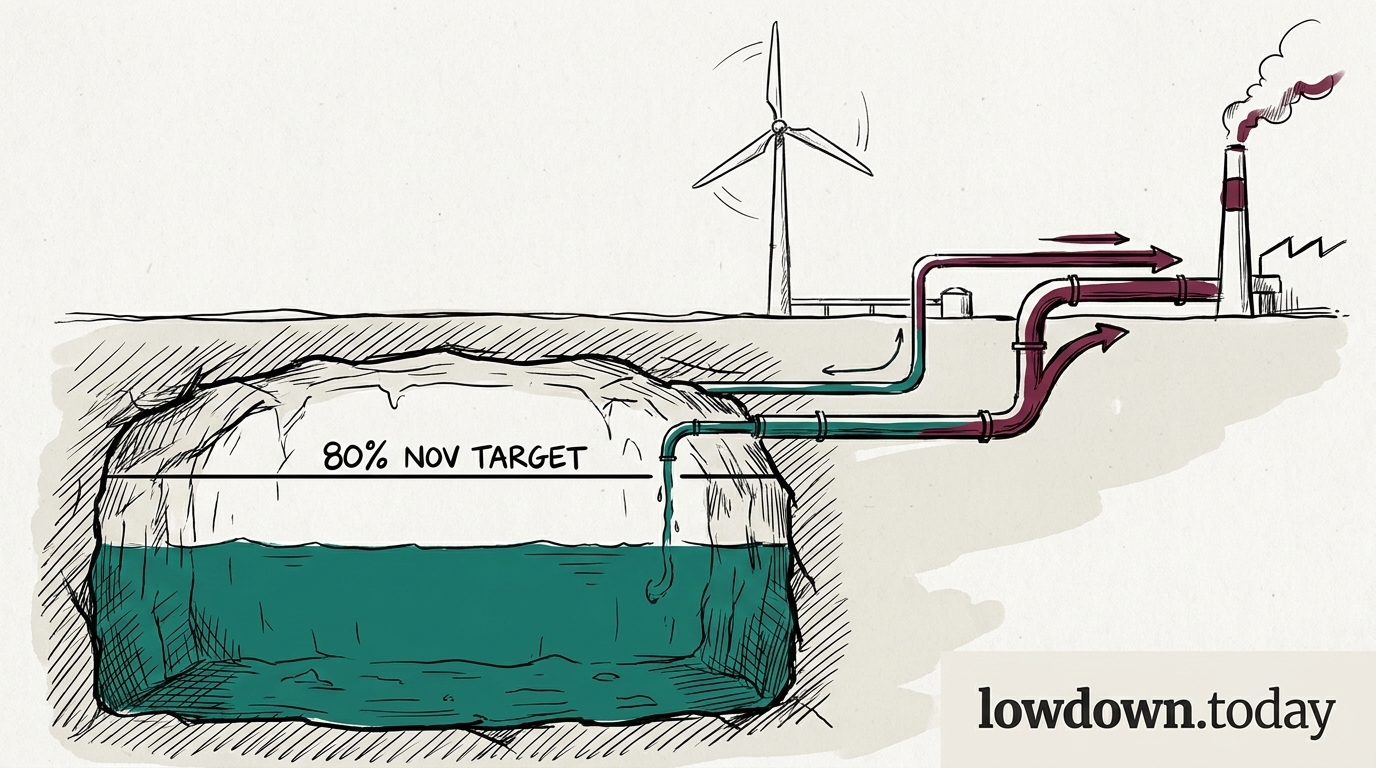
Spain's 9,145 GWh terminal inventory is the largest single stock in the EU LNG network, an option value that can reroute cargoes wherever the winter strip pays best rather than a cavern gas obligation tied to a fixed date. That flexibility matters more as Germany's cavern shortfall pushes more of the winter security question onto import infrastructure.
European Commission
European Commission
Brussels holds the bloc to 90% on a flexible window while Germany, holding roughly a quarter of EU storage capacity, tracks toward missing its own lower 80% figure by 21 points. A national shortfall this size in the anchor market matters more to bloc security than the flexible timetable alone can absorb.
French power exporters and CRE
French day-ahead rose in step with Germany but by less, reopening a EUR 7-17 premium that makes northward export flows commercially attractive again after the EUR 43.09 discount evaporated in days. CRE separately authorised RTE and Enedis to buy flexibility locally, betting the coming winter's binding constraint is grid congestion rather than a shortage of firm capacity.
TTF trading desk
TTF trading desk
A visible national shortfall like Germany's 21-point gap is a directional signal, not noise, for a desk holding the summer-winter spread. TTF's flat EUR 58-60 range through this week's German price swings says the market has not yet chosen to reprice refill risk into the front of the curve.
German cavern and CCGT operators
German caverns kept buying prompt gas at TTF near EUR 58-60 through the inversion; the wind collapse to 2.4 GW then flipped the spark spread to plus EUR 29 and put turbines back in the same queue. Every day turbines win that bid, injection at a third of the 877 GWh/day pace needed falls further behind.
Slovakia
Slovakia
Slovakia says it dropped its hold-out on the 21st sanctions package only after Ursula von der Leyen personally signed written gas-price and supply guarantees. The Council of the European Union's own 17,238-character release on the package names neither Slovakia nor any guarantee, leaving Bratislava's account unconfirmed by the institutional record.



