Skip to content
You can now search across every topic, entity and event.What's new
European Energy Markets
31JUL

The ban's own text makes it porous

3 min read
09:44UTC

Regulation (EU) 2026/261 binds on 17 June for short-term pipeline contracts, but exempts every long-term deal to September 2027 and six supply origins from prior authorisation.

EconomicDeveloping

Regulation (EU) 2026/261 takes effect on 17 June for short-term pipeline contracts, those concluded before 17 June 2025 1. Regulation 2026/261 is the EU instrument phasing out Russian pipeline gas under the RePowerEU framework. Long-term contracts are exempt under its transitional provisions until 30 September 2027, which leaves the structural Russian flow into Central Europe legally intact for fifteen months past the headline date. The ban step-down was already flagged to bind with long-term TurkStream carved out ; the regulation's detail confirms how little physical gas the deadline actually stops.

Implementing Decision (EU) 2026/335, adopted 9 February, exempts six origins from the prior-authorisation requirement: Algeria, Nigeria, Norway, Qatar, the UK and the USA 2. Prior authorisation is the mechanism a short-term importer uses to bring in non-exempt gas: it files one month before customs entry and clears an administrative check, a bureaucratic delay rather than a hard stop. Hungary's MVM, the state energy group, holds a 3.5 bcm long-term TurkStream contract fully exempt to September 2027.

The market priced this architecture days before the deadline. The CEGH-TTF basis had compressed to EUR 0.41/MWh by 11 June , reading the ban as procedural rather than disruptive. CEGH is the Austrian virtual hub at the eastern end of the TurkStream route, the basis most exposed to any genuine physical step-down. A near-flat basis going into the binding week is the traded confirmation that desks expect the molecules to keep moving. TurkStream carries roughly 15 bcm a year to Hungary, Slovakia, the Czech Republic and Austria, and none of that long-term volume is touched on 17 June.


Deep Analysis

In plain English

The EU passed a law banning imports of Russian pipeline gas under short-term contracts, with the ban taking effect on 17 June 2026. Short-term contracts are deals signed less than a year ago, the kind traders use to move gas quickly across borders. But the ban has two large holes. First, long-term contracts signed before June 2025 are fully legal until at least September 2027. Hungary's state energy company MVM holds one such contract for 3.5 billion cubic metres per year of Russian gas through the TurkStream pipeline, which runs under the Black Sea and through Turkey. That gas keeps flowing legally. Second, six countries' gas is exempt from even the new administrative rules: Algeria, Norway, Qatar, Nigeria, the UK, and the US. Those six supply most of Europe's non-Russian gas already, so the rule mainly confirms the status quo for the main alternative suppliers.

Deep Analysis
Root Causes

The long-term contract exemption exists because Hungary and Slovakia negotiated transitional protection during the regulation's drafting. Both countries receive roughly 4-5 bcm per year of TurkStream gas under long-term contracts with pricing formulae that Gazprom set before the 2022 invasion.

Replacing those volumes at spot TTF prices would add an estimated EUR 0.8-1.2 billion per year to their combined energy import bills at current price levels, a fiscal shock that the Commission had no solidarity mechanism to offset.

The six-origin prior-authorisation exemption in Implementing Decision 2026/335 reflects a separate structural constraint: LNG terminals in France, Spain, Belgium and the Netherlands cannot physically process sufficient non-Russian volumes to substitute short-term pipeline gas without queue and regasification capacity bottlenecks.

Algeria, Norway, Qatar, Nigeria, the UK and the US were already the primary alternative supply vectors before the regulation was drafted; exempting them is functionally an acknowledgement that no new supply origination was politically or commercially viable within the legislative window.

The prior-authorisation system, rather than an outright ban, reflects the Commission's legal caution: an absolute ban on all gas of Russian origin would likely trigger CJEU annulment on proportionality grounds given the 2018 European Court ruling on EU energy trade measures. Structuring the instrument as an administrative gate rather than a prohibition lets the Commission defend it as targeted and reversible in ongoing CJEU proceedings.

What could happen next?
  • Precedent

    Regulation 2026/261's tiered architecture creates a template for phased energy sanctions that subsequent EU instruments on TurkStream long-term volumes or LNG will reference as the established compromise model.

    Long term · Assessed
  • Risk

    MVM's 3.5 bcm TurkStream contract remaining exempt until September 2027 means Hungary retains Russian gas dependency for 15 more months, sustaining Kremlin leverage over Central European supply security through the 2026-27 heating season.

    Medium term · Assessed
  • Consequence

    The prior-authorisation exemption for six origins effectively grandfathers the current EU LNG supply structure, reducing the regulatory incentive to diversify beyond US LNG at 58% of EU imports.

    Medium term · Assessed
First Reported In

Update #18 · TTF breaks the floor into the import ban

EUR-Lex· 15 Jun 2026
Read original
Causes and effects
This Event
The ban's own text makes it porous
The regulation stops a thin slice of short-term flow while the structural Russian pipeline supply into Central Europe stays legally intact for fifteen more months.
Different Perspectives
Spain's LNG terminal operators
Spain's 9,145 GWh terminal inventory is the largest single stock in the EU LNG network, an option value that can reroute cargoes wherever the winter strip pays best rather than a cavern gas obligation tied to a fixed date. That flexibility matters more as Germany's cavern shortfall pushes more of the winter security question onto import infrastructure.
European Commission
European Commission
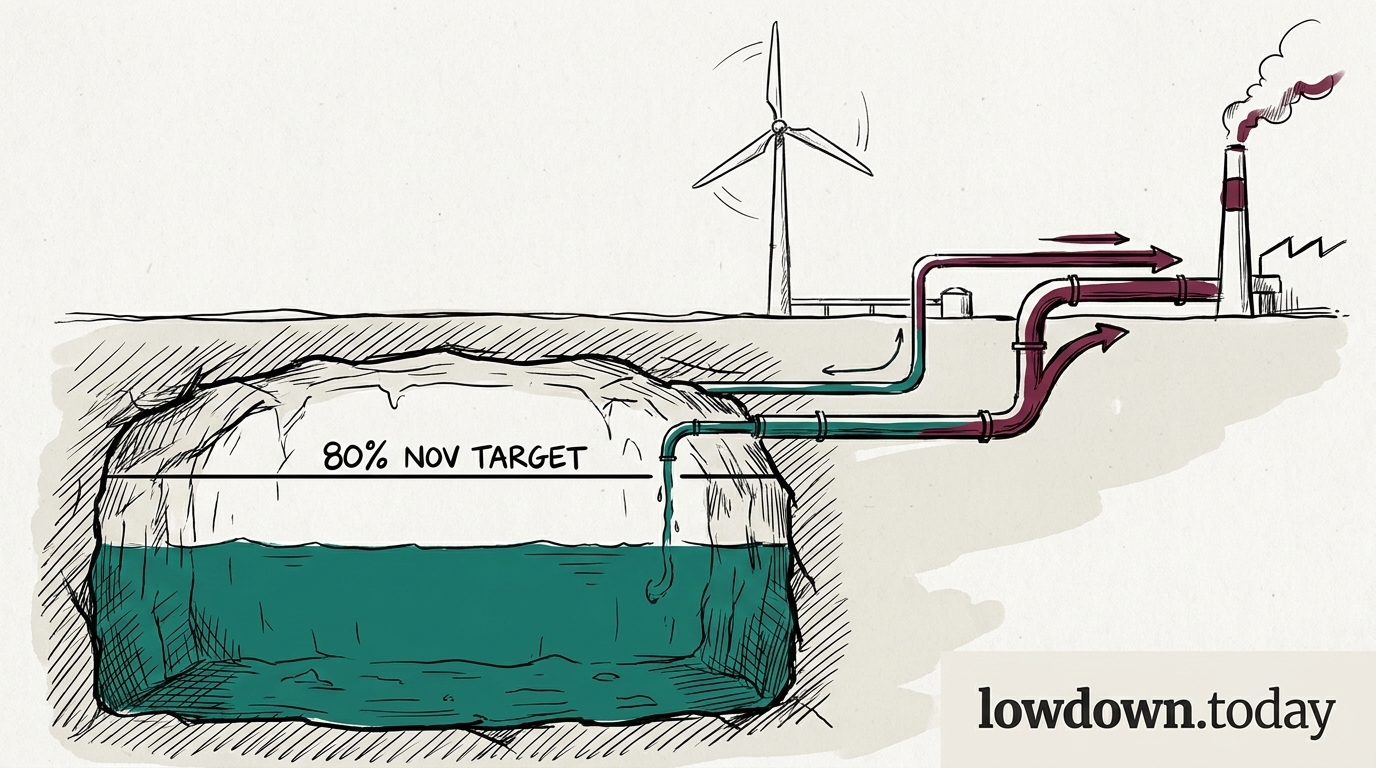
Brussels holds the bloc to 90% on a flexible window while Germany, holding roughly a quarter of EU storage capacity, tracks toward missing its own lower 80% figure by 21 points. A national shortfall this size in the anchor market matters more to bloc security than the flexible timetable alone can absorb.
French power exporters and CRE
French day-ahead rose in step with Germany but by less, reopening a EUR 7-17 premium that makes northward export flows commercially attractive again after the EUR 43.09 discount evaporated in days. CRE separately authorised RTE and Enedis to buy flexibility locally, betting the coming winter's binding constraint is grid congestion rather than a shortage of firm capacity.
TTF trading desk
TTF trading desk
A visible national shortfall like Germany's 21-point gap is a directional signal, not noise, for a desk holding the summer-winter spread. TTF's flat EUR 58-60 range through this week's German price swings says the market has not yet chosen to reprice refill risk into the front of the curve.
German cavern and CCGT operators
German caverns kept buying prompt gas at TTF near EUR 58-60 through the inversion; the wind collapse to 2.4 GW then flipped the spark spread to plus EUR 29 and put turbines back in the same queue. Every day turbines win that bid, injection at a third of the 877 GWh/day pace needed falls further behind.
Slovakia
Slovakia
Slovakia says it dropped its hold-out on the 21st sanctions package only after Ursula von der Leyen personally signed written gas-price and supply guarantees. The Council of the European Union's own 17,238-character release on the package names neither Slovakia nor any guarantee, leaving Bratislava's account unconfirmed by the institutional record.



