
Skip to content
You can now search across every topic, entity and event.What's new
European Energy Markets
15JUN

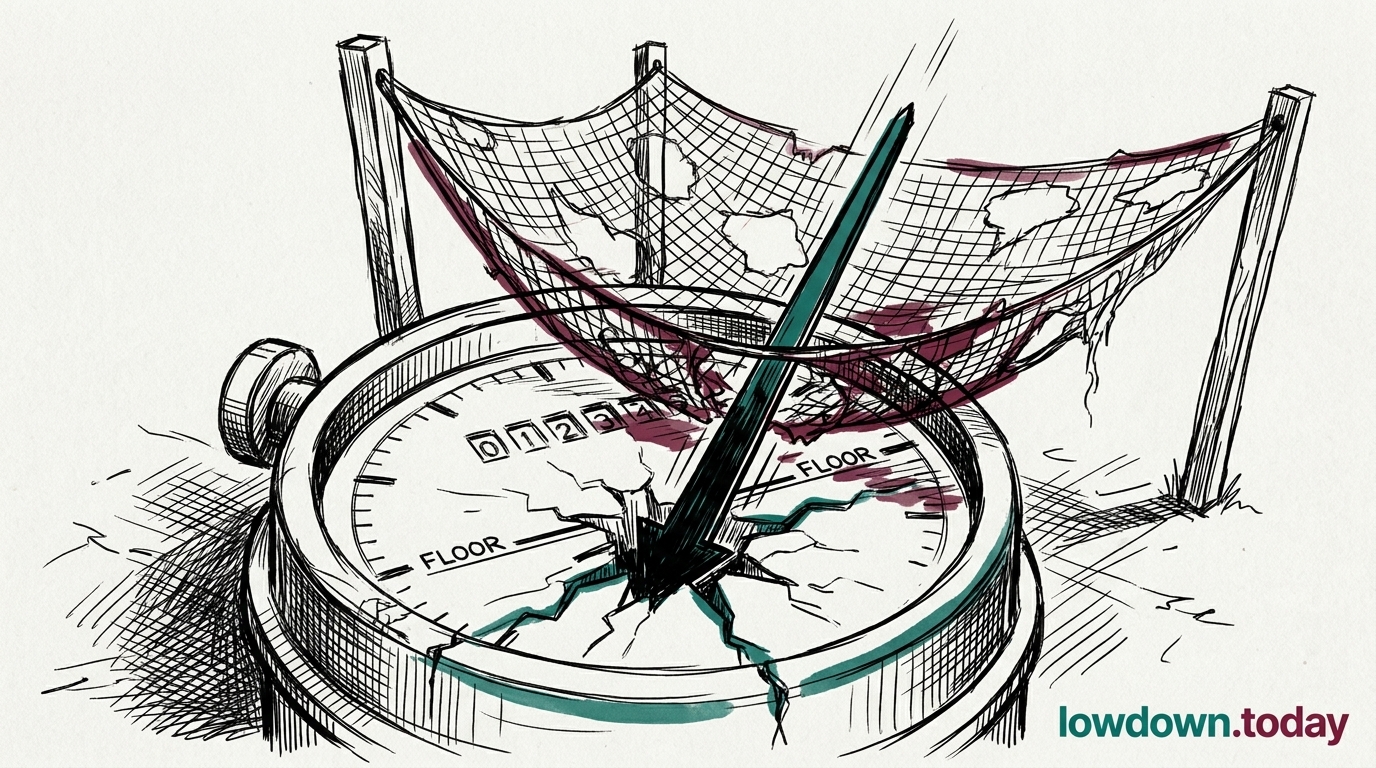
TTF breaks the floor into the import ban

3 min read
12:23UTC

TTF front-month fell to approximately EUR 43.8 on 15 June, down roughly 12% from 11 June and through its EUR 46-47 floor, two days before the 17 June pipeline-import ban binds. The benchmark is selling into the ban, not pricing a supply premium, because the squeeze is on power demand, the ban is porous at every layer, and the one tightening supply is the LNG it does not touch.

Key takeaway

The EU pipeline ban proved porous at every layer as TTF broke its floor on demand, not supply.

This briefing mapped
Loading map…
Economic
Regulatory
Legal
Infrastructure

TTF front-month settled near EUR 43.8/MWh on Monday 15 June, down roughly 12% in four days and clean through its EUR 46-47 floor, two days before the pipeline-import ban binds.

Sources profile:This story draws on neutral-leaning sources from United States
United States

Europe's wholesale gas price fell 12% in four days to EUR 43.8 per megawatt-hour on 15 June, breaking a floor held since early May, just before the EU pipeline import ban took effect on 17 June.

German gas power stations stopped buying gas because generating costs around EUR 119 per megawatt-hour against a EUR 74 market price. Europe's storage sits 22 percentage points below seasonal norms. 

Regulation (EU) 2026/261 binds on 17 June for short-term pipeline contracts, but exempts every long-term deal to September 2027 and six supply origins from prior authorisation.

Sources profile:This story draws on neutral-leaning sources

The EU pipeline gas ban took effect on 17 June, but Hungary's MVM company keeps receiving 3.5 billion cubic metres per year via TurkStream under a long-term deal exempt until at least September 2027.

Six supply origins including Norway, Qatar and the US face no new requirements at all. Markets treated the date as administrative: the Central European Gas Hub traded just EUR 0.41 above TTF , barely moving. 

German day-ahead cleared near EUR 74/MWh on 15 June, taking the clean spark spread to roughly -EUR 44/MWh and shutting gas plants in. StromVKG, the capacity-payment fix, sits in committee.

Sources profile:This story draws on neutral-leaning sources

German gas power stations stopped generating on 15 June 2026. Gas costs and carbon taxes totalled around EUR 119-128 per megawatt-hour, but the market paid only EUR 74, a loss of EUR 44-54 per unit.

Germany's parliament passed a first reading of the StromVKG law on 11 June to pay plants just to stay available. The Greens want to require hydrogen conversion by 2030 as a condition, which may deter companies from bidding. 

Sources:Lowdown Data Desk·EU Energy Live
1 Lowdown Data Desk2 Lowdown Data Desk

BOTAS mixes Russian, Azeri and Iranian molecules into a 'Turkish blend' and routes it through Kipi, the Greek-Turkish crossing that lacks the origin checks applied elsewhere.

Sources profile:This story draws on centre-left-leaning sources from Belgium
Belgium

Turkey's state gas company BOTAS mixes Russian, Azerbaijani and Iranian gas and sells the blend as Turkish-origin. At the Kipi border crossing into Greece, EU rules do not require BOTAS to prove what share is Russian.

Some Russian gas molecules are entering the EU after the 17 June ban, labelled as Turkish. The enforcement gap exists because the Kipi crossing runs on trade-balancing rules, not origin-tracing standards. 

Sources:EUobserver

No CJEU interim stay was filed before 17 June; the annulment case now sits with Peter Magyar's Tisza government, which wants the ban to stand. Slovakia under Fico is the sole live challenger.

Sources profile:This story draws on neutral-leaning sources

Hungary's Prime Minister Peter Magyar, in office since May 2026, has dropped the court fight against the EU gas ban. Magyar's government calls Russian gas dependency a security risk, removing the incentive to challenge the ban that Orban filed.

Slovakia's Robert Fico now challenges alone at the Court of Justice in Luxembourg, arguing the ban needed unanimous agreement. Any ruling will arrive years after the ban has taken effect. 

France cleared roughly EUR 1.6/MWh above Germany on 15 June, a full reversal of the EUR 96.20 record set on 8 June, after French July power jumped about 10% in two days on cooling-water risk.

Sources profile:This story draws on mixed-leaning sources from United States
United States

France and Germany's day-ahead power prices swapped on 15 June: France at EUR 75.8 per megawatt-hour, Germany at EUR 74.3. Seven days earlier France was EUR 96 cheaper.

Summer temperatures pushed river water towards EDF's thermal discharge limits. Markets priced possible reactor cuts, pushing French July contracts up about 10% in two days and flipping the spread. 

JKM printed USD 18.86/MMBtu on 12 June, more than doubling the arb against TTF to roughly USD 5.26/MMBtu and pulling Atlantic LNG cargoes east to Asia, away from Europe in injection season.

Sources profile:This story draws on centre-left-leaning sources from United States
United States

Asian spot LNG (JKM) hit USD 18.86 per unit on 12 June, running USD 5.26 above the European equivalent. That gap is twice the threshold required to redirect a gas cargo from Europe to Asia.

Flexible LNG cargoes that would normally fill European storage during summer are heading to Japan and South Korea instead. Europe's storage sits well below seasonal targets, and the price signal points supply eastward. 

Sources:Bloomberg

Equinor stacked a fresh 13-16 June maintenance window on top of the unresolved compressor fault that has kept Hammerfest LNG dark since 22 April, putting two live outages on one plant at once.

Sources profile:This story draws on neutral-leaning sources

Norway's Hammerfest LNG terminal was running two simultaneous shutdowns from 13 June 2026. An unresolved compressor fault from late April remained open. Equinor layered planned maintenance from 13-16 June on top of it.

Hammerfest ships Arctic gas to European ports as liquefied natural gas. Its absence during the EU ban's binding week removed Norway's seaborne supply option at the one moment European markets most needed alternative volumes. 

Sources:LNG Prime
Closing comments

Sideways into the injection window, with a downside tail. TTF's demand-destruction pricing regime holds as long as German CCGTs remain off-merit; the only mechanism that reverses it without a policy change is a power-price recovery to above EUR 90-95/MWh, which requires a demand pulse or renewable underproduction that the June calendar does not yet supply. The September 2026 StromVKG capacity auction is the dated decision hinge: if the Greens' hydrogen-conversion amendment is adopted in the Wirtschaftsausschuss and Uniper or RWE declines to bid, the auction fails and the CCGT shut-in extends through the heating season. On the supply side, the Hammerfest 10 July return date is the near-term test; a 2025-style 24-day slip would push the outage into late July, compounding the JKM arb's cargo diversion effect on the August injection pace.

Different Perspectives
ARA gas trading desks
Amsterdam-Rotterdam-Antwerp trading desks read the EUR 43.8 close as the market separating the ban's headline from its enforceable reach: at -EUR 44 clean spark spread, gas-for-power demand is structurally absent and the floor has no physical bid to hold it. The desk view is demand-led repricing, not a supply event.
German CCGT capacity planners
Capacity planners at Uniper and RWE face the StromVKG Wirtschaftsausschuss scrutiny as the decisive near-term fork: if the Greens' hydrogen-conversion amendment passes, the September 2026 auction becomes unbiddable on technology risk grounds and the capacity-payment fix delays into winter. Plants that have run at -EUR 44 spark spread for weeks cannot commercially sustain extended shut-in.
European Commission / ACER
The Commission structured Regulation 2026/261 as a QMV trade measure to resist Article 194 unanimity challenges; the six-origin prior-authorisation waiver acknowledges that LNG capacity cannot substitute pipeline gas within the legislative window. ACER's cross-border enforcement powers activate in H2 2026, but jurisdiction over the Kipi entry point is legally contested.
LNG spot traders and cargo routers
At JKM-TTF of USD 5.26/MMBtu, every uncommitted Atlantic cargo loading in late June routes east; the arb sits roughly twice the OIES-assessed diversion threshold of USD 2.50-3.00/MMBtu after freight. European storage terminals are the losing bid in the cargo auction until TTF recovers or JKM eases.
Hungary and Slovakia supply-security ministries
Hungary's Tisza government has reframed Russian gas dependency as a systemic risk, removing Budapest as a co-plaintiff in the CJEU challenge; MVM's 3.5 bcm long-term TurkStream contract remains exempt to September 2027, so Budapest's near-term supply is intact. Slovakia under Fico presses its QMV challenge alone and faces a 3-4 bcm/year short-term supply gap with no contracted LNG alternative.
EDF and French nuclear-anchored power buyers
EDF's fleet repriced French July contracts roughly 10% in two days on cooling-water curtailment risk, flipping the FR-DE spread to France EUR 1.6 above Germany after a EUR 96.20 record in the other direction a week earlier. Industrial buyers long France against short Germany face EUR 97.7/MWh of spread swing in seven calendar days.