Skip to content
You can now search across every topic, entity and event.What's new
European Energy Markets
31JUL

Katz calls Iran's heir 'a dead man'

2 min read
09:44UTC

Israel's defence minister Israel Katz called Iran's new supreme leader Mojtaba Khamenei 'a dead man' on 1 July; foreign minister Abbas Araghchi warned Tehran would answer any strike at once.

EconomicDeveloping
Key takeaway

Israel has named Iran's new leader a target just as his father's funeral may draw him into public view.

Israel's defence minister Israel Katz called Iran's Supreme Leader Mojtaba Khamenei "marked for death" and "a dead man" on 1 July, in remarks first carried by the Israeli outlet Ynet 1. Iran's foreign minister Abbas Araghchi warned of an "immediate and powerful response" if Israel acted on the threat 2.

Mojtaba, 56, took office on 8 March and has not appeared in public since, governing through handwritten notes carried in sealed envelopes. His father Ali Khamenei, killed in the opening Israeli strike of 28 February, is to be buried over six days from 4 July, and the funeral offers the first occasion on which the son might appear in person 3. That would place the man Israel says it wants dead at a known location and hour, in front of crowds in the tens of millions, on a date printed weeks ahead.

On 1 July the Qom seminary and the Assembly of Experts, the clerical body that installed Mojtaba in an emergency online vote, both faulted the emerging US deal for falling short of his father's red lines . Israel wants him dead; his own clerics say he has already conceded too much.

The colder calculation cuts the other way. Israel gains little from killing a reclusive figurehead whose real authority already runs through the Islamic Revolutionary Guard Corps (IRGC), Iran's ideological military force, rather than his own office, and a great deal from the retaliation Araghchi has promised.


Deep Analysis

In plain English

Israel's defence minister, Israel Katz, called Iran's Supreme Leader Mojtaba Khamenei 'a dead man' in remarks first carried by the Israeli news site Ynet. Mojtaba took over the role in March, after an Israeli strike killed his father, Ali Khamenei, Iran's previous Supreme Leader, along with his wife and son. Iran's Foreign Minister, Abbas Araghchi, warned of an 'immediate and powerful response' if Israel acts on the threat. It is not the first such statement: Israeli officials made near-identical threats against Mojtaba back in March, when he was first installed, so this looks like a repeat of an existing warning rather than a new signal.

Deep Analysis
Root Causes

Mojtaba Khamenei's legitimacy gap widens the threat's political reach. The Assembly of Experts installed him in an emergency online session on 7 March after Israeli strikes destroyed its Qom headquarters, with at least eight of its remaining members boycotting the vote over his lack of the marja theological credentials Article 109 requires.

A leader whose own clerical establishment already contests his authority is more exposed to an external threat aimed at that same legitimacy, which is why the Qom Seminary and Assembly of Experts criticism of the US deal lands at the same moment as Katz's statement rather than before or after it.

What could happen next?
  • Risk

    Escalation risk rises if Israel is perceived to act on the threat during the funeral week, when Iran's leadership is most concentrated and exposed.

  • Meaning

    Katz's repeated targeting language shows Israel treats leadership decapitation as a standing doctrine rather than a one-off statement.

First Reported In

Update #143 · Diplomacy pauses for a funeral under threat

The Express Tribune· 2 Jul 2026
Read original
Different Perspectives
Spain's LNG terminal operators
Spain's 9,145 GWh terminal inventory is the largest single stock in the EU LNG network, an option value that can reroute cargoes wherever the winter strip pays best rather than a cavern gas obligation tied to a fixed date. That flexibility matters more as Germany's cavern shortfall pushes more of the winter security question onto import infrastructure.
European Commission
European Commission
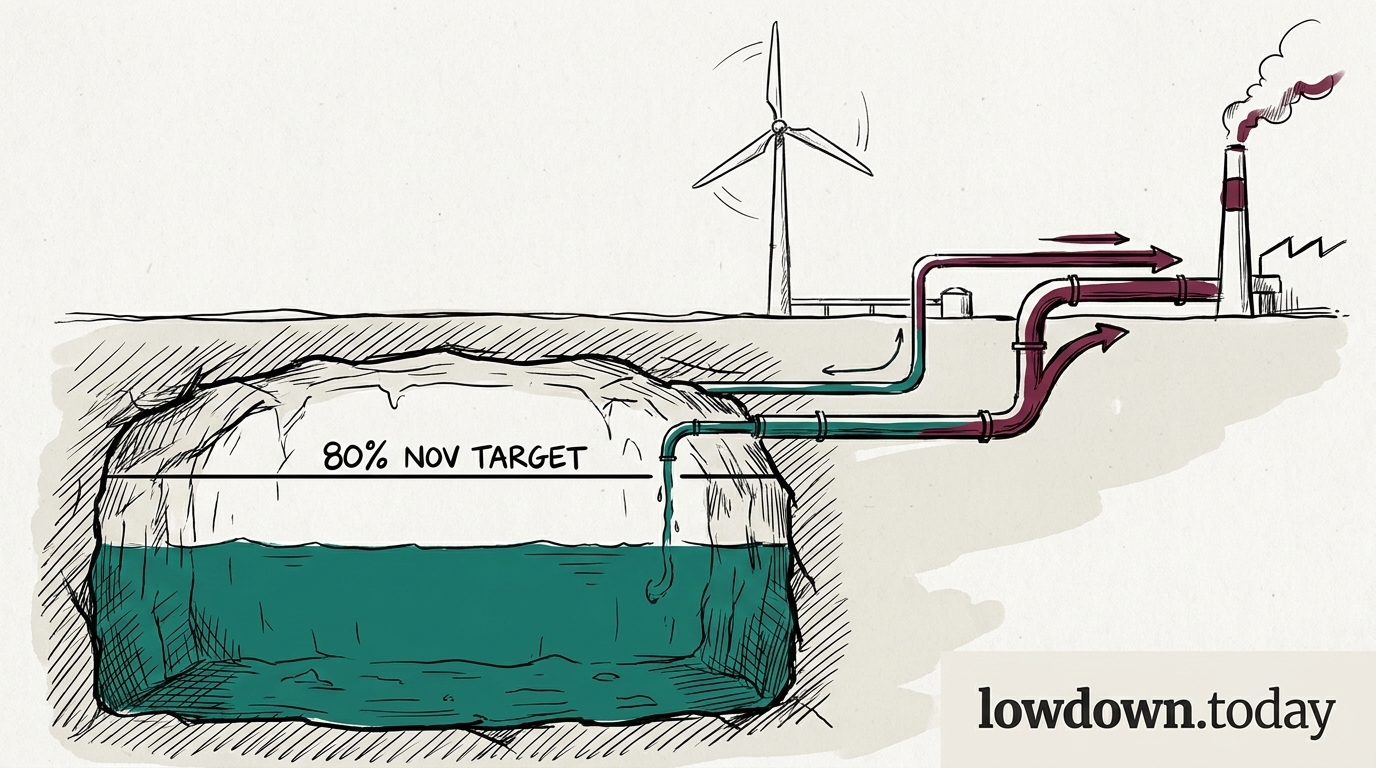
Brussels holds the bloc to 90% on a flexible window while Germany, holding roughly a quarter of EU storage capacity, tracks toward missing its own lower 80% figure by 21 points. A national shortfall this size in the anchor market matters more to bloc security than the flexible timetable alone can absorb.
French power exporters and CRE
French day-ahead rose in step with Germany but by less, reopening a EUR 7-17 premium that makes northward export flows commercially attractive again after the EUR 43.09 discount evaporated in days. CRE separately authorised RTE and Enedis to buy flexibility locally, betting the coming winter's binding constraint is grid congestion rather than a shortage of firm capacity.
TTF trading desk
TTF trading desk
A visible national shortfall like Germany's 21-point gap is a directional signal, not noise, for a desk holding the summer-winter spread. TTF's flat EUR 58-60 range through this week's German price swings says the market has not yet chosen to reprice refill risk into the front of the curve.
German cavern and CCGT operators
German caverns kept buying prompt gas at TTF near EUR 58-60 through the inversion; the wind collapse to 2.4 GW then flipped the spark spread to plus EUR 29 and put turbines back in the same queue. Every day turbines win that bid, injection at a third of the 877 GWh/day pace needed falls further behind.
Slovakia
Slovakia
Slovakia says it dropped its hold-out on the 21st sanctions package only after Ursula von der Leyen personally signed written gas-price and supply guarantees. The Council of the European Union's own 17,238-character release on the package names neither Slovakia nor any guarantee, leaving Bratislava's account unconfirmed by the institutional record.



