Skip to content
You can now search across every topic, entity and event.What's new
European Energy Markets
31JUL

Medvedev likens Hormuz to nuclear arms

3 min read
09:44UTC

Dmitry Medvedev, Putin's envoy to the Tehran funeral, wrote that Iran's grip on the Strait of Hormuz is equivalent to possessing a nuclear weapon.

EconomicDeveloping
Key takeaway

Russia's Medvedev called Iran's Hormuz leverage a nuclear-equivalent deterrent, the strongest outside endorsement of that threat yet.

Dmitry Medvedev, deputy chairman of Russia's Security Council, attended the Tehran funeral as Vladimir Putin's personal envoy and wrote on Telegram that Iran's ability to disrupt the Strait of Hormuz "is equivalent to possession of a nuclear weapon" 1. the strait is the shipping channel through which roughly a fifth of the world's oil passes, and Iran sits on its northern shore. Medvedev added that Iran will "prevail" over the United States, and of the paused Doha negotiating track said: "negotiations are good, but they must be concluded with a result" 2.

TASS (Russia's state news agency) reported that Medvedev also reaffirmed the Russia-Iran comprehensive strategic partnership treaty, the 2025 pact formalising cooperation between the two states 3. His delegation carried Orthodox, Sunni and Shia clergy, a religious-diplomacy gesture more than a government-to-government one.

The framing matters more than the theatre. Since the war's opening weeks, Iran's grip on the strait has been treated as a commercial-disruption risk, a threat to oil prices and shipping schedules. Medvedev, speaking for a nuclear-armed partner, recast it as a strategic deterrent in its own right, the most explicit external endorsement yet of the chokepoint as a weapon Iran already holds. That gives Tehran outside cover to treat any future interdiction as deterrence rather than economic warfare.

Yet Putin stayed home and sent a deputy, matching China, which also sent its own deputy while Pakistan's prime minister came in person and Europe was left off the guest list entirely . The nuclear-weapon analogy is cheap to voice and costly to disown, which is why it arrived on Medvedev's Telegram feed rather than in a Kremlin statement. Russia is signalling alignment while withholding the personal Putin commitment that would raise the stakes.


Deep Analysis

In plain English

Dmitry Medvedev is a senior Russian official, formerly Russia's president, who now serves as deputy chair of its Security Council. Russia's actual president, Vladimir Putin, did not attend Iran's state funeral for its late supreme leader; he sent Medvedev instead. At the funeral, Medvedev made a striking comparison: he said Iran's ability to block the Strait of Hormuz, a narrow shipping channel through which a large share of the world's oil passes, is as powerful a deterrent as owning a nuclear weapon. He also reaffirmed a treaty between Russia and Iran that formalises their cooperation, though the treaty does not commit Russia to defend Iran militarily. The comparison matters because it puts a Russian stamp of approval on Iran's argument that it doesn't need nuclear weapons to have serious leverage over the rest of the world, it just needs control of a narrow strip of water.

Deep Analysis
Root Causes

Russia's own leverage over Iran is limited by the comprehensive strategic partnership treaty's terms, which commit both states to consultation but not mutual defence, so Moscow has no treaty obligation to intervene materially at Hormuz and instead trades rhetorical alignment for continued Iranian cooperation on other fronts.

Iran's Hormuz-as-deterrent framing depends on the strait remaining under-transited relative to its pre-war baseline: the moment vessel counts return fully to normal, as they have begun to on some days , the chokepoint's deterrent value as a live threat, rather than a historical one, erodes.

Escalation

Direction: rhetorical escalation without a material commitment. Medvedev's statement raises the stakes of Hormuz rhetorically but is not accompanied by any announced Russian naval deployment or arms transfer, so the practical escalation risk remains tied to Iran's own IRGC Navy posture rather than Russian involvement.

What could happen next?
  • Meaning

    Russia's highest-level funeral representation endorsing Iran's chokepoint doctrine gives Tehran a rhetorical ally for its Hormuz leverage without any accompanying material Russian commitment.

  • Precedent

    Framing a conventional chokepoint capability as nuclear-equivalent gives other states with geographic leverage, such as Egypt over Suez, rhetorical cover to make similar claims in future disputes.

First Reported In

Update #147 · Japan opens Iran oil talks under US waiver

Al Jazeera· 6 Jul 2026
Read original
Different Perspectives
Spain's LNG terminal operators
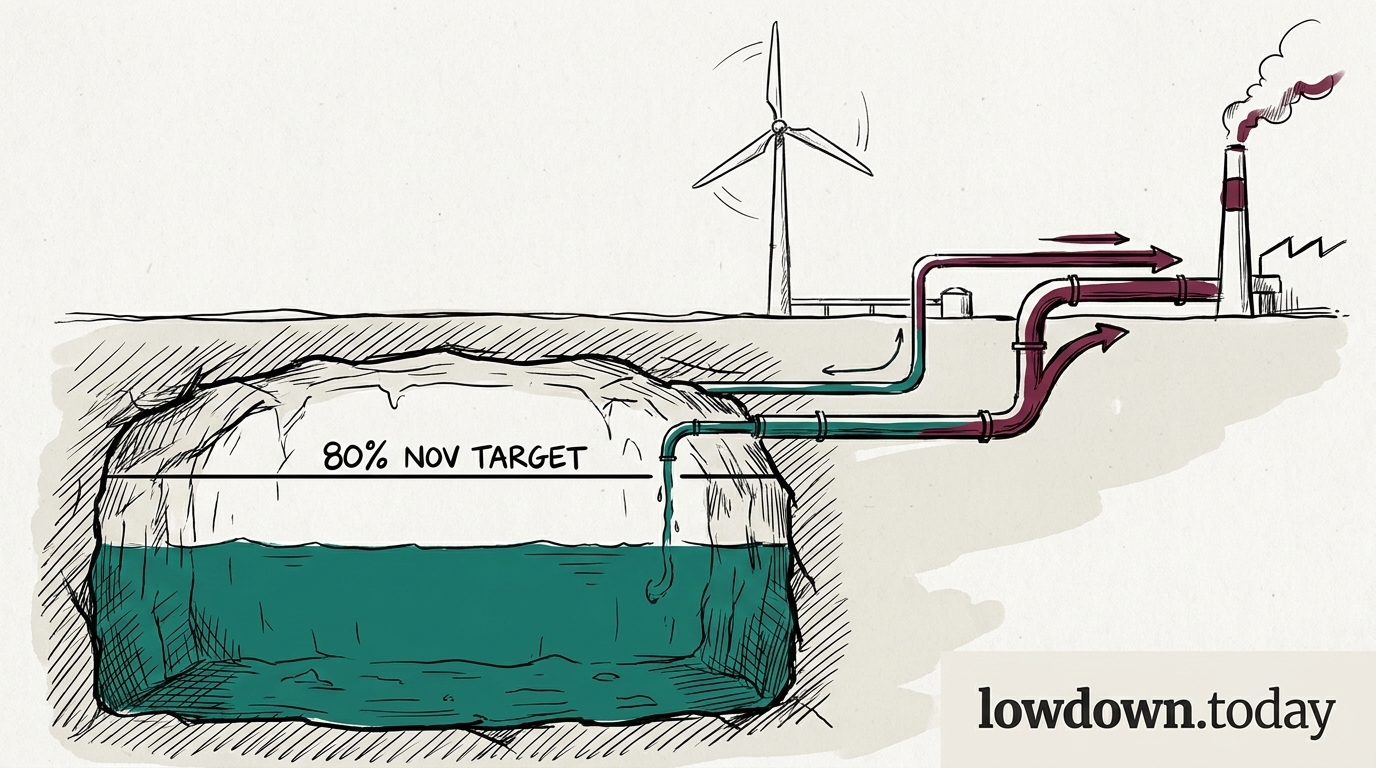
Spain's 9,145 GWh terminal inventory is the largest single stock in the EU LNG network, an option value that can reroute cargoes wherever the winter strip pays best rather than a cavern gas obligation tied to a fixed date. That flexibility matters more as Germany's cavern shortfall pushes more of the winter security question onto import infrastructure.
European Commission
European Commission
Brussels holds the bloc to 90% on a flexible window while Germany, holding roughly a quarter of EU storage capacity, tracks toward missing its own lower 80% figure by 21 points. A national shortfall this size in the anchor market matters more to bloc security than the flexible timetable alone can absorb.
French power exporters and CRE
French day-ahead rose in step with Germany but by less, reopening a EUR 7-17 premium that makes northward export flows commercially attractive again after the EUR 43.09 discount evaporated in days. CRE separately authorised RTE and Enedis to buy flexibility locally, betting the coming winter's binding constraint is grid congestion rather than a shortage of firm capacity.
TTF trading desk
TTF trading desk
A visible national shortfall like Germany's 21-point gap is a directional signal, not noise, for a desk holding the summer-winter spread. TTF's flat EUR 58-60 range through this week's German price swings says the market has not yet chosen to reprice refill risk into the front of the curve.
German cavern and CCGT operators
German caverns kept buying prompt gas at TTF near EUR 58-60 through the inversion; the wind collapse to 2.4 GW then flipped the spark spread to plus EUR 29 and put turbines back in the same queue. Every day turbines win that bid, injection at a third of the 877 GWh/day pace needed falls further behind.
Slovakia
Slovakia
Slovakia says it dropped its hold-out on the 21st sanctions package only after Ursula von der Leyen personally signed written gas-price and supply guarantees. The Council of the European Union's own 17,238-character release on the package names neither Slovakia nor any guarantee, leaving Bratislava's account unconfirmed by the institutional record.



