Skip to content
You can now search across every topic, entity and event.What's new
European Energy Markets
31JUL

Iran War Hands Russia an Unexpected Oil Windfall

2 min read
09:44UTC

Ukraine's Baltic port strikes cut Russian crude exports by 43%, but the Iran war more than doubled the per-barrel price, projecting a 70% April revenue jump over March.

EconomicDeveloping
Key takeaway

Iran war doubled the per-barrel price, creating a net Russian windfall only sustained Baltic disruption can reverse.

Urals crude reached $123.45 per barrel on 3 April, more than double Russia's $59 budget assumption and nearly triple the January average. The cause is not Russian strength; it is the Iran war, which disrupted Gulf supplies and dragged global benchmarks upward.

Ukraine's Baltic drone campaign inflicted genuine physical damage: 15 tankers did not sail, weekly revenue fell by roughly $1 billion, and Primorsk lost 40% of storage capacity. But the Iran war has separated price from volume in a way the infrastructure campaign cannot control. At $123 per barrel, Russia earns approximately $64 more per barrel than its budget assumed. The G7 price cap of $44.10, enforced through insurance and shipping restrictions, is arithmetically irrelevant. CREA data shows 68% of Russian seaborne crude was already on sanctioned shadow tankers before the surge, meaning the enforcement architecture cannot reach two-thirds of exports even in normal conditions.

The physical threat remains real. Both terminals are offline for petroleum products. Russia's gasoline export ban through July signals domestic storage saturation, not export preference. A refinery specialist told Reuters stockpiles would fill within days, forcing output cuts. Russia's National Wealth Fund had already lost $4.8 billion in two months , but elevated prices now mask the structural erosion.

The decisive variable is strike tempo. Ukraine must sustain Baltic attacks long enough for storage saturation to force output curtailment before Transneft completes Arctic rerouting. That window is measured in weeks, not months.


Deep Analysis

In plain English

Ukraine successfully damaged Russia's ability to ship oil from its Baltic ports, cutting shipments by nearly half. But at the same time, a separate war in the Middle East caused global oil prices to more than double. Russia now earns so much more money per barrel that it is actually making more revenue overall, even though it is selling less oil. The question is whether Ukraine can keep damaging the ports long enough that Russia's storage tanks fill up, forcing it to cut production entirely — which would hurt Russia even at high prices.

Deep Analysis
Root Causes

The Iran war is the primary external cause of the price surge — unrelated to Ukrainian or Russian strategy. Russia's shadow fleet infrastructure (built since 2022) and CREA-documented circumvention of the price cap are the enabling structural conditions allowing Moscow to realise the windfall.

Escalation

The price windfall reduces Russia's incentive to negotiate on energy infrastructure and increases Ukraine's incentive to escalate Baltic strikes. Both sides now have stronger reasons to continue the infrastructure war through April.

What could happen next?
  • Consequence

    Russia's April oil revenues may be the highest since before Western sanctions, directly funding continued war prosecution.

    Immediate · High
  • Risk

    OFAC GL 134A expires 11 April; extension at $121/barrel would hand Moscow far greater revenue per barrel than when issued at $73.

    Immediate · High
  • Consequence

    The G7 price cap enforcement architecture is rendered ineffective while Urals trades at more than double the cap level.

    Short term · High
  • Opportunity

    Forced production cuts from storage saturation would compress Russian revenues even at elevated prices — achievable if Ukraine sustains strike tempo through April.

    Short term · Medium
First Reported In

Update #11 · Russia Sells Less Oil but Earns More

Gulf News / Bloomberg / Business Standard· 5 Apr 2026
Read original
Different Perspectives
Spain's LNG terminal operators
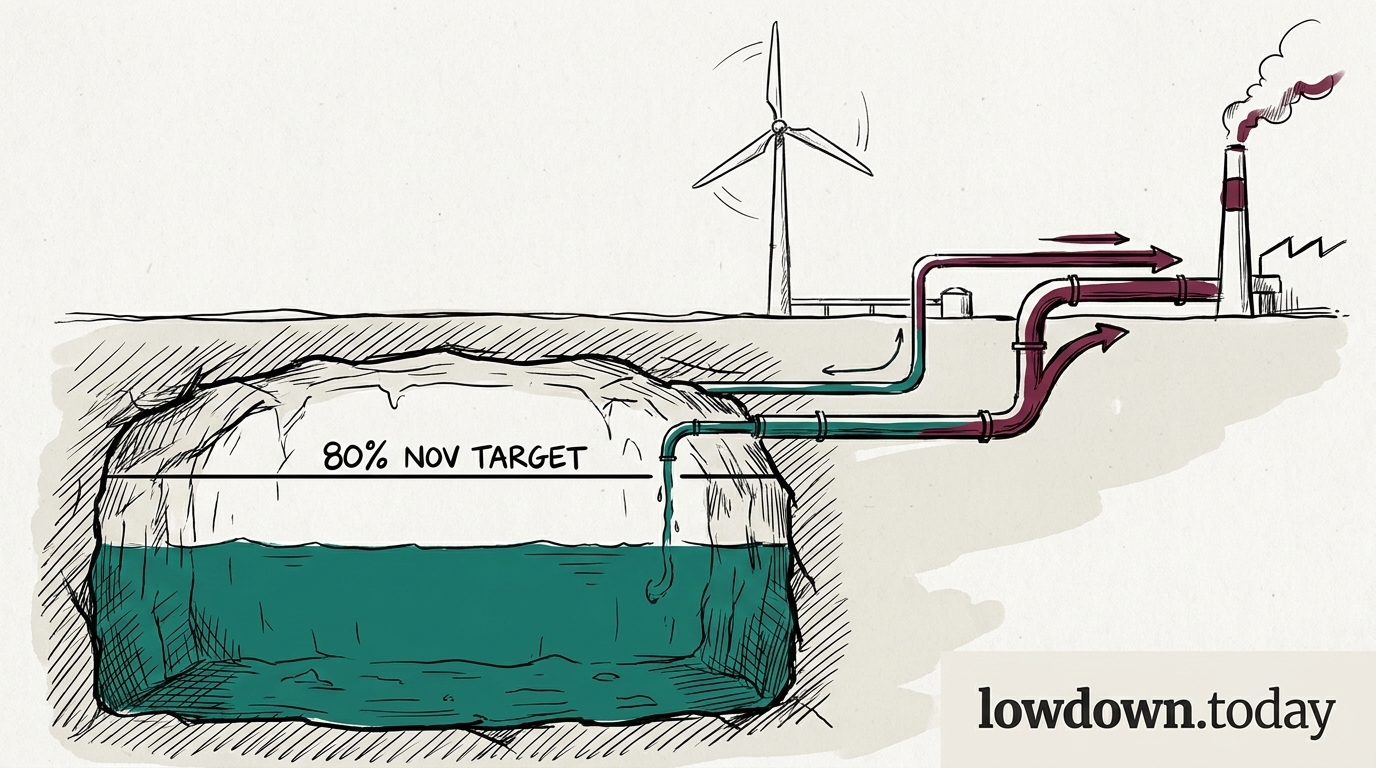
Spain's 9,145 GWh terminal inventory is the largest single stock in the EU LNG network, an option value that can reroute cargoes wherever the winter strip pays best rather than a cavern gas obligation tied to a fixed date. That flexibility matters more as Germany's cavern shortfall pushes more of the winter security question onto import infrastructure.
European Commission
European Commission
Brussels holds the bloc to 90% on a flexible window while Germany, holding roughly a quarter of EU storage capacity, tracks toward missing its own lower 80% figure by 21 points. A national shortfall this size in the anchor market matters more to bloc security than the flexible timetable alone can absorb.
French power exporters and CRE
French day-ahead rose in step with Germany but by less, reopening a EUR 7-17 premium that makes northward export flows commercially attractive again after the EUR 43.09 discount evaporated in days. CRE separately authorised RTE and Enedis to buy flexibility locally, betting the coming winter's binding constraint is grid congestion rather than a shortage of firm capacity.
TTF trading desk
TTF trading desk
A visible national shortfall like Germany's 21-point gap is a directional signal, not noise, for a desk holding the summer-winter spread. TTF's flat EUR 58-60 range through this week's German price swings says the market has not yet chosen to reprice refill risk into the front of the curve.
German cavern and CCGT operators
German caverns kept buying prompt gas at TTF near EUR 58-60 through the inversion; the wind collapse to 2.4 GW then flipped the spark spread to plus EUR 29 and put turbines back in the same queue. Every day turbines win that bid, injection at a third of the 877 GWh/day pace needed falls further behind.
Slovakia
Slovakia
Slovakia says it dropped its hold-out on the 21st sanctions package only after Ursula von der Leyen personally signed written gas-price and supply guarantees. The Council of the European Union's own 17,238-character release on the package names neither Slovakia nor any guarantee, leaving Bratislava's account unconfirmed by the institutional record.



