Skip to content
You can now search across every topic, entity and event.What's new
European Energy Markets
31JUL

Hormuz stand-down has not reopened the strait

2 min read
09:44UTC

Four days on from the 29 June verbal stand-down, IMF PortWatch counts 27 to 43 Hormuz transits a day against a baseline near 84, and QatarEnergy runs at 35% of nameplate.

EconomicDeveloping
Key takeaway

QatarEnergy is running at 35% of nameplate, below its own guidance, with Hormuz transits still a fraction of normal.

Traffic through the Strait of Hormuz is still running at a fraction of normal, four days after the 29 June verbal stand-down between the warring parties. IMF PortWatch, the Fund's vessel-tracking service, counted between 27 and 43 transits a day at the start of July against a pre-crisis baseline near 84. QatarEnergy, Qatar's state energy company, is running at roughly 35% of its 77 MTPA (million tonnes a year) nameplate.

That trails the 50%-within-a-month restart pace QatarEnergy guided when the strait first reopened . The stand-down unlocked a slow, escorted trickle rather than open lanes, which invalidated the OIES clean-reopening base case built on a smooth late-June restart . This is a follow-up on that thread, not a fresh break: the numbers confirm what the round-trip already signalled.

LNG feels the drag directly. The JKM-TTF arbitrage held near parity while two Qatari trains stayed dark , so Europe is not being outbid for the cargoes that do move; there are simply too few of them clearing the corridor. For a spreads desk that reads as a supply constraint sitting upstream of price, which no de-escalation headline resolves on its own.


Deep Analysis

In plain English

Iran said it would stop threatening ships in the Strait of Hormuz, the narrow sea route Qatar's gas tankers must pass through, four days before this report. But shipping through the strait is still far below normal, and Qatar's gas export company is running well below the recovery pace it promised. Firms that insure ships against war risk want several weeks of calm before cutting their rates, which is why shipowners are holding tankers back from Hormuz until that window passes, not because of any fresh threat.

Deep Analysis
Root Causes

Protection and indemnity clubs and hull war-risk underwriters do not lift elevated premiums on a verbal military stand-down alone; industry practice requires a sustained claims-free window, typically four to eight weeks, before rates come back down. Shipowners holding tankers back from Hormuz are pricing that lag, not a fresh threat.

QatarEnergy's own restart guidance assumed insurers would move faster than they have, which is why the current reading sits below the pace it announced at reopening rather than reflecting a change in the security picture itself.

What could happen next?
  • Consequence

    QatarEnergy's restart lagging its own guidance keeps global LNG scarcer for longer, supporting the near-parity JKM-TTF read rather than a return to the pre-crisis arbitrage.

First Reported In

Update #23 · The EU's own regulator says the ban isn't biting

straits.live· 3 Jul 2026
Read original
Different Perspectives
Spain's LNG terminal operators
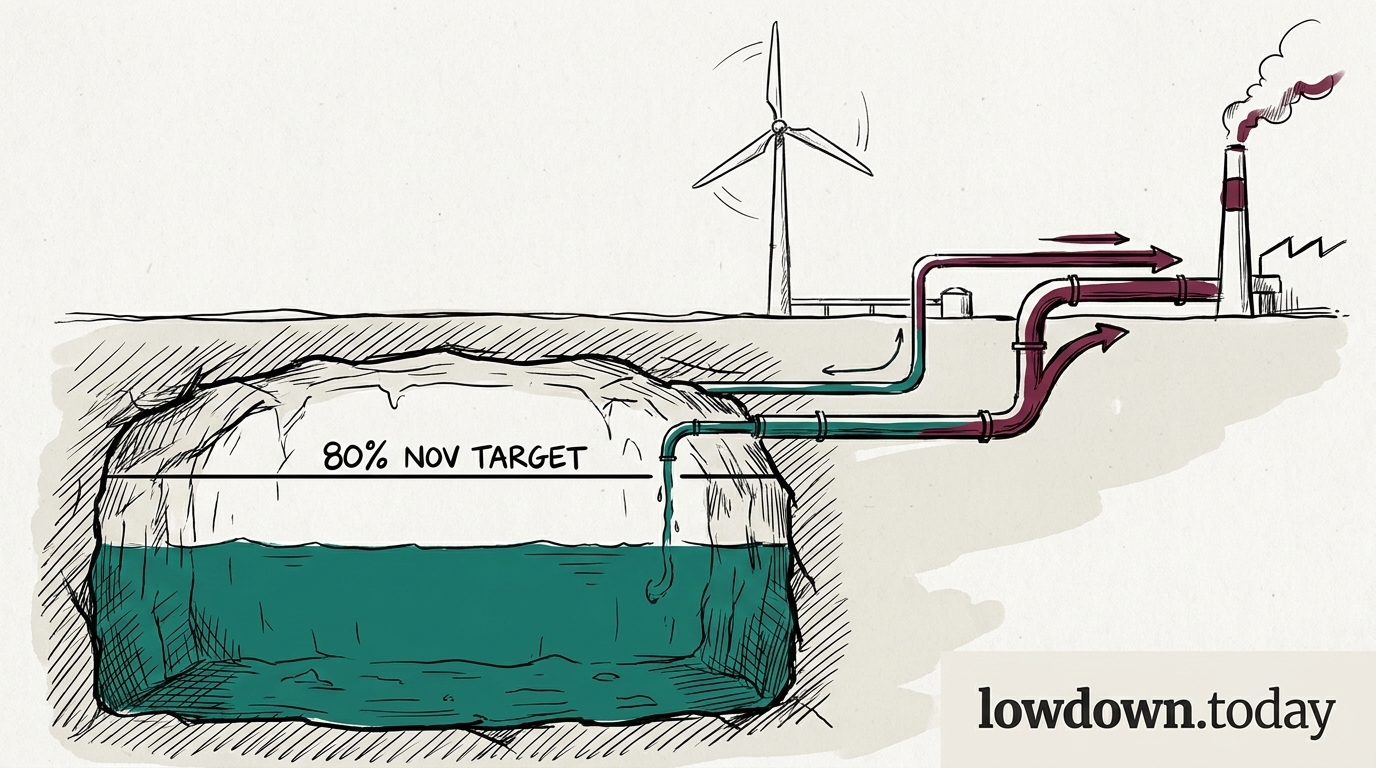
Spain's 9,145 GWh terminal inventory is the largest single stock in the EU LNG network, an option value that can reroute cargoes wherever the winter strip pays best rather than a cavern gas obligation tied to a fixed date. That flexibility matters more as Germany's cavern shortfall pushes more of the winter security question onto import infrastructure.
European Commission
European Commission
Brussels holds the bloc to 90% on a flexible window while Germany, holding roughly a quarter of EU storage capacity, tracks toward missing its own lower 80% figure by 21 points. A national shortfall this size in the anchor market matters more to bloc security than the flexible timetable alone can absorb.
French power exporters and CRE
French day-ahead rose in step with Germany but by less, reopening a EUR 7-17 premium that makes northward export flows commercially attractive again after the EUR 43.09 discount evaporated in days. CRE separately authorised RTE and Enedis to buy flexibility locally, betting the coming winter's binding constraint is grid congestion rather than a shortage of firm capacity.
TTF trading desk
TTF trading desk
A visible national shortfall like Germany's 21-point gap is a directional signal, not noise, for a desk holding the summer-winter spread. TTF's flat EUR 58-60 range through this week's German price swings says the market has not yet chosen to reprice refill risk into the front of the curve.
German cavern and CCGT operators
German caverns kept buying prompt gas at TTF near EUR 58-60 through the inversion; the wind collapse to 2.4 GW then flipped the spark spread to plus EUR 29 and put turbines back in the same queue. Every day turbines win that bid, injection at a third of the 877 GWh/day pace needed falls further behind.
Slovakia
Slovakia
Slovakia says it dropped its hold-out on the 21st sanctions package only after Ursula von der Leyen personally signed written gas-price and supply guarantees. The Council of the European Union's own 17,238-character release on the package names neither Slovakia nor any guarantee, leaving Bratislava's account unconfirmed by the institutional record.



