Skip to content
You can now search across every topic, entity and event.What's new
European Energy Markets
31JUL

China crude imports hit decade low

3 min read
09:44UTC

Kpler logged Chinese seaborne crude at 6.78 million barrels a day in May 2026, the lowest May reading in almost a decade and 3.88 mbd below the 2025 average. The Brent-Dubai EFS compression is a demand hole, not a deflating Hormuz premium.

EconomicDeveloping
Key takeaway

The EFS narrowed because the marginal Eastern buyer vanished, not because Hormuz reopened.

Kpler put Chinese seaborne crude imports at roughly 6.78 million barrels a day in May 2026, against 8.5 mbd in April and a 10.66 mbd 2025 average 1. It is the lowest May print in almost a decade. Onshore crude stocks slipped to about 1,232 million barrels from the 1,251mb early-May peak, and state-refiner margins clawed back to around -$2/bbl from -$60 in mid-April.

That withdrawal is the driver behind the Brent-Dubai EFS (the Exchange of Futures for Swaps that prices Atlantic-basin Brent against Middle Eastern Dubai crude) pulling off its $6-plus peak . Trading desks read the compression as the Hormuz war premium deflating on the 23 May Iran memorandum that took Brent down $14 . The barrels say otherwise: Dubai-linked demand collapsed while Dubai supply held, so the spread narrowed because the marginal Eastern buyer vanished, not because Hormuz reopened.

State-refiner margins at -$2/bbl stay negative, giving Chinese runs no economic pull to restock, and onshore stocks have barely drawn from the peak. A move back toward the 2025 average is a 3.9 mbd swing, north of 200 incremental VLCC (Very Large Crude Carrier) liftings a year on the Middle East-China leg, enough to snap the EFS wider before the freight curve can reprice.

Goldman Sachs argued in a late-May note that demand destruction at $90-100 Brent is keeping China sidelined for longer 2, the counter-case worth tracking. Kpler, a flow-analytics vendor, also has a commercial reason to frame a pause as a coiled spring. Beijing's return is a question of when rather than whether, and the EFS screen at this level is pricing never.


Deep Analysis

In plain English

China is the world's biggest buyer of crude oil by sea, taking roughly one barrel in every four shipped globally. In May 2026 it bought the least it has in almost ten years. The reason is simple: Chinese refineries were barely breaking even on their fuel sales, so they stopped buying new crude and used up what they already had stored. Because China stepped back, the price gap between oil priced in the Atlantic (Brent) and oil priced in the Middle East (Dubai) shrank. Most people assumed that gap shrank because the Gulf war tensions were easing. The physical data says the opposite: China just stopped buying, which removed the demand that normally keeps Middle Eastern prices firm. When China starts buying again, that gap could snap back hard and quickly.

Deep Analysis
Root Causes

The EFS compression mechanism runs through the Brent-Dubai spread and the TD3C freight route. When the marginal Eastern buyer (China, representing roughly 40% of global seaborne crude imports) steps back, Dubai-linked demand falls faster than Dubai supply because Gulf exporters cannot instantly redirect barrels West. The EFS narrows not because Brent falls but because Dubai holds on constrained physical supply while the freight demand that would otherwise pull Dubai barrels East has evaporated.

State-refiner margin economics are the proximate gating mechanism: at -$60/bbl in mid-April, CNPC and Sinopec had no P&L logic to lift spot cargoes. At -$2/bbl the logic is still negative. Historically the restart threshold for Chinese spot buying has been around +$3-5/bbl margin, meaning the market needs another $5-7/bbl of crack recovery before the demand hole fills.

What could happen next?
  • Risk

    Positions short the Brent-Dubai EFS on a deflating-war-premium thesis face asymmetric re-tightening the moment a single Kpler print shows Chinese imports recovering toward 8-9 mbd.

    Short term · Reported
  • Consequence

    TD3C VLCC freight and the ME-China route remain structurally suppressed until Chinese refiner margins recover above roughly +$3-5/bbl, which requires a further $5-7/bbl crack improvement from current -$2/bbl.

    Short term · Reported
  • Opportunity

    Atlantic-basin light-sweet grades staying West tighten the NWE crude supply picture, supporting European refiner margins independently of any Hormuz development.

    Immediate · Reported
First Reported In

Update #4 · EFS compression is a China hole, not Hormuz

Kpler· 1 Jun 2026
Read original
Different Perspectives
Spain's LNG terminal operators
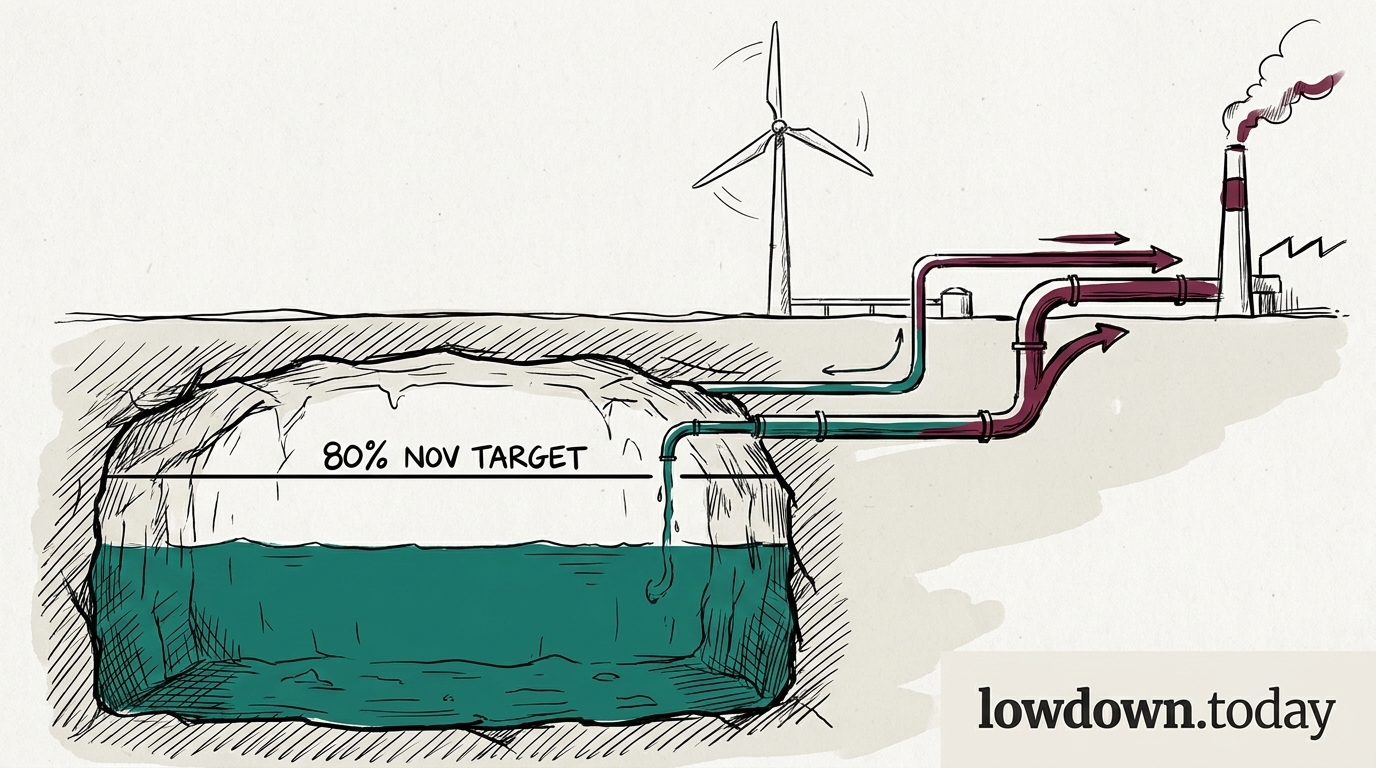
Spain's 9,145 GWh terminal inventory is the largest single stock in the EU LNG network, an option value that can reroute cargoes wherever the winter strip pays best rather than a cavern gas obligation tied to a fixed date. That flexibility matters more as Germany's cavern shortfall pushes more of the winter security question onto import infrastructure.
European Commission
European Commission
Brussels holds the bloc to 90% on a flexible window while Germany, holding roughly a quarter of EU storage capacity, tracks toward missing its own lower 80% figure by 21 points. A national shortfall this size in the anchor market matters more to bloc security than the flexible timetable alone can absorb.
French power exporters and CRE
French day-ahead rose in step with Germany but by less, reopening a EUR 7-17 premium that makes northward export flows commercially attractive again after the EUR 43.09 discount evaporated in days. CRE separately authorised RTE and Enedis to buy flexibility locally, betting the coming winter's binding constraint is grid congestion rather than a shortage of firm capacity.
TTF trading desk
TTF trading desk
A visible national shortfall like Germany's 21-point gap is a directional signal, not noise, for a desk holding the summer-winter spread. TTF's flat EUR 58-60 range through this week's German price swings says the market has not yet chosen to reprice refill risk into the front of the curve.
German cavern and CCGT operators
German caverns kept buying prompt gas at TTF near EUR 58-60 through the inversion; the wind collapse to 2.4 GW then flipped the spark spread to plus EUR 29 and put turbines back in the same queue. Every day turbines win that bid, injection at a third of the 877 GWh/day pace needed falls further behind.
Slovakia
Slovakia
Slovakia says it dropped its hold-out on the 21st sanctions package only after Ursula von der Leyen personally signed written gas-price and supply guarantees. The Council of the European Union's own 17,238-character release on the package names neither Slovakia nor any guarantee, leaving Bratislava's account unconfirmed by the institutional record.



