Skip to content
You can now search across every topic, entity and event.What's new
European Energy Markets
31JUL

Brent touches $119 before falling back

4 min read
09:44UTC

Brent crude has risen 76% in 19 days. Three named energy analysts now model $200 per barrel as a realistic outcome — and Middle Eastern benchmarks have already crossed $150.

EconomicDeveloping
Key takeaway

The settled price of $108 embeds a structural shortage premium, not merely a fear premium.

Brent Crude touched $119 per barrel intraday on 19 March — 76% above the pre-war level of $67.41 — before settling at $108.65 after Netanyahu claimed Israel was working to reopen the strait of Hormuz 1. The $10 intraday swing is a measure of how prices now move on political statements rather than physical supply data. The trajectory has been relentless: $103.14 on 14 March , past $106 on 15 March , $110.90 on 17 March , and now $119 — a 15% climb in five trading days. The IEA's record 400-million-barrel strategic reserve release, announced a week ago, failed to hold prices below $100 for more than a single session .

Three named analysts have placed $200 within their forecast range. Ann-Louise Hittle of Wood Mackenzie forecast $150 "soon" and called $200 "not outside the realms of possibility." Vandana Hari of Vanda Insights said $200 is "already within sight" and noted that Middle Eastern benchmarks — Oman and Dubai crudehave already crossed $150 2. Adi Imsirovic of the Oxford Institute for Energy Studies called $200 "perfectly possible" and a "major handbrake to world economy" 3. Rystad Energy modelled two scenarios: a two-month war yields $110 by April; a four-month war, $135 by June 4. Chatham House assessed last week that Brent could reach $130 if the conflict persists for months . At the current pace, that threshold may arrive weeks before the timeline the institution modelled.

The split between Brent and Middle Eastern benchmarks matters more than the headline number. Brent is priced off North Sea delivery and reflects global expectations. Oman and Dubai crude reflect the physical cost of sourcing oil near a closed strait where daily transits have fallen to single digits against a pre-war average of 138 . The $30-plus gap between regional and international benchmarks means energy importers in Asia — Japan, South Korea, India — face an effective price closer to $150 already. Europe's position is compounded by the gas dimension: EU storage stood below 30% before the latest Qatar LNG damage, and Bloomberg traders expect the Asian LNG benchmark to surpass $26 per million British thermal units by mid-April 5.

The market has now absorbed every intervention — strategic reserve releases, Russian sanctions waivers , Iranian tankers allowed through the strait — and continued to climb. Each measure adds marginal barrels. None reopens Hormuz. Until the strait functions or the war ends, the question for importing economies is not whether prices reach $150 but how quickly.


Deep Analysis

In plain English

When oil prices rise sharply, the cost does not stop at the petrol station. Everything transported, grown, or manufactured using energy becomes more expensive over the following weeks. At $108 per barrel — 76% above pre-war levels — fuel bills, food prices, and airline tickets will remain elevated. The disruption lasts as long as the supply constraint does. The gap between the $119 intraday spike and the $108 settled price shows markets are simultaneously pricing two scenarios: a complete Hormuz lockout and a diplomatic exit that partially restores supply. The settled price reflects what traders believe the minimum structural shortage is actually worth, independent of diplomatic noise.

Deep Analysis
Synthesis

The absence of any IEA emergency reserve announcement — which typically suppresses spikes of this magnitude — signals that member governments are either conserving reserves for a longer conflict or lack confidence that releases would offset structural shortfalls. At $108 settled, petrostates are accumulating surpluses of $30+ per barrel above their fiscal break-even points, generating geopolitical capital that may outlast the conflict itself.

Root Causes

The structural driver is the simultaneous elimination of both primary and secondary export infrastructure: Hormuz closure removes the primary maritime route, Yanbu attacks remove the principal land alternative. Standard supply-shock models were not calibrated for concurrent primary and backup infrastructure loss — this creates genuine pricing uncertainty beyond normal war-premium methodology.

Escalation

The $10+ gap between intraday high and settled price implies markets are pricing roughly a 30–40% probability of near-term Hormuz resolution. If Yanbu — the only remaining Gulf Arab crude export terminal — sustains further damage, the settled price floor rises materially toward $150, because no comparable alternative routing exists for Gulf crude exports.

What could happen next?
2 risk1 consequence1 opportunity1 precedent
  • Risk

    If Yanbu sustains further damage, there is no comparable alternative Gulf crude export route, and the settled price floor rises toward the $150 threshold.

    Short term · Assessed
  • Consequence

    At 76% above pre-war levels, oil prices are already transmitting into food and manufactured goods inflation across energy-import-dependent economies.

    Immediate · Assessed
  • Risk

    Demand destruction in Asia at $130+ could trigger a secondary global slowdown independent of conflict resolution or Hormuz status.

    Medium term · Suggested
  • Opportunity

    Petrostates accumulating $30+ per-barrel surplus revenue above fiscal break-even are building geopolitical capital that will shape post-war reconstruction and alliance dynamics.

    Medium term · Suggested
  • Precedent

    Simultaneous primary and secondary infrastructure destruction has no modern oil market precedent; existing price models were not calibrated for this scenario.

    Immediate · Assessed
First Reported In

Update #42 · Iran hits four countries; Brent at $119

CNBC· 20 Mar 2026
Read original
Causes and effects
This Event
Brent touches $119 before falling back
The steepest sustained oil price rally since 2008 is accelerating beyond institutional forecasts. Middle Eastern crude benchmarks — reflecting physical proximity to the Hormuz disruption — have already crossed $150, a threshold associated with global recessionary pressure. The $30-plus gap between regional and international benchmarks reveals a two-tier market that penalises energy-importing economies in Asia and Europe most acutely.
Different Perspectives
Spain's LNG terminal operators
Spain's 9,145 GWh terminal inventory is the largest single stock in the EU LNG network, an option value that can reroute cargoes wherever the winter strip pays best rather than a cavern gas obligation tied to a fixed date. That flexibility matters more as Germany's cavern shortfall pushes more of the winter security question onto import infrastructure.
European Commission
European Commission
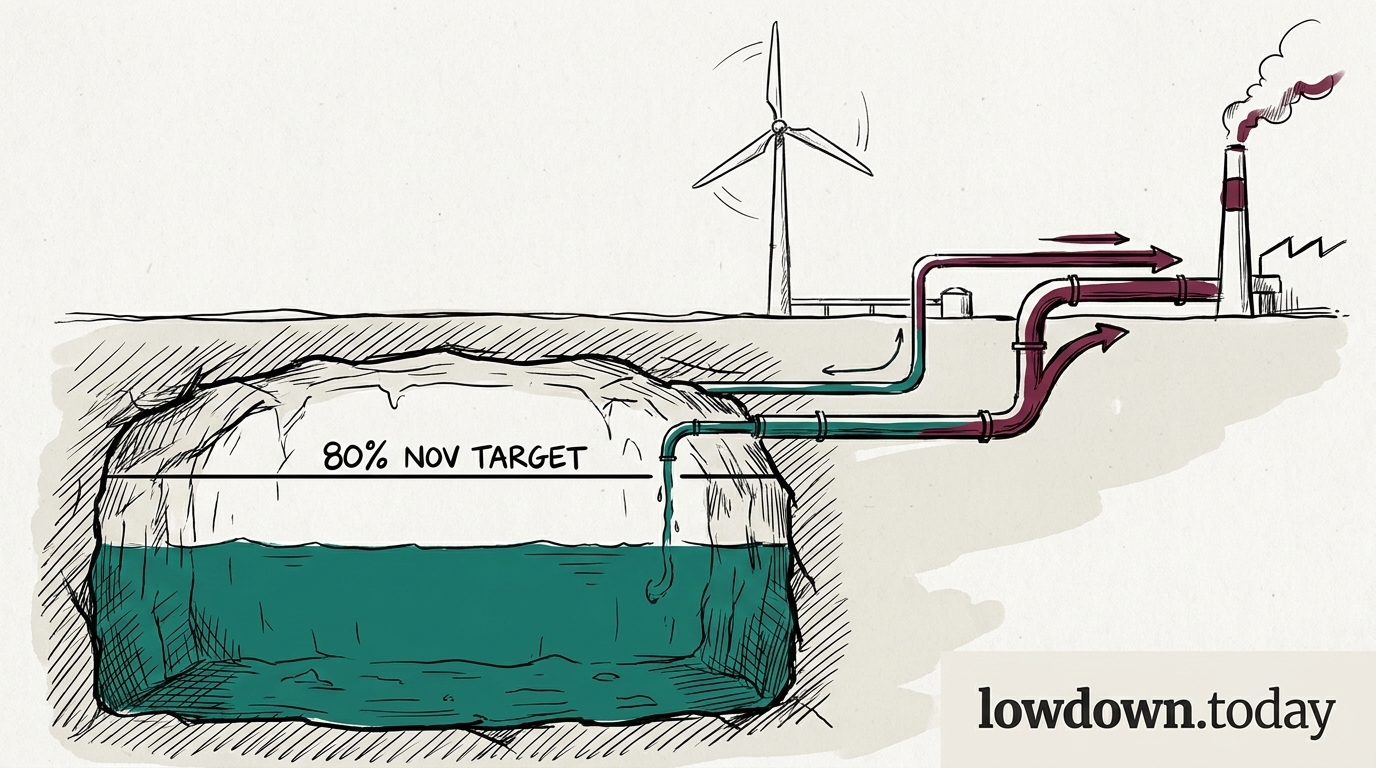
Brussels holds the bloc to 90% on a flexible window while Germany, holding roughly a quarter of EU storage capacity, tracks toward missing its own lower 80% figure by 21 points. A national shortfall this size in the anchor market matters more to bloc security than the flexible timetable alone can absorb.
French power exporters and CRE
French day-ahead rose in step with Germany but by less, reopening a EUR 7-17 premium that makes northward export flows commercially attractive again after the EUR 43.09 discount evaporated in days. CRE separately authorised RTE and Enedis to buy flexibility locally, betting the coming winter's binding constraint is grid congestion rather than a shortage of firm capacity.
TTF trading desk
TTF trading desk
A visible national shortfall like Germany's 21-point gap is a directional signal, not noise, for a desk holding the summer-winter spread. TTF's flat EUR 58-60 range through this week's German price swings says the market has not yet chosen to reprice refill risk into the front of the curve.
German cavern and CCGT operators
German caverns kept buying prompt gas at TTF near EUR 58-60 through the inversion; the wind collapse to 2.4 GW then flipped the spark spread to plus EUR 29 and put turbines back in the same queue. Every day turbines win that bid, injection at a third of the 877 GWh/day pace needed falls further behind.
Slovakia
Slovakia
Slovakia says it dropped its hold-out on the 21st sanctions package only after Ursula von der Leyen personally signed written gas-price and supply guarantees. The Council of the European Union's own 17,238-character release on the package names neither Slovakia nor any guarantee, leaving Bratislava's account unconfirmed by the institutional record.



