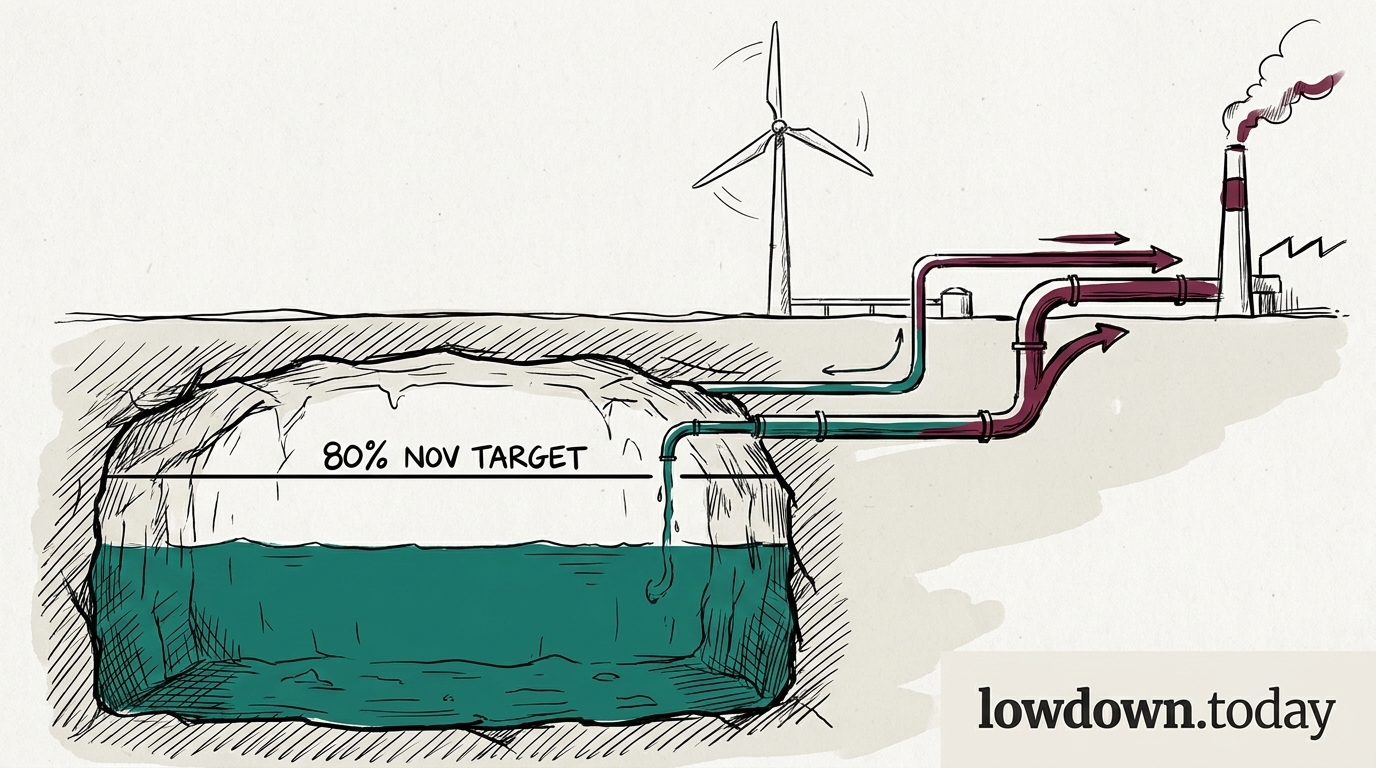
German gas storage stood at 46.54% full on the 29 July gas day, filling at an eight-day mean rate of 313.7 GWh/day 1. Ninety-four days separate that reading from 1 November. German working capacity of 246.5 TWh makes one percentage point worth 2,465 GWh. Carry the observed pace forward unchanged and the caverns reach 58.5% on 1 November.
Getting to 80% instead requires 877 GWh/day on every one of those 94 days. That is 2.8 times the current rate, and 62% above the strongest single gas day of the restart window. The arithmetic is the desk's own, worked from published AGSI+ inputs rather than taken from a market forecast, so a reader can reproduce it.
The 80% is Germany's own number and it binds. The Gasspeicherfüllstandsverordnung (GasSpFüllstV), the gas storage filling level ordinance approved by cabinet on 30 April 2025, in force from 5 May 2025 and running to 31 March 2027, requires most German storage facilities to hold 80% on 1 November. Berlin wrote that itself, and wrote it downward: the ordinance cut the country's own requirement from 90%. The caverns are on a pace to miss a bar Germany had already lowered for them, which is a different proposition from missing an obligation imposed from Brussels.
Two qualifications belong on the 21 points. The same ordinance sets a reduced 45% requirement for six named pore-storage sites (Bad Lauchstädt, Frankenthal, Hähnlein, Rehden, Stockstadt and Uelsen), with four Bavarian facilities (Bierwang, Breitbrunn, Inzenham-West and Wolfersberg) exempted from the reduction. The 46.54% is a national aggregate while the duty falls per facility, so the aggregate national requirement sits somewhat below 80% and 21 points is an upper bound rather than an exact gap. The EU instrument above it moved the other way: Regulation (EU) 2025/1733, adopted 18 July 2025 and in force from 11 September 2025, holds the bloc target at 90% but replaced the fixed 1 November deadline with a 1 October to 1 December window, downgraded the intermediate trajectory from binding to indicative, and opened deviation tiers reaching a 70% floor. Brussels loosened. Berlin's number did not move.
The counter deserves stating. Ninety-four days is a long runway, injection is not linear, and an eight-day mean is a thin base for a November projection. Germany imports through interconnectors all winter, so a sub-80% cavern position is not by itself a shortage. But linear extrapolation flatters this trajectory rather than damning it, because injection rates normally decay into autumn as temperatures fall and heating load returns. Nor is the gap new: the one genuine burst of European injection this summer, 3,721 GWh/day across the EU on 27 June , came and went before the German pace settled where it now sits.





