Skip to content
You can now search across every topic, entity and event.What's new
European Energy Markets
31JUL

Oxford puts EU gas at 67% on 1 November

3 min read
09:44UTC

Jack Sharples and Ricky Hill told a 27 July presentation that EU-27 stocks reach 72 bcm on 1 November if injections match 2024, the lowest first-of-November level since 2012.

EconomicAssessed
Key takeaway

OIES and Centrica see EU stocks at their lowest 1 November level since 2012.

Jack Sharples of the Oxford Institute for Energy Studies and Ricky Hill of Centrica presented "European Storage Refill in Summer 2026" on Monday 27 July, putting EU-27 stocks at 72 bcm, or 67% full, on 1 November if injections from 22 July match the same period in 2024 1. That would be the lowest 1 November level since 2012.

OIES is the Oxford-based energy research institute whose storage work is widely used as a reference case by European gas traders; Centrica owns Rough, Britain's largest storage facility, and buys into the same continental market. Their inputs are stated: EU-27 stocks stood at 52 bcm on 1 July, 10.6 bcm below the same date last year, and net injections over 1 to 22 July already ran 1.4 bcm behind 2025 2.

What gives the projection its weight is where it sits against their own earlier work. The OIES base case of 74.3 bcm was invalidated in June by the Strait of Hormuz round-trip , and 72 bcm sits below even that already-downgraded scenario. A modelling house revising downward twice in six weeks is describing a summer that is not recovering.

EU aggregate fill did rise, reaching 56.39% on the 30 July gas day against 54.41% on 21 July 3. The bloc is building, at a rate that finishes the summer below every 1 November level of the past thirteen years, which is the point on which the Oxford projection and this desk's German arithmetic, drawn from separate datasets by separate methods, agree.


Deep Analysis

In plain English

Two energy researchers, one from Oxford University's energy institute and one from British Gas owner Centrica, published a forecast on 27 July for how full Europe's gas storage will be by 1 November. Their number, 72 billion cubic metres or 67% full, would be the lowest level for that date since 2012, calculated simply by assuming this year's remaining injection matches last year's pace from a lower starting point.

Deep Analysis
Root Causes

The 72 bcm figure is not a prediction that the market will underperform; it is what happens if 2026 injection from 22 July onward tracks 2024's pace exactly, applied to a base that starts 10.6 bcm lower. The root cause of the low projection is therefore the starting deficit, not any assumed deterioration in injection behaviour between now and November.

That starting deficit itself traces to the earlier 26-29 June round trip through the Strait of Hormuz, which invalidated OIES's own June base case of 74.3 bcm; the new 72 bcm figure sits below even that already-revised scenario, meaning two consecutive downgrades in as many months.

What could happen next?
  • Risk

    If actual injection tracks the OIES and Centrica base case rather than a stronger LNG-diversion outcome, EU storage would enter winter at its lowest 1 November level since 2012.

  • Opportunity

    A widening winter strip strong enough to pull LNG cargoes away from Asian buyers could push the actual outcome above the 72 bcm base case, as happened with 2023's post-2022 refill.

First Reported In

Update #31 · Caverns restart, 21 points short of November

Oxford Institute for Energy Studies and Centrica· 31 Jul 2026
Read original
Causes and effects
This Event
Oxford puts EU gas at 67% on 1 November
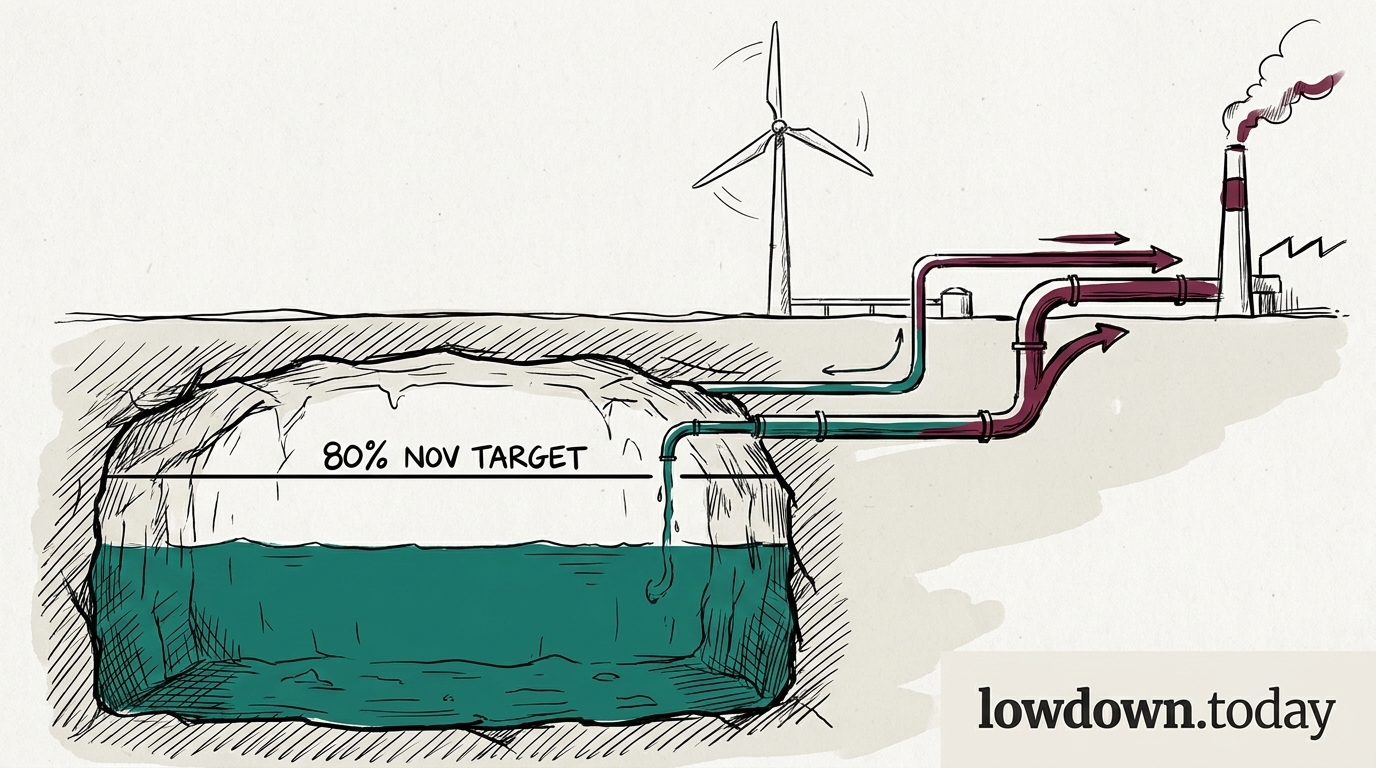
A bloc-wide projection and a German national calculation reach the same verdict from entirely different data.
Different Perspectives
Spain's LNG terminal operators
Spain's 9,145 GWh terminal inventory is the largest single stock in the EU LNG network, an option value that can reroute cargoes wherever the winter strip pays best rather than a cavern gas obligation tied to a fixed date. That flexibility matters more as Germany's cavern shortfall pushes more of the winter security question onto import infrastructure.
European Commission
European Commission
Brussels holds the bloc to 90% on a flexible window while Germany, holding roughly a quarter of EU storage capacity, tracks toward missing its own lower 80% figure by 21 points. A national shortfall this size in the anchor market matters more to bloc security than the flexible timetable alone can absorb.
French power exporters and CRE
French day-ahead rose in step with Germany but by less, reopening a EUR 7-17 premium that makes northward export flows commercially attractive again after the EUR 43.09 discount evaporated in days. CRE separately authorised RTE and Enedis to buy flexibility locally, betting the coming winter's binding constraint is grid congestion rather than a shortage of firm capacity.
TTF trading desk
TTF trading desk
A visible national shortfall like Germany's 21-point gap is a directional signal, not noise, for a desk holding the summer-winter spread. TTF's flat EUR 58-60 range through this week's German price swings says the market has not yet chosen to reprice refill risk into the front of the curve.
German cavern and CCGT operators
German caverns kept buying prompt gas at TTF near EUR 58-60 through the inversion; the wind collapse to 2.4 GW then flipped the spark spread to plus EUR 29 and put turbines back in the same queue. Every day turbines win that bid, injection at a third of the 877 GWh/day pace needed falls further behind.
Slovakia
Slovakia
Slovakia says it dropped its hold-out on the 21st sanctions package only after Ursula von der Leyen personally signed written gas-price and supply guarantees. The Council of the European Union's own 17,238-character release on the package names neither Slovakia nor any guarantee, leaving Bratislava's account unconfirmed by the institutional record.



