Skip to content
You can now search across every topic, entity and event.What's new
European Energy Markets
16JUL

Project Freedom moves TTF only 1.48%

4 min read
09:48UTC

Trump announced a 15,000-personnel Hormuz shipping escort on 3-4 May. TTF moved from EUR 45.77/MWh on Friday 1 May to EUR 46.44/MWh on Monday 4 May, a 1.48% session gain.

EconomicDeveloping
Key takeaway

Trump's 15,000-personnel Hormuz escort moved TTF only 1.48%; markets price the operation as risk, not supply unlock.

Donald Trump announced Project Freedom on Sunday 3 to Monday 4 May, a US military escort for stranded shipping through the Strait of Hormuz backed by 15,000 personnel, more than 100 aircraft, warships, and drones 1. Iran's Abdollahi warned that any US forces approaching the strait "will be attacked". Fars claimed two missiles were fired at a US warship, denied by the US side. The UK MTCO (Marine Transit Coordination Office) classified the Hormuz threat level as critical on Monday 4 May. The iran-conflict-2026 desk owns the operation itself ; the European angle sits in the TTF price response.

TTF moved from EUR 45.77/MWh on Friday 1 May to EUR 46.44/MWh on Monday 4 May, a +1.48% session gain on the announcement day. That is not the move a real supply unlock would produce. A credible US escort actually resuming Hormuz LNG transits would normally compress TTF by EUR 5 to 8/MWh on the news; the muted print indicates traders read the operation as a risk event and not a route by which European cargoes return.

The Mubaraz transit on 27 April , the first loaded LNG run through Hormuz since the war began, headed to Asia, not Europe. That precedent now anchors the read on Project Freedom: even with US escort credibility added to the route, the cargoes that move first move east. Iran's 18 April re-closure and the IRGC seizures of Epaminondas and MSC Francesca on 22 April established the risk premium the market now prices durably, and Project Freedom does not displace that premium.


Deep Analysis

In plain English

The Strait of Hormuz is a narrow waterway between Iran and Oman through which roughly a fifth of the world's oil and a large share of its liquefied natural gas travels. Iran has been restricting shipping there since March 2026 as part of a wider conflict. On 3 and 4 May, US President Donald Trump announced a military escort programme called Project Freedom, sending warships and aircraft to protect cargo vessels trying to pass through. European gas prices rose only slightly on the news. Traders concluded that even if the escort works and ships start moving again, the first cargoes of gas will likely go to Asia, where buyers are paying more, not to Europe.

What could happen next?
  • Risk

    If Project Freedom triggers a direct US-Iran naval confrontation, TTF would spike well above the EUR 46/MWh current level as Hormuz LNG transit closes entirely rather than partially; the market's +1.48% move suggests traders have not priced this tail.

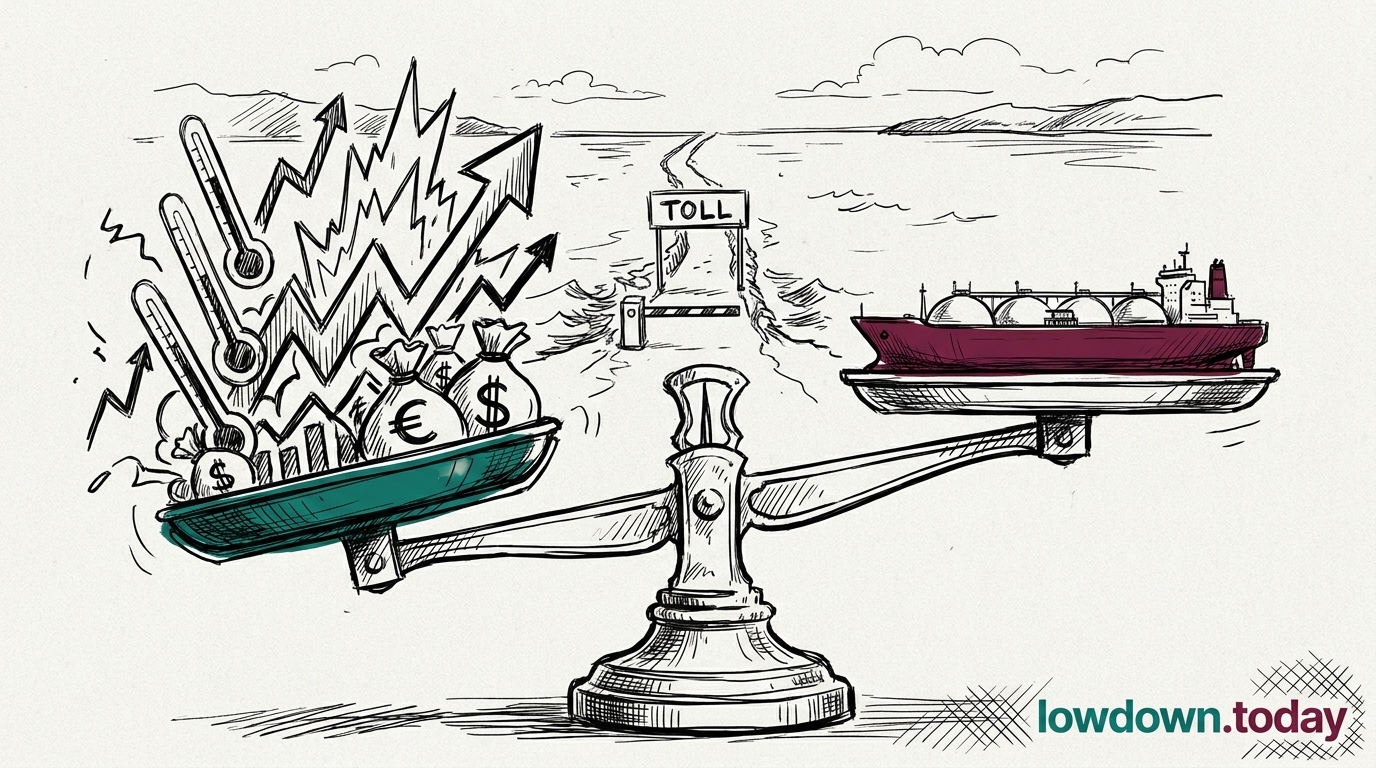
    Immediate · 0.6
  • Consequence

    Even if Project Freedom successfully escorts LNG carriers, the JKM-TTF arbitrage routes first movers to Asia; European supply relief may lag a Hormuz reopening by four to six weeks.

    Short term · 0.72
  • Precedent

    The 1987 Earnest Will precedent suggests sustained US naval presence eventually deters Iran from direct attacks on escorted vessels, but requires Iran to absorb one or two confrontations first; that escalation window is when European gas prices face the most upside risk.

    Short term · 0.65
First Reported In

Update #7 · Storage pace 0.21 vs 0.257; floor not yet met

Trading Economics / ICE· 4 May 2026
Read original
Different Perspectives
LNG spreads desk
LNG spreads desk
The JKM-TTF arb flipped to a TTF premium of roughly USD 0.6/MMBtu on 15 July, the first time this cycle Europe has outbid Asia, yet no Atlantic cargo has rerouted west. Until a cargo actually moves, the desk reads the Hormuz premium as unconfirmed and the EUR 55 print as vulnerable to a fast reversal.
United States
United States
Washington reimposed a blockade on Iranian ports and a 20% Strait of Hormuz cargo toll on 13 July, driving TTF's 9% two-session rally to EUR 54.995/MWh. The posture is again setting Europe's gas benchmark by sentiment rather than by any confirmed change in cargo flows.
EDF
EDF
EDF slipped the Bugey 3, Golfech 2 and Chooz 2 restarts to 19, 22 and 25 July, pushing all three past the 20 July Bugey heat exemption, after river-cooling limits on the Rhone, Garonne and Meuse forced the cuts. The same thermal ceiling has capped the fleet in every major heatwave since 2003, and this cycle is no exception.
German power desk
German power desk
German day-ahead power climbed from EUR 126 to EUR 156/MWh over 14-16 July as the heat dome held, flipping the clean spark spread positive for the first time since 14 July. Gas-for-power demand is now back in competition with mandate storage injection right as the injection margin itself is thinning.
EU carbon and storage regulators
EUA carbon broke EUR 81/tonne on 13 July as the ETS Market Stability Reserve's scheduled withdrawals met fresh fuel-switching demand from France's nuclear curtailment. Brussels' mandatory storage-fill rule kept German and French injection running regardless of the TTF swings, the mechanism working as designed four years after the 2022 shock.
Equinor
Equinor
Equinor returned its Asgard field from maintenance on 11 July, lifting Gassco's exit nominations to 319.8 mcm/day just as TTF round-tripped on Hormuz risk. The restart gave Norway spare pipeline capacity to help Europe absorb the gas rally without drawing down storage, reinforcing its role as the post-2022 swing supplier.
