Skip to content
You can now search across every topic, entity and event.What's new
European Energy Markets
15JUN

TTF breaks its floor into the import ban

4 min read
12:23UTC

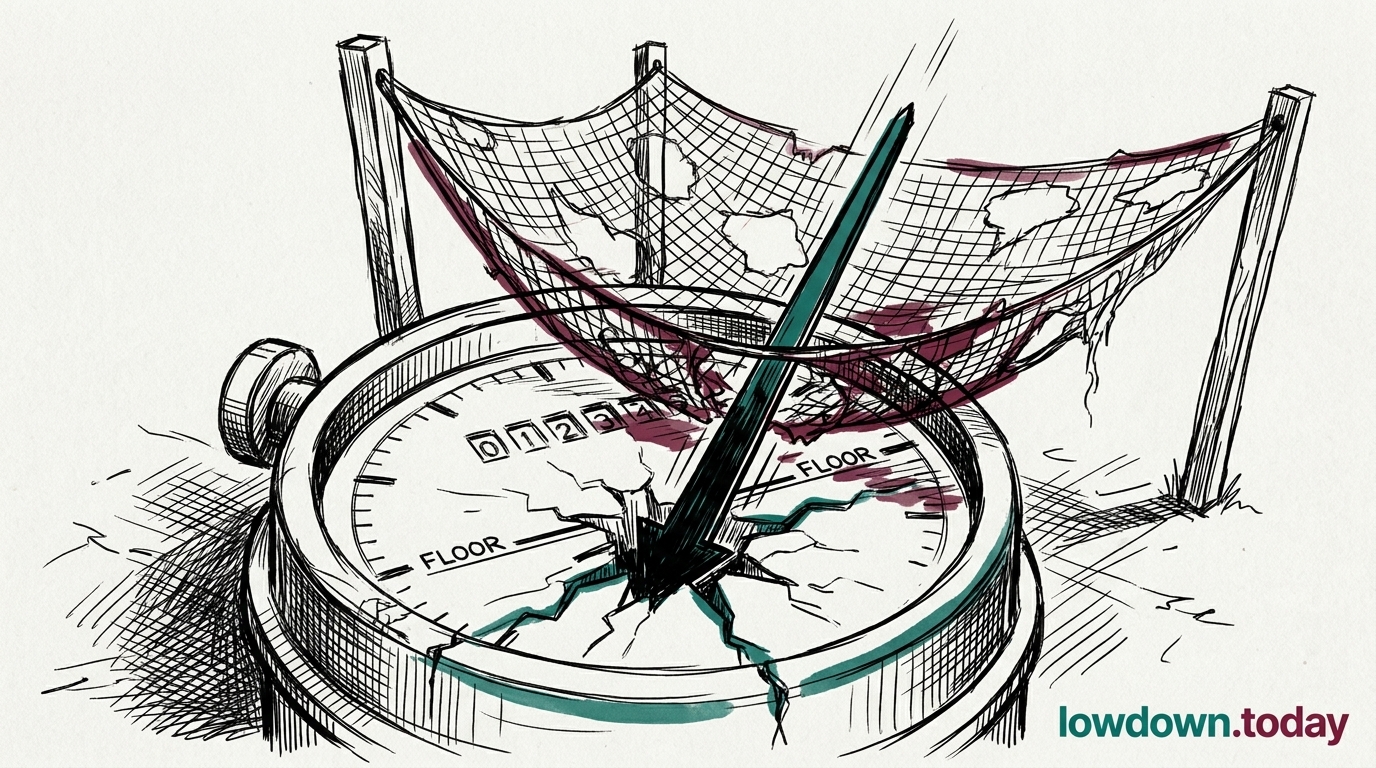
TTF front-month settled near EUR 43.8/MWh on Monday 15 June, down roughly 12% in four days and clean through its EUR 46-47 floor, two days before the pipeline-import ban binds.

EconomicDeveloping

TTF front-month settled at approximately EUR 43.8/MWh on Monday 15 June, down from EUR 49.69 on Thursday 11 June, a fall of roughly 12% over four calendar days that took the Dutch benchmark through its EUR 46-47 floor 1. TTF is the Title Transfer Facility, the Dutch virtual hub that sets Europe's reference wholesale gas price. The break came two days before the EU's pipeline-import ban binds on Wednesday 17 June, and it ran the wrong way for a supply squeeze: the prompt sold off into the deadline rather than bidding a premium ahead of it.

TTF had closed at EUR 50.83 on 8 June , its first settlement above EUR 50 since the 26 May fade, on re-priced Iran risk. The reversal since unwinds that bid and then some. EUR 50 had held as a diplomatic ceiling through May; the EUR 46-47 band had held as a floor across roughly 38 sessions until the 2 June range break to EUR 48.9 . Both levels are now gone, and the prompt sits where it last traded in early May.

The move matters because the consensus going into this week was that the deadline would bid the prompt, not break it. A benchmark falling 12% into the binding date is the market separating the regulation's headline from its enforceable reach. For a winter-Cal-26-long against summer-short desk, the strip inversion that FNB Gas called a broken refill mechanism still pays here, because the front fell faster than the back. The pre-ban sell-off is the clearest signal yet that the squeeze on European gas is not coming from the pipeline supply the regulation targets.


Deep Analysis

In plain English

TTF is the price tag on wholesale natural gas in Europe, set daily at a virtual trading hub in the Netherlands. When it falls, that is good news for heating bills in theory, but the context here is not a supply surplus. The price dropped 12% in four days, settling at EUR 43.8/MWh on 15 June, just as a new EU rule banning certain Russian gas imports was about to take effect on 17 June. Normally, you would expect the price to rise before a supply disruption, not fall. The reason it fell is that European gas power stations, which burn gas to make electricity, have been operating at a loss for weeks. They have simply stopped buying gas, which created a demand vacuum that pushed the price down. The practical paradox: Europe has a gas storage deficit heading into next winter, but the price signal that would normally encourage storage companies to buy and store gas is pointing the wrong way. The price is too low to justify injection, yet not low enough to be certain it stays low.

Deep Analysis
Root Causes

At a clean spark spread of approximately -EUR 44/MWh, every CCGT in Germany runs structurally off-merit, removing the single largest day-to-day marginal gas demand source in the EU. Germany holds roughly 24% of EU gas storage capacity, meaning German injection economics matter disproportionately to the aggregate EU balance.

Germany abolished its gas storage levy on 1 January 2026, removing the administrative mechanism that had previously incentivised injection even when commercial economics were negative. Without a levy-funded injection floor, German operators face a pure commercial decision at TTF EUR 43.8, and that decision is currently non-injection across the entire CCGT fleet.

TTF priced a geopolitical risk premium of approximately EUR 6-7/MWh through late May and early June on Gulf supply uncertainty. That premium dissolved in four sessions as EU demand-side weakness overrode the supply risk bid, leaving the market to discover the underlying physical clearing level without diplomatic support.

What could happen next?
  • Consequence

    German CCGT shut-in removes approximately 800-1,200 mcm/month of gas-for-power demand at the peak injection window, widening the EU storage deficit beyond what the current 43.91% fill implies.

    Short term · Assessed
  • Risk

    If the EUR 43.8 TTF level persists through July, EU aggregate storage targets the 65-67% November landing rather than the 80% mandatory floor, heightening Q4 2026 supply security risk.

    Medium term · Suggested
  • Opportunity

    Industrial gas consumers and flexible LNG importers can lock forward volumes at below-floor TTF levels while the demand-destruction pricing regime persists.

    Immediate · Assessed
First Reported In

Update #18 · TTF breaks the floor into the import ban

Investing.com / ICE· 15 Jun 2026
Read original
Different Perspectives
Equinor
Equinor
Equinor stacked a 13-16 June planned maintenance window on Hammerfest LNG directly atop the unresolved compressor fault running since 22 April, creating two simultaneous live stoppages at 4.3 mtpa capacity for the first time. The 10 July return target carries overrun risk: the same compressor class slipped 24 days in the 2025 maintenance cycle.
EDF and French nuclear-anchored power buyers
EDF's fleet repriced French July contracts roughly 10% in two days on cooling-water curtailment risk, flipping the FR-DE spread to France EUR 1.6 above Germany after a EUR 96.20 record in the other direction a week earlier. Industrial buyers long France against short Germany face EUR 97.7/MWh of spread swing in seven calendar days.
Hungary and Slovakia supply-security ministries
Hungary's Tisza government has reframed Russian gas dependency as a systemic risk, removing Budapest as a co-plaintiff in the CJEU challenge; MVM's 3.5 bcm long-term TurkStream contract remains exempt to September 2027, so Budapest's near-term supply is intact. Slovakia under Fico presses its QMV challenge alone and faces a 3-4 bcm/year short-term supply gap with no contracted LNG alternative.
LNG spot traders and cargo routers
At JKM-TTF of USD 5.26/MMBtu, every uncommitted Atlantic cargo loading in late June routes east; the arb sits roughly twice the OIES-assessed diversion threshold of USD 2.50-3.00/MMBtu after freight. European storage terminals are the losing bid in the cargo auction until TTF recovers or JKM eases.
European Commission / ACER
The Commission structured Regulation 2026/261 as a QMV trade measure to resist Article 194 unanimity challenges; the six-origin prior-authorisation waiver acknowledges that LNG capacity cannot substitute pipeline gas within the legislative window. ACER's cross-border enforcement powers activate in H2 2026, but jurisdiction over the Kipi entry point is legally contested.
German CCGT capacity planners
Capacity planners at Uniper and RWE face the StromVKG Wirtschaftsausschuss scrutiny as the decisive near-term fork: if the Greens' hydrogen-conversion amendment passes, the September 2026 auction becomes unbiddable on technology risk grounds and the capacity-payment fix delays into winter. Plants that have run at -EUR 44 spark spread for weeks cannot commercially sustain extended shut-in.



