Skip to content
Briefings are running a touch slower this week while we rebuild the foundations.See roadmap
Drones: Industry & Defence
7JUN

Spring mud cuts engagements to 106

3 min read
11:27UTC

Combat engagements fell to 106 from 145 in two days — mud season, not restraint — as Russia presses three axes toward Kramatorsk and Sloviansk.

TechnologyDeveloping
Key takeaway

Spring thaw creates a reconstitution window; summer operations will reveal which side used it better.

106 combat engagements along the front line on 4 March, down from 145 on 2 March 1. The drop coincides with rasputitsa — the seasonal thaw that turns Ukraine's black earth into vehicle-swallowing mud. The pattern is consistent with reduced mechanised mobility, not reduced intent: infantry-led assaults continued across all active sectors.

The heaviest pressure fell on three axes. At Pokrovsk, which fell to Russian forces in December 2025 , attacks targeted Ukrainian positions west of Krasnoarmeysk — the next step in exploiting the city as a forward logistics platform. At Kostiantynivka, nine separate Russian assault actions hit Pleshchiivka, Sofiivka, and the approaches to Illinivka. These settlements sit on the routes to Kramatorsk and Sloviansk, the twin cities anchoring Ukraine's eastern defence; their encirclement has been Russia's stated operational objective for over a year. At Huliaipole, Russian forces pressed the Zaporizhzhia axis — the same sector where Commander-in-Chief Syrskyi reported Ukrainian forces recaptured 300–400 square kilometres during February .

Rasputitsa has constrained operations in this theatre for centuries; what changes is how armies compensate. The 8,828 Russian kamikaze drones launched in a single 24-hour period days earlier — roughly triple the 2025 daily average — suggest Moscow is substituting aerial volume for ground mobility. Drones are unaffected by mud, cheaper per sortie than artillery, and impose constant attrition on Ukrainian positions regardless of whether Russian armour can move. The operational tempo on 4 March was lower. The war of attrition was not.

Deep Analysis

In plain English

The 106 clashes on 4 March is down from 145 two days earlier — but this does not mean the war is cooling. Ukraine's terrain turns to deep mud in spring, making it physically impossible to move tanks and armoured vehicles cross-country. Both sides are still fighting; they simply cannot mass forces for large-scale pushes. The hardest fighting is concentrated on three fronts: near Pokrovsk (which Russia captured in December), near Kostiantynivka in central Donetsk, and at Huliaipole in the south. The Kostiantynivka axis is the most strategically consequential — Russian advances there would place direct pressure on Kramatorsk and Sloviansk, Ukraine's main administrative and logistics hub for the entire Donetsk front. Losing that urban complex would be more operationally damaging than Pokrovsk's fall.

Deep Analysis
Synthesis

Simultaneous Russian pressure on three geographically dispersed axes — Pokrovsk, Kostiantynivka, Huliaipole — reflects a classical economy-of-force attritional design rather than opportunistic advance. Maintaining pressure across all three vectors forces Ukraine to distribute reserves, preventing defensive concentration on any single threatened point. The operational goal is reserve depletion and positional degradation, not rapid breakthrough — consistent with Russian doctrinal preference for attrition over manoeuvre at this phase of the conflict.

Escalation

The engagement reduction is mechanistic, not political. Russian intent on all three axes is unchanged. The Kostiantynivka axis carries the highest strategic consequence: capture would position Russian forces for direct pressure on Kramatorsk-Sloviansk, Ukraine's primary Donetsk administrative and logistics hub. Loss of that complex would be operationally more severe than Pokrovsk's fall in December.

What could happen next?
  • Consequence

    Reduced spring engagement tempo creates a narrow reconstitution window for both sides before ground hardens and summer operational tempo resumes.

    Immediate · Assessed
  • Risk

    Russian success on the Kostiantynivka axis would bring direct pressure on Kramatorsk-Sloviansk, Ukraine's primary Donetsk logistics and administrative hub — operationally more consequential than Pokrovsk.

    Short term · Assessed
  • Meaning

    Three-axis simultaneous pressure indicates Russian force generation capacity remains sufficient for multi-vector attritional operations despite cumulative losses since 2022.

    Medium term · Assessed
First Reported In

Update #2 · Shadow fleet tanker sunk, talks seek venue

Russia Matters· 5 Mar 2026
Read original
Causes and effects
This Event
Spring mud cuts engagements to 106
Russia's offensive tempo toward Kramatorsk and Sloviansk continues across three axes despite seasonal constraints that have historically halted mechanised operations. The shift to infantry-led assault and intensified drone use suggests operational adaptation, not pause.
Different Perspectives
Denmark (host nation)
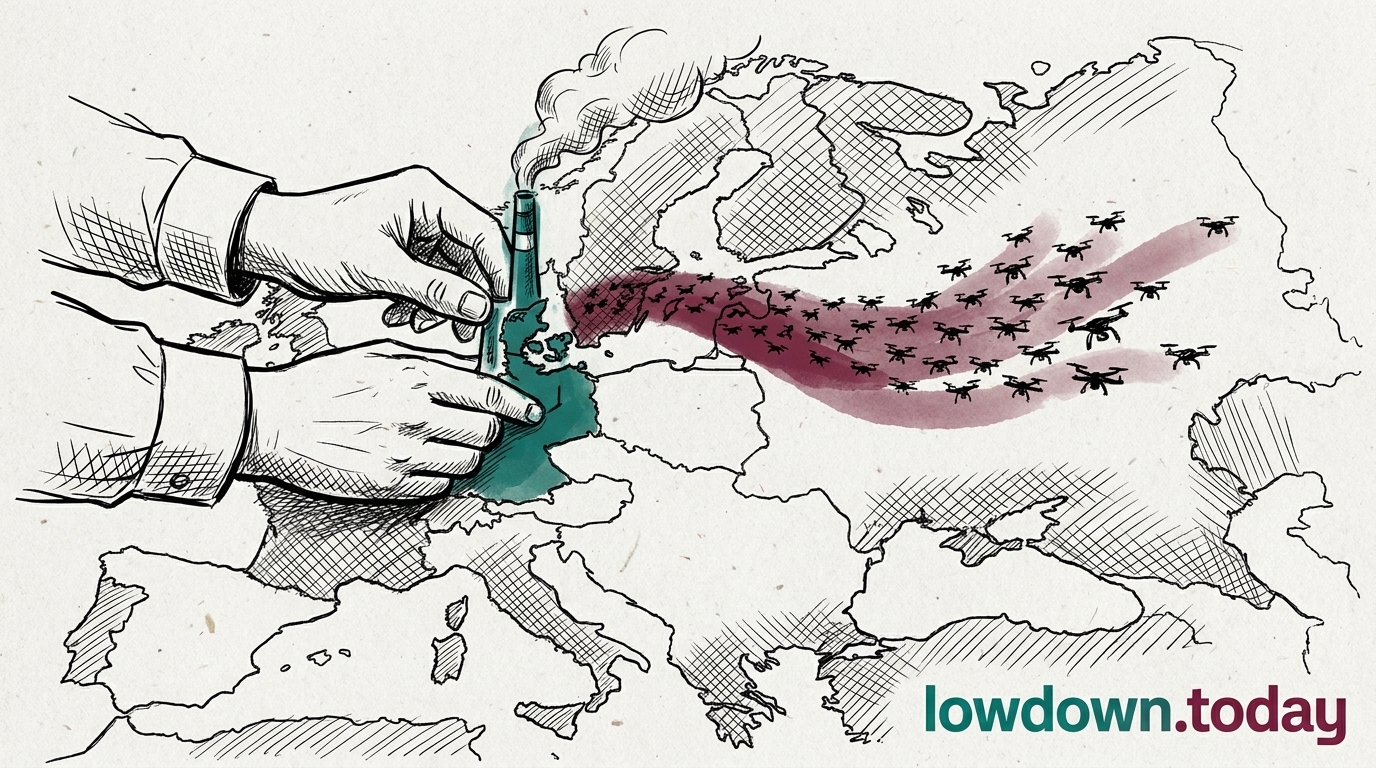
Denmark accepted Fire Point's Skrydstrup plant after committing to bilateral defence co-production at the B9 Nordic summit in May; the facility sits beside a Danish F-35 base, sharing security perimeters. NATO has published no legal guidance on whether hosting Ukrainian weapons production converts Denmark into a co-belligerent, leaving the host-state obligation unresolved.
Russian Ministry of Defence
Russia's 117% YoY drone-output rise in April, accelerating from a 68% full-year 2025 baseline, validates the FPV mass-production doctrine and hands Moscow a cleaner targeting argument for the Skrydstrup plant than any hidden production line offered; a Ukrainian weapons facility on NATO sovereign territory is a legitimate military target under the laws of armed conflict.
Baltic NATO states (Latvia, Estonia, Lithuania)
Latvia deployed mobile drone-intercept teams on 29 May using domestic Origin Robotics and Eraser interceptors, the first kinetic Baltic border response to Russia's 117% output surge. The Baltic states are the primary target market for Ukraine's ten EU export offices, giving them direct commercial access to combat-tested interceptors their own manufacturers have not yet matched.
Pentagon / Joint Interagency Task Force 401
Two Ukrainian entrants in Drone Dominance Phase 2 and Red Cat's SEC-filed STE partnership bring combat-iterated Ukrainian designs into US procurement without triggering Foreign Military Sale approvals; the programme's performance-scoring methodology does not require US-origin hardware. Northrop holding the Common UAS Payload standard means a heritage prime captures interface revenue regardless of which startup airframe wins.
Ukrainian defence industry (Fire Point / Spetstechnoexport)
Fire Point's Skrydstrup construction start and Spetstechnoexport's Red Cat partnership execute Zelensky's 13 May Bucharest proposal: converting wartime production surplus into a state export apparatus, independent of US approval chains. For Ukraine, embedded manufacturing on NATO soil protects propellant supply from Russian strikes while generating hard currency the war effort needs.
Chinese drone manufacturers (DJI, Autel)
Autel's Ralls Corp Fifth Amendment filing and DJI's Ninth Circuit quantification of USD 1.56 billion in 2026 losses are parallel constitutional attacks on a classified-evidence exclusion mechanism; neither company can contest the intelligence allegations directly, so both are betting on due-process doctrine to reopen the FCC authorisation route.
