Skip to content
You can now search across every topic, entity and event.What's new
Autonomous Systems: Land & Sea
12AUG

Ukraine intercepts 89.9% in March

3 min read
14:17UTC

Ukraine's interception rate reached 89.9% in March as domestically produced drones costing under $2,000 each displaced $13.5 million Patriot rounds for most Shahed kills.

TechnologyDeveloping
Key takeaway

Sub-$2,000 interceptor drones now handle most Shahed kills, loosening Ukraine's dependence on US missile supply.

C4ISRNET reported on 1 April that Ukraine's air defence interception rate reached 89.9% in March, the highest monthly figure of the entire war, up from 85.6% in February and 80.2% in December 2025 1. Over 2,300 Russian aerial targets were destroyed. Interceptor drones now account for over 30% of all air defence kills, and more than 70% of Shahed downings specifically.

The economics reshape the attrition calculus. A single interceptor drone costs under $2,000. A PAC-3 MSE round costs $13.5 million. Zelenskyy told the BBC on 26 March that 800 US-made interceptors were consumed in three days of the Iran war, compared to 700 Ukraine received over its entire winter . At 60 to 65 Patriot missiles produced per month, replacing those 800 rounds takes over a year.

Russian attack volumes rose 23.5% month on month: 6,600 aerial threats in March, up from 5,345 in February. The 948-drone barrage on 24 March remains the single largest attack of the war. The absolute number of threats slipping through is not falling proportionally to the interception rate. But the cost curve has shifted: Ukraine is spending thousands per kill where it once spent millions. The Pentagon's planned $750 million diversion from the PURL fund loses some leverage if Ukraine's primary air defence tool is domestically produced.

Deep Analysis

In plain English

Ukraine is now shooting down almost 90% of Russian drone and missile attacks. In March, over 2,300 Russian aerial threats were destroyed. The interesting part is how: rather than using expensive American missiles costing $13.5 million each, Ukraine increasingly uses small interceptor drones costing under $2,000 to ram or detonate Russian Shahed drones mid-flight. These interceptor drones now handle over 70% of all Shahed kills. This matters because the US recently suggested diverting money intended for Ukraine's air defence to restock American weapons used in the Iran war. If Ukraine can defend itself primarily with cheap domestically made drones rather than expensive American missiles, it is less exposed to that diversion.

Deep Analysis
Root Causes

The interceptor drone's emergence as a primary air defence tier reflects two pressures: the shortage of Patriot rounds (800 consumed in three days of Iran-war operations, ) and Ukraine's three years of operational data on Shahed flight patterns, which enabled development of guidance algorithms for sub-$2,000 drones to intercept a target costing $20,000-$50,000.

The cost structure also reflects Ukraine's wartime industrial development. A country that had no missile industry before 2022 now manufactures the most cost-effective Shahed-killing system in the world. That transition took three years of battlefield learning, not a research programme.

Escalation

Russia has responded to declining Shahed effectiveness by increasing barrages (6,600 threats in March, up 23.5%). The logic is to saturate defences. Ukraine's response is to scale interceptor drone production. Both sides are locked in an industrial capacity race rather than a technology race, favouring whichever side can scale manufacturing faster.

What could happen next?
  • Opportunity

    Ukraine's interceptor drone model offers NATO allies a cost-effective supplement to high-end air defence against drone threats, with potential technology transfer implications for European air defence architecture.

  • Consequence

    If Russia responds by switching from Shaheds to cruise missiles or ballistic weapons, Ukraine's sub-$2,000 interceptors may become less effective, restoring dependency on Patriot-class systems.

First Reported In

Update #9 · Ukraine halves Russia's Baltic oil exports

C4ISRNET· 1 Apr 2026
Read original
Different Perspectives
Conservative opposition
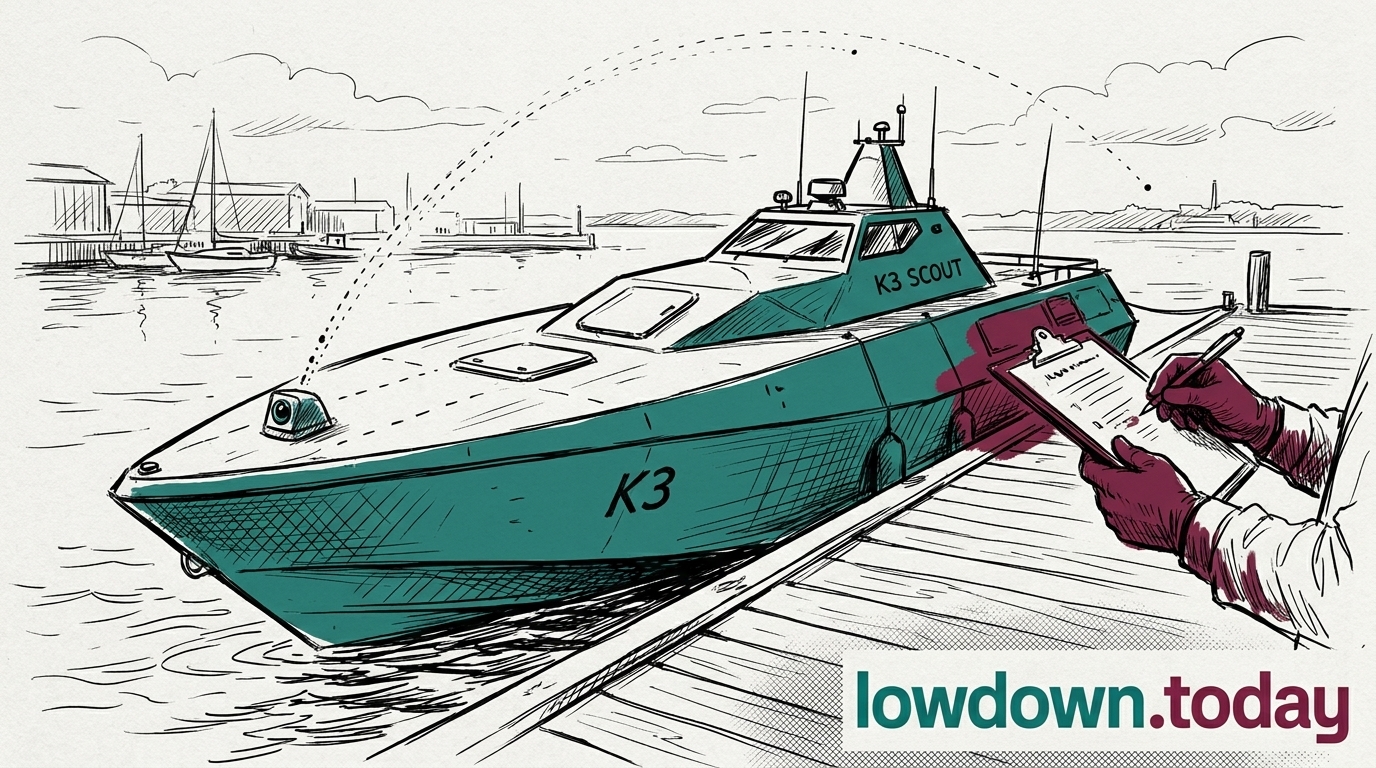
The Conservative opposition called on the Government on 9 August to 'urgently audit' equipment for hidden Chinese components, after the Telegraph's K3 SCOUT report. No named MP has been quoted on the record; the call came at party level, alongside the Ministry of Defence's own 10 August statement that no data had been compromised.
Netherlands Ministry of Defence
The Netherlands Ministry of Defence authorised Dutch Naval Design on 4 August to design 12-metre anti-submarine warfare uncrewed vessels for the Dutch-Belgian frigate programme, and to buy an adapted Compact FLASH dipping sonar from Thales Underwater Systems France. The order commits money and a named supplier while Britain's own certification body remains at the market-engagement stage.
Kraken Technology Group
Kraken Technology Group is a UK maritime-defence company based in Portsmouth that builds the K3 SCOUT, and crossed a $1bn valuation in July on a single-sourced $175m raise. The camera components reached the fleet under a third party's written security assurance, which the Platform Authority, which does not yet exist, was never positioned to check.
Navy Commercial
Navy Commercial
Navy Commercial at Whale Island published two notices on 5 August: 074032-2026, asking industry how to build a Platform Authority to certify uncrewed vessels, and 074351-2026, a GBP10m multi-role USV testbed for the Defence Chief Technology Officer. Responses on the Platform Authority close 19 August, ten days after the cameras were found transmitting to China.
Ministry of Defence
Ministry of Defence
The Ministry of Defence said on 10 August that a routine cyber vulnerability assessment found the camera fault, and a thorough investigation found no evidence that MoD data or systems had been accessed, compromised or transmitted externally. It stripped the cameras of internet connectivity but did not say whether it acted against the supplier.
Thales
Thales
Thales converted its 6 July engaging accord with Exail into a definitive combination agreement on 30-31 July, but the tender offer for Exail's remaining shares now closes by early 2028, later than July's timetable implied. Thales integrates its new undersea prime while still bidding against Kongsberg and DRASS's 2027 target for the AUKUS Pillar II contest.
