Skip to content
You can now search across every topic, entity and event.What's new
Autonomous Systems: Land & Sea
12AUG

Ukraine's STING Drone Intercepts at 500 km for First Time

2 min read
14:17UTC

A Ukrainian operator destroyed two Shahed drones simultaneously from 500 km using STING and HORNET VISION Ctrl technology, a 15-20 times multiplication of previous engagement range.

TechnologyDeveloping
Key takeaway

500 km STING interception creates theatre-wide air defence coverage from rear-area positions beyond Russian artillery range.

On 4 April, an operator with the callsign Hulk in Ukraine's Bulava unit destroyed two Shahed-type drones simultaneously from 500 km using STING interceptor drones equipped with HORNET VISION Ctrl technology. Previous operational range was 20 to 30 km. At 500 km, a single crew covers an area comparable to England from a position beyond Russian counter-battery range.

The multiplication effect compounds Ukraine's existing trajectory. March's 89.9% interception rate was achieved across 6,600 Russian attacks, a 23% monthly increase in volume. Interceptor drones already account for 30% of all aerial kills. At under $2,000 per STING versus $13.5 million per PAC-3 MSE , the cost calculus was already shifting before the range breakthrough.

MASS deployment is the declared intent but the timeline is unconfirmed. The 5 April overnight interception of 76 of 93 Shaheds (82%) is consistent with a smaller raid rather than a capability drop, and it does not yet demonstrate HORNET VISION Ctrl at scale. The claim warrants validation over several weeks of operational data.

Deep Analysis

In plain English

Ukraine developed a new capability to shoot down Russian drones from 500 kilometres away, roughly the distance from London to Edinburgh. Previously, the same drones could only engage targets 20-30 kilometres away. One Ukrainian operator destroyed two Russian drones simultaneously from this record distance. If this technology is deployed widely, Ukrainian defenders could protect the entire country from drone strikes while stationed far behind the front line, out of range of Russian artillery.

What could happen next?
  • Consequence

    Air defence operators can be stationed 400-500 km behind the front line, beyond Russian counter-battery range, while maintaining full theatre coverage.

  • Opportunity

    Cost asymmetry of $2,000 per STING kill versus $13.5 million per PAC-3 round makes sustained high interception rates financially viable without Western missile resupply.

First Reported In

Update #11 · Russia Sells Less Oil but Earns More

Ukrainska Pravda / Defence Express· 5 Apr 2026
Read original
Causes and effects
This Event
Ukraine's STING Drone Intercepts at 500 km for First Time
If mass-deployed as claimed, HORNET VISION Ctrl transforms Ukrainian air defence from point coverage to a theatre-wide interception grid, with operators protected 400-500 km behind the front line.
Different Perspectives
Conservative opposition
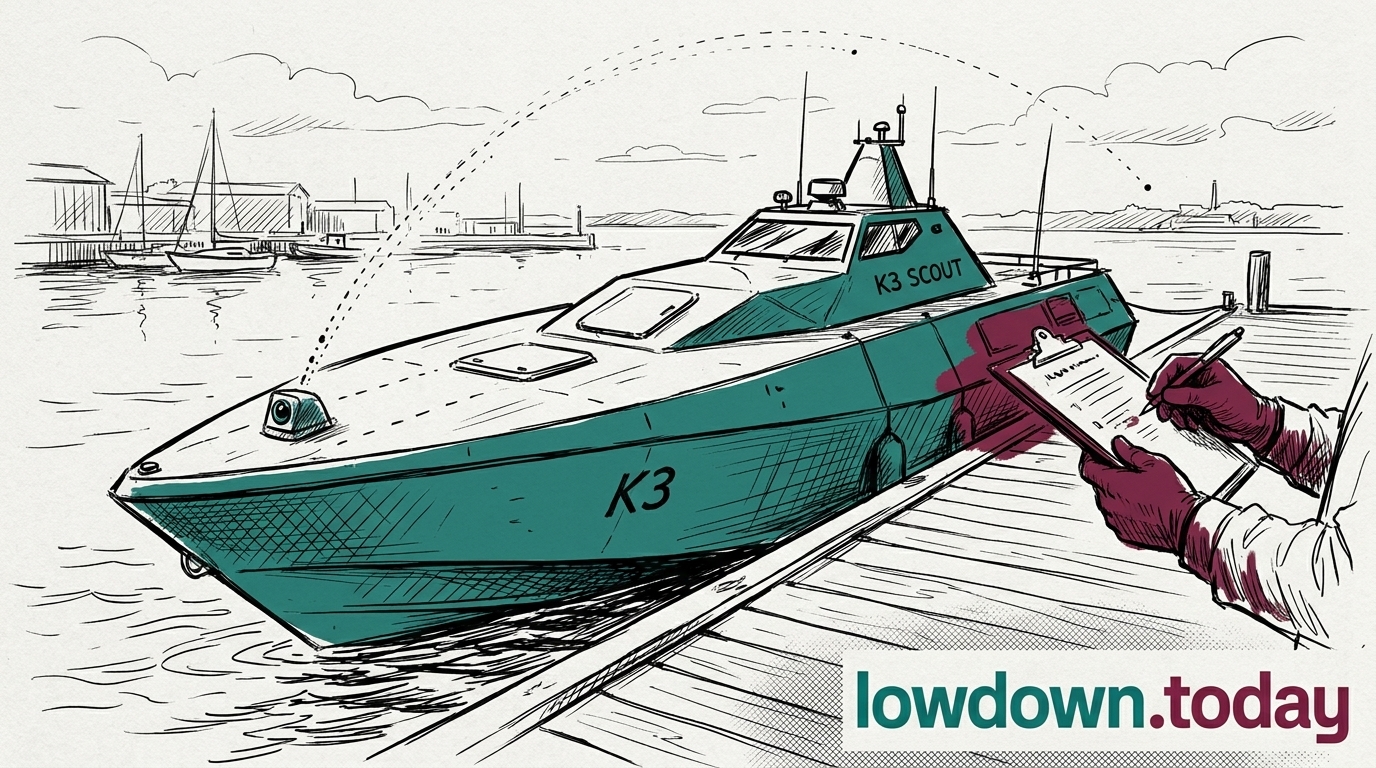
The Conservative opposition called on the Government on 9 August to 'urgently audit' equipment for hidden Chinese components, after the Telegraph's K3 SCOUT report. No named MP has been quoted on the record; the call came at party level, alongside the Ministry of Defence's own 10 August statement that no data had been compromised.
Netherlands Ministry of Defence
The Netherlands Ministry of Defence authorised Dutch Naval Design on 4 August to design 12-metre anti-submarine warfare uncrewed vessels for the Dutch-Belgian frigate programme, and to buy an adapted Compact FLASH dipping sonar from Thales Underwater Systems France. The order commits money and a named supplier while Britain's own certification body remains at the market-engagement stage.
Kraken Technology Group
Kraken Technology Group is a UK maritime-defence company based in Portsmouth that builds the K3 SCOUT, and crossed a $1bn valuation in July on a single-sourced $175m raise. The camera components reached the fleet under a third party's written security assurance, which the Platform Authority, which does not yet exist, was never positioned to check.
Navy Commercial
Navy Commercial
Navy Commercial at Whale Island published two notices on 5 August: 074032-2026, asking industry how to build a Platform Authority to certify uncrewed vessels, and 074351-2026, a GBP10m multi-role USV testbed for the Defence Chief Technology Officer. Responses on the Platform Authority close 19 August, ten days after the cameras were found transmitting to China.
Ministry of Defence
Ministry of Defence
The Ministry of Defence said on 10 August that a routine cyber vulnerability assessment found the camera fault, and a thorough investigation found no evidence that MoD data or systems had been accessed, compromised or transmitted externally. It stripped the cameras of internet connectivity but did not say whether it acted against the supplier.
Thales
Thales
Thales converted its 6 July engaging accord with Exail into a definitive combination agreement on 30-31 July, but the tender offer for Exail's remaining shares now closes by early 2028, later than July's timetable implied. Thales integrates its new undersea prime while still bidding against Kongsberg and DRASS's 2027 target for the AUKUS Pillar II contest.
