Skip to content
You can now search across every topic, entity and event.What's new
Russia-Ukraine War 2026
27MAR

948 drones — war record in one day

2 min read
20:48UTC

The largest single drone attack of the war hit 11 Ukrainian regions in rare daytime waves, killing at least eight people as the spring offensive gathered force.

ConflictDeveloping
Key takeaway

Russia launched its largest ever drone barrage precisely when US interceptor stocks were split between two wars.

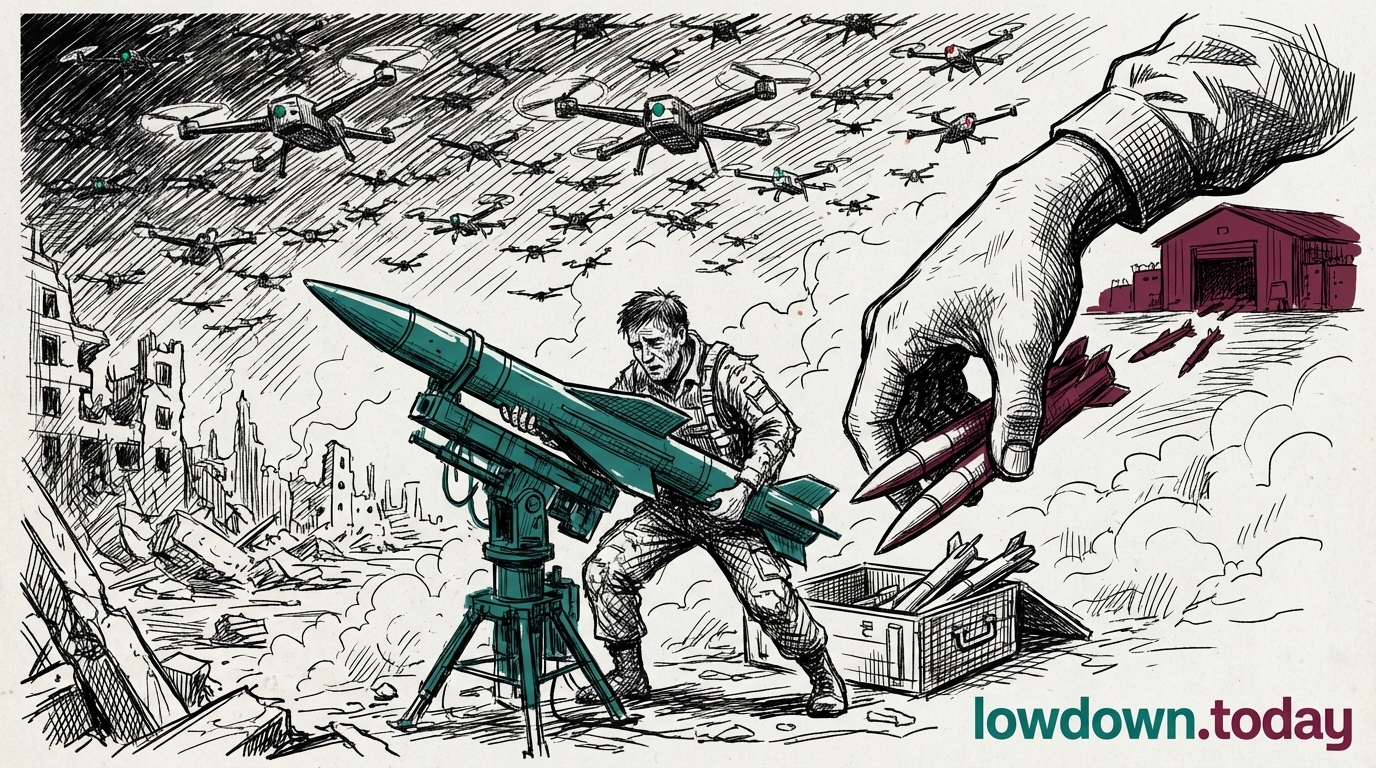
Russia launched 948 drones at Ukraine on 24 March, the largest single drone attack since the full-scale invasion began in February 2022 1. Strikes hit 11 oblasts in rare daytime waves, killing two people in Ivano-Frankivsk, two in Poltava, and one each in Vinnytsia, Zaporizhzhia, Kherson, and Kharkiv.

The barrage dwarfed the previous record of 430 drones and 68 missiles on 13-14 March and continued a trajectory that saw 9,616 kamikaze drones launched on 17 March alone . Daytime attacks are operationally different from night strikes: thermal detection works best against dark skies, while cluttered urban environments in daylight demand radar-guided interception instead. Russia appears to be testing whether saturating both halves of the 24-hour cycle can overwhelm Ukrainian air defence scheduling.

Zelenskyy told the BBC two days later that 800 US-made interceptors were consumed in three days of the Iran war , against 700 Ukraine received over its entire winter. With American production at 60 to 65 Patriot rounds per month, replacing those 800 takes a full year. Russia's spring offensive launched in the window of maximum interceptor scarcity.

In Lviv, a UNESCO World Heritage city 750 kilometres from the front line, the 16th-century Bernardine monastery lost its tower and the Church of St Mary Magdalene had its windows shattered 2. UNESCO dispatched experts to assess the cultural damage. The reach of the barrage, far beyond the eastern front, signals a deliberate effort to stretch Ukrainian air defences across the country's entire depth.

Deep Analysis

In plain English

Russia launched nearly 1,000 drones at Ukraine in a single day — more than double its previous record. Think of it as flooding every intersection in a city with cars at once: no matter how many traffic police you have, some will get through. Ukraine uses expensive missiles (think £1 million each) to shoot down cheap drones (think £10,000 each). Russia is betting it can exhaust Ukraine's missiles before Ukraine gets more. The timing matters because the US — Ukraine's main missile supplier — is currently using its own stockpile in a separate war against Iran.

Deep Analysis
Root Causes

Russia's drone escalation stems from three structural factors not visible in the daily headlines.

First, Iran's supply of Shahed-136 production licences in 2023 enabled Russia to manufacture at scale domestically, breaking its dependence on imported units and absorbing Western supply interdiction.

Second, Ukrainian air defence is fundamentally reactive: it must cover the entire country's depth, while Russia chooses when and where to strike. The 948-drone barrage across 11 oblasts simultaneously exploits that asymmetry.

Third, the Iran war created a window of US interceptor scarcity that Russia's military planners almost certainly anticipated from the moment American involvement in the Middle East became probable.

First Reported In

Update #8 · Pentagon diverts funds; 948 drones fired

Al Jazeera· 27 Mar 2026
Read original
Different Perspectives
Belarus
Belarus
Minsk announced completion of its own 37th Separate Airborne Assault Brigade near Gomel, under plans dating to August 2025 rather than a response to any single frontline event this window, keeping its hedge of hosting the war without formally joining Russia's mobilisation drive.
European Union / Operation IRINI states
Italy, Greece and Poland boarded the sanctioned tanker Toa Payoh off Pantelleria under a standing EU mandate rather than a national decision, extending enforcement from the Channel and Baltic and the Black Sea and Azov into the Mediterranean. Italian Defence Minister Guido Crosetto praised the crew; the captain's refusal to produce documentation left detention unconfirmed.
Poland and the NATO eastern flank
Warsaw's Coordination Team said explicitly its forces tracked the 30 July missile incursion and were ready to shoot it down, then flew air cover for an EU tanker interdiction three days later. Poland is simultaneously the war's nearest spillover victim and a contributor to enforcing sanctions against the state causing that spillover.
Ukraine (government, defence establishment and civilians)
Kyiv runs its manpower crisis through acting Defence Minister Yevhen Khmara, whose formal appointment waits for parliament's 18 August return, and a fortnight-old Commander-in-Chief, Mykhailo Drapatyi. Reported attacks on enlistment officers rose from 5 cases in 2022 to 341 in 2025, reaching Odesa's Territorial Recruitment Centre staff directly on 2 August.
Kremlin and Russian domestic economic voices
Moscow has not addressed July's advance-rate collapse or Sberbank's OFZ warning; Novak's diary ran to OPEC+ quota diplomacy with no diesel item logged since 15 July. Economist Nikolai Korzhenevsky calls the Central Bank's RUB 2.3tn in bank lending effectively deficit monetisation, a framing Sberbank's Skvortsov, with his own institutional interest, has not disputed.
IAEA (Rafael Grossi)
IAEA inspectors logged Zaporizhzhia's 22nd loss of off-site power, ten of them in the last three months, after a thunderstorm knocked out the plant's sole surviving backup line. Grossi reads the accelerating frequency, not any single outage, as the safety signal now that the plant's redundancy is exhausted.
