Skip to content
You can now search across every topic, entity and event.What's new
Autonomous Systems: Land & Sea
12AUG

948 drones — war record in one day

2 min read
14:17UTC

The largest single drone attack of the war hit 11 Ukrainian regions in rare daytime waves, killing at least eight people as the spring offensive gathered force.

TechnologyDeveloping
Key takeaway

Russia launched its largest ever drone barrage precisely when US interceptor stocks were split between two wars.

Russia launched 948 drones at Ukraine on 24 March, the largest single drone attack since the full-scale invasion began in February 2022 1. Strikes hit 11 oblasts in rare daytime waves, killing two people in Ivano-Frankivsk, two in Poltava, and one each in Vinnytsia, Zaporizhzhia, Kherson, and Kharkiv.

The barrage dwarfed the previous record of 430 drones and 68 missiles on 13-14 March and continued a trajectory that saw 9,616 kamikaze drones launched on 17 March alone . Daytime attacks are operationally different from night strikes: thermal detection works best against dark skies, while cluttered urban environments in daylight demand radar-guided interception instead. Russia appears to be testing whether saturating both halves of the 24-hour cycle can overwhelm Ukrainian air defence scheduling.

Zelenskyy told the BBC two days later that 800 US-made interceptors were consumed in three days of the Iran war , against 700 Ukraine received over its entire winter. With American production at 60 to 65 Patriot rounds per month, replacing those 800 takes a full year. Russia's spring offensive launched in the window of maximum interceptor scarcity.

In Lviv, a UNESCO World Heritage city 750 kilometres from the front line, the 16th-century Bernardine monastery lost its tower and the Church of St Mary Magdalene had its windows shattered 2. UNESCO dispatched experts to assess the cultural damage. The reach of the barrage, far beyond the eastern front, signals a deliberate effort to stretch Ukrainian air defences across the country's entire depth.

Deep Analysis

In plain English

Russia launched nearly 1,000 drones at Ukraine in a single day — more than double its previous record. Think of it as flooding every intersection in a city with cars at once: no matter how many traffic police you have, some will get through. Ukraine uses expensive missiles (think £1 million each) to shoot down cheap drones (think £10,000 each). Russia is betting it can exhaust Ukraine's missiles before Ukraine gets more. The timing matters because the US — Ukraine's main missile supplier — is currently using its own stockpile in a separate war against Iran.

Deep Analysis
Root Causes

Russia's drone escalation stems from three structural factors not visible in the daily headlines.

First, Iran's supply of Shahed-136 production licences in 2023 enabled Russia to manufacture at scale domestically, breaking its dependence on imported units and absorbing Western supply interdiction.

Second, Ukrainian air defence is fundamentally reactive: it must cover the entire country's depth, while Russia chooses when and where to strike. The 948-drone barrage across 11 oblasts simultaneously exploits that asymmetry.

Third, the Iran war created a window of US interceptor scarcity that Russia's military planners almost certainly anticipated from the moment American involvement in the Middle East became probable.

First Reported In

Update #8 · Pentagon diverts funds; 948 drones fired

Al Jazeera· 27 Mar 2026
Read original
Different Perspectives
Conservative opposition
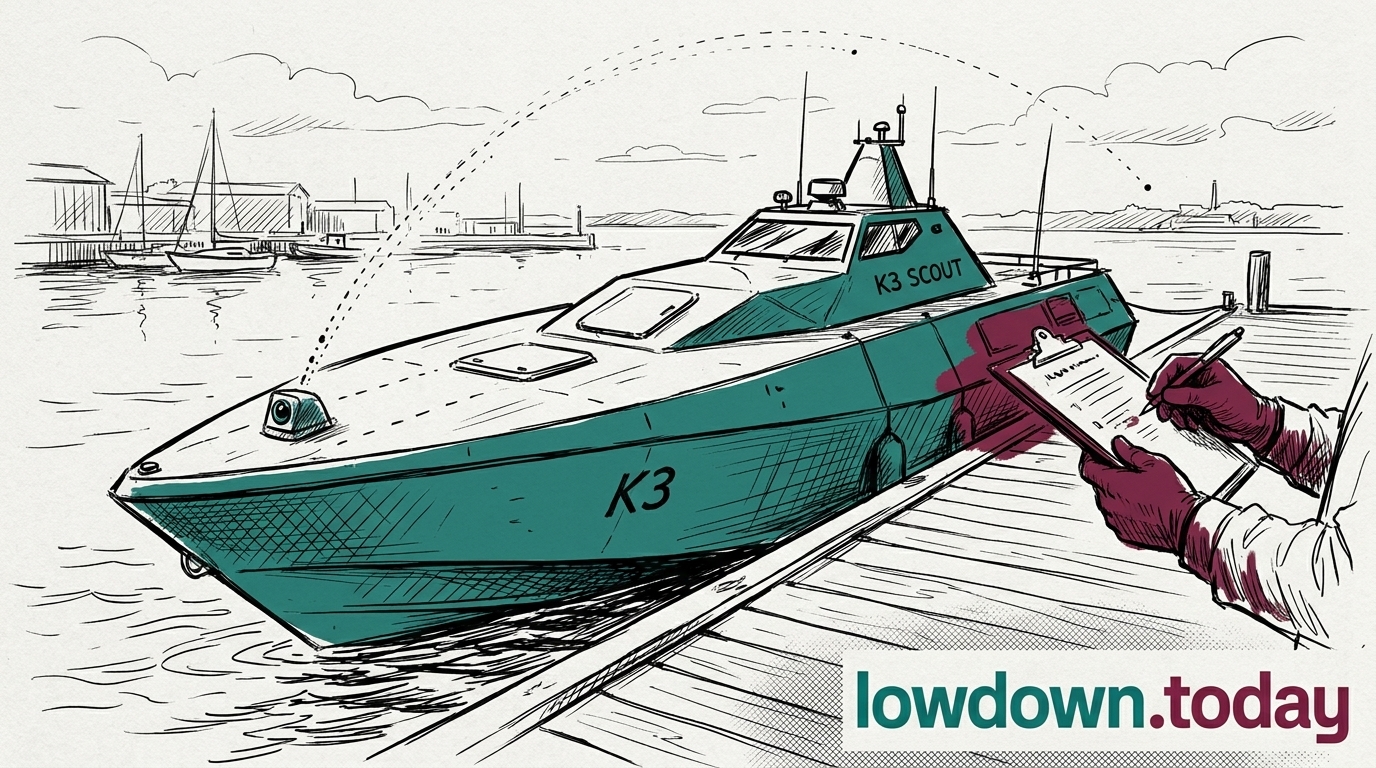
The Conservative opposition called on the Government on 9 August to 'urgently audit' equipment for hidden Chinese components, after the Telegraph's K3 SCOUT report. No named MP has been quoted on the record; the call came at party level, alongside the Ministry of Defence's own 10 August statement that no data had been compromised.
Netherlands Ministry of Defence
The Netherlands Ministry of Defence authorised Dutch Naval Design on 4 August to design 12-metre anti-submarine warfare uncrewed vessels for the Dutch-Belgian frigate programme, and to buy an adapted Compact FLASH dipping sonar from Thales Underwater Systems France. The order commits money and a named supplier while Britain's own certification body remains at the market-engagement stage.
Kraken Technology Group
Kraken Technology Group is a UK maritime-defence company based in Portsmouth that builds the K3 SCOUT, and crossed a $1bn valuation in July on a single-sourced $175m raise. The camera components reached the fleet under a third party's written security assurance, which the Platform Authority, which does not yet exist, was never positioned to check.
Navy Commercial
Navy Commercial
Navy Commercial at Whale Island published two notices on 5 August: 074032-2026, asking industry how to build a Platform Authority to certify uncrewed vessels, and 074351-2026, a GBP10m multi-role USV testbed for the Defence Chief Technology Officer. Responses on the Platform Authority close 19 August, ten days after the cameras were found transmitting to China.
Ministry of Defence
Ministry of Defence
The Ministry of Defence said on 10 August that a routine cyber vulnerability assessment found the camera fault, and a thorough investigation found no evidence that MoD data or systems had been accessed, compromised or transmitted externally. It stripped the cameras of internet connectivity but did not say whether it acted against the supplier.
Thales
Thales
Thales converted its 6 July engaging accord with Exail into a definitive combination agreement on 30-31 July, but the tender offer for Exail's remaining shares now closes by early 2028, later than July's timetable implied. Thales integrates its new undersea prime while still bidding against Kongsberg and DRASS's 2027 target for the AUKUS Pillar II contest.
