Skip to content
Welcome, thoughtbot's Giant Robots listeners!Start here
Tokyo
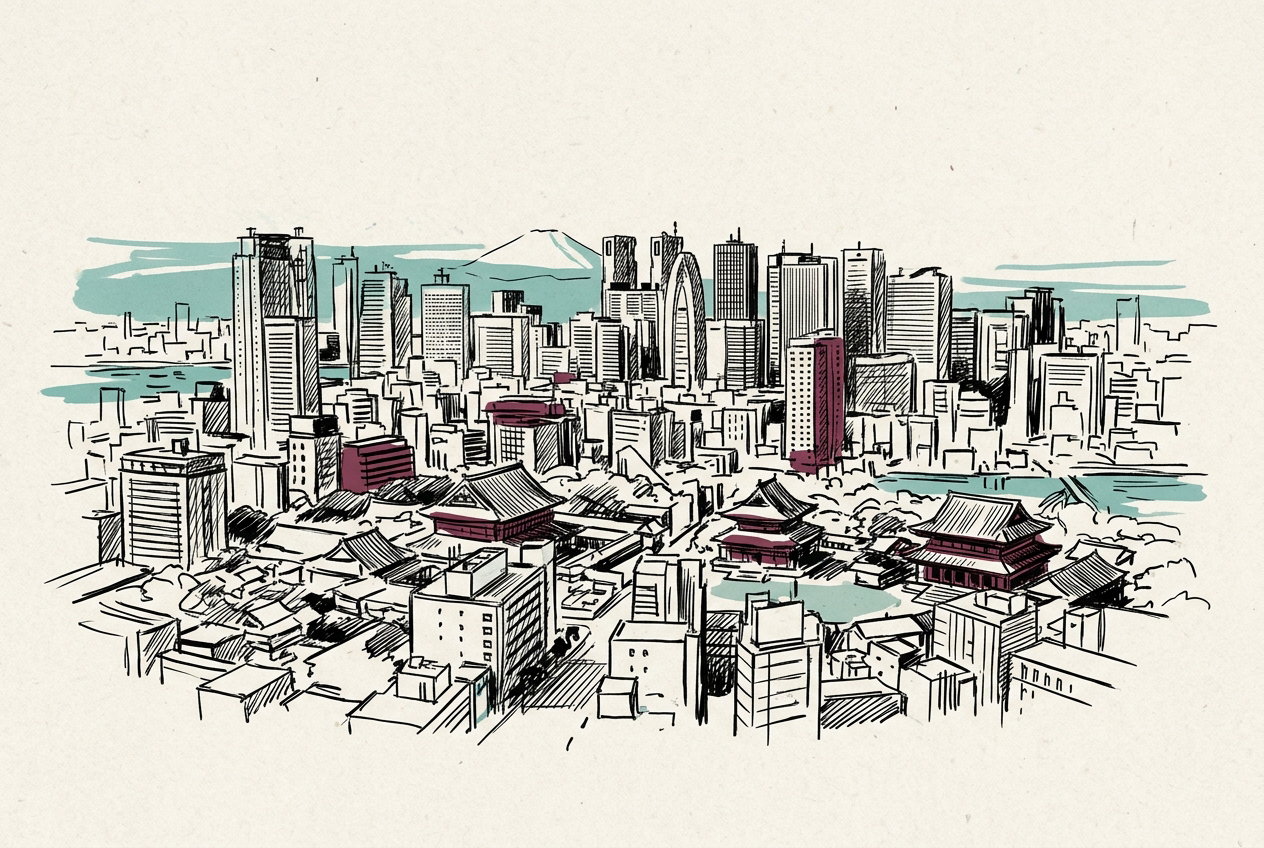
AI-generated illustration
Nation / PlaceJP

Tokyo

Japan's capital and Asia's largest metro economy; a 90%-import-dependent city exposed to Gulf energy shocks.

As of 20 August, Tokyo faces the economic effects of disrupted Gulf shipping because Japan depends heavily on imported energy.

Last refreshed: 1 October 2026

Key Question

Can Tokyo absorb a prolonged Hormuz closure without triggering domestic energy rationing?

Timeline for Tokyo

View full timeline →

Background

Tokyo is Japan's capital and Asia's largest metropolitan economy. Its concentration of households, transport, finance and industry makes dependable energy supplies important to national economic life.

The city’s exposure to Gulf disruption follows Japan’s Reliance on imported energy, rather than a separate municipal energy policy. On 20 August, Japan called for greater international co-ordination to protect navigation through the Strait of Hormuz and Bab el-Mandeb.

Tokyo matters because national fuel and power shocks become visible there in commercial activity and household costs. Its significance is therefore as the principal urban economy exposed to Japan’s energy dependence, not as an Independent actor in Gulf policy.

Common Questions
What happens to Japanese energy prices if Hormuz closes?
A Hormuz closure would force Japan to seek emergency SPOT LNG cargoes at premium prices or activate strategic petroleum reserves. Brent Crude rising to $95 in March 2026 had already begun transmitting inflationary pressure across import-dependent economies including Japan, before any full closure occurred.Source: Lowdown
How does Tokyo compare to Seoul in Gulf energy exposure?
Both Tokyo and Seoul depend on Gulf imports for the bulk of their energy needs. In March 2026, both the Nikkei and KOSPI crashed simultaneously on war shock, illustrating near-identical financial vulnerability. Japan's Reliance is slightly higher: Japan is the world's second largest LNG importer, while South Korea ranks third.Source: Lowdown
How did the Iran-Israel war affect the Nikkei?
Japan's Nikkei index fell 3.9 per cent in its worst daily session of the conflict as Gulf War shock rippled through Asian markets. South Korea's KOSPI fell 12 per cent in the same session, the worst on record, reflecting how tightly Asian import-dependent economies track Hormuz stability.Source: Lowdown
What is Tokyo's role in the Iran conflict?
Tokyo is not a military participant, but Japan's economy is acutely exposed to the conflict. Japan imports roughly 90 per cent of its energy, mostly from The Gulf. The Nikkei dropped 3.9 per cent in a single session as Gulf War shock reached Asian markets, and rising oil prices toward $95 a barrel created direct inflationary pressure on Japanese supply chains.Source: Lowdown
Why is Tokyo vulnerable to the Strait of Hormuz crisis?
Japan imports approximately 90 per cent of its primary energy, with Gulf crude and LNG making up the majority. Any sustained closure of the strait of Hormuz would cut off supplies Japan cannot quickly replace, threatening domestic energy rationing and Stagflation.Source: Lowdown
What did the EU-Japan Digital Partnership Council agree in 2026?
The fourth EU-Japan Digital Partnership Council met in Brussels on 5 May 2026. It produced a joint Data Strategy Working Group, AI safety research collaboration, semiconductor cooperation on next-generation technologies, and a quantum initiative called Q Neko.
What is the Japan Rail Pass price in 2026?
The Japan Rail Pass rises by ¥3,000 to ¥7,000 from October 2026, following a previous price increase. The Sayonara tax (departure levy) also doubles to ¥3,000 from July 2026.
Which Japanese cities now charge an accommodation tax in 2026?
From 1 April 2026: Hokkaido (three-tier ¥100–¥500/night), Sapporo (additional ¥200–¥500), 15 Hokkaido municipalities, Hiroshima, Yugawara, Gifu, and Toba. Nagano, Kumamoto, and Miyazaki City approved for June 2026. Tokyo has its own separate framework.
