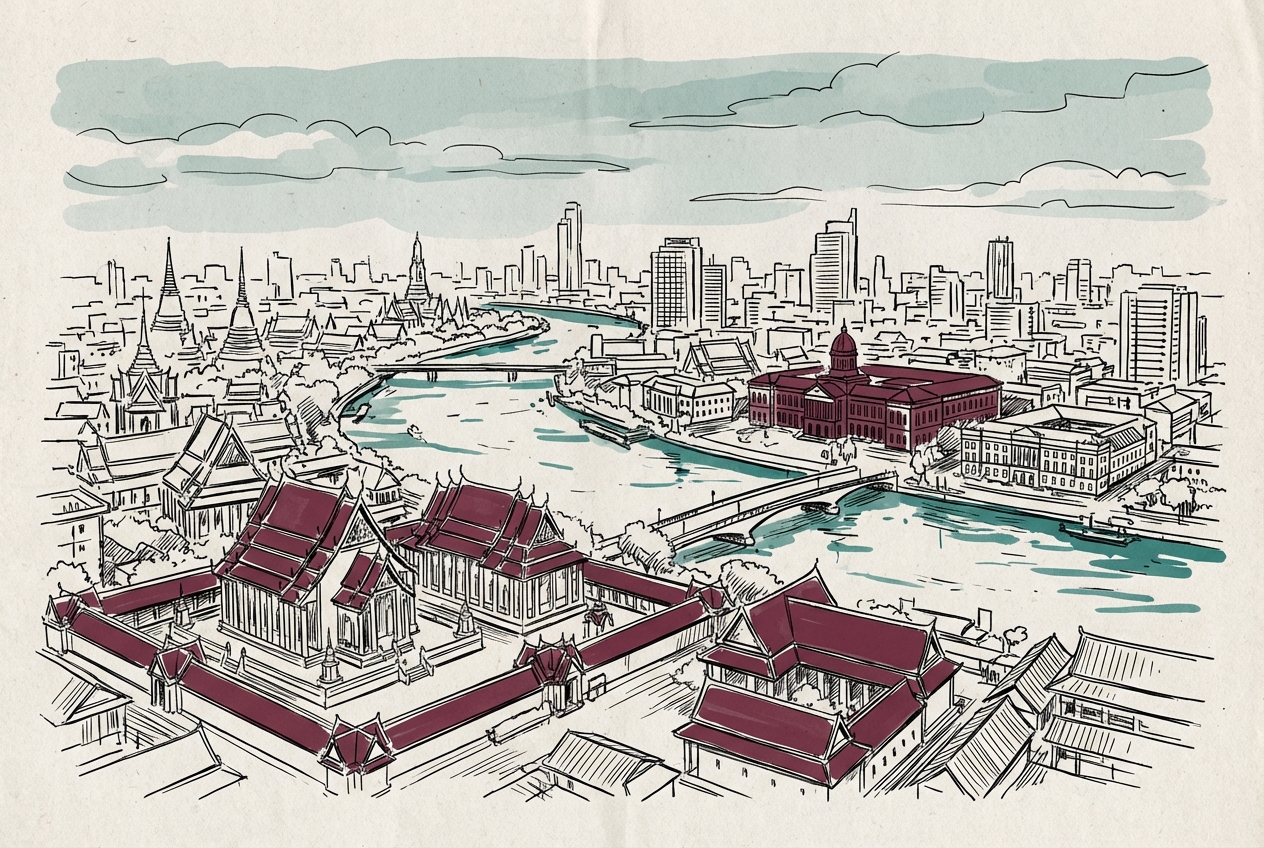
Thailand
Southeast Asian constitutional monarchy; tightening visitor-visa policy while running the priced DTV long-stay route.
Since 15 September citizens of 60 countries get 30 days of visa-free entry to Thailand rather than 60, and most visitors who cross by land may use that exemption only twice a year.
Last refreshed: 3 October 2026 · Appears in 6 active topics
Is Thailand's 60-day visa-free window still open, and when will the 30-day rule kick in?
Timeline for Thailand
Pushed its data-centre rulebook draft to the first quarter of 2027
Data Centres: Boom and Backlash: Thailand's data-centre rules slip to Q1Mentioned in: Georgieva sees an AI 'tsunami' for youth
AI: Jobs, Power & MoneyNamed in event analysis
Nomads & Communities: Mentioned in: State bank BTN explores Bali levy paymentsMentioned in: Cambodia confirms sixth human H5N1 case
Pandemics and BiosecurityCut visa-free stays to 30 days from 15 September
Nomads & Communities: Thailand limits land border runs to twoBackground
Thailand is a constitutional monarchy in mainland Southeast Asia, with Bangkok as its capital. Tourism is one of its largest industries, and a sizeable long-stay foreign population, from retirees to remote workers, makes entry rules a standing part of its public profile.
Its visa system runs on two tracks: a visa-free exemption for short stays and the Destination Thailand Visa, which requires 500,000 baht in savings, for longer ones. In 2026 the government cut the exemption from 60 days to 30 and capped land-border use, steering long stays towards the priced route.
Thailand also keeps a foot in both rival lunar programmes. By January 2026 it had signed the US-led Artemis Accords and joined the China-Russia International Lunar Research Station framework. That dual membership preserves access to competing space partnerships without committing Bangkok to either.
Thailand halves its visa-free stay
Ministers agreed on 19 May to halve the visa-free window to 30 days, citing a first-quarter arrivals drop of 3.4% and worries about nominee businesses. The tiers settled on 16 July gave 30 days to 59 countries and territories, all 27 EU states among them; Mauritius and Seychelles received 15 days, and 65 countries got visa on arrival.
The shorter allowance applied from 15 September to citizens of 60 countries. Overland arrivals are now capped at two visa-free entries a year for most travellers, which ends the repeated border run as a way to stay for months.
Its priced visa becomes the main route
The Destination Thailand Visa requires 500,000 baht in savings, roughly €13,000, for a 180-day stay. The Cabinet kept it in place on 19 May while cutting visa-free entry, which made it the principal legal option for long stays. The cut itself waited on Royal Gazette notices, and on 23 June the 60-day window was still open at every border.
The visa's own gate narrowed later in the year. Since 31 August the London mission has asked applicants to prove permanent residence in the UK or Ireland and to supply a police record issued within the past six months. Combined with the cap on land entries, that leaves fewer routes to a long stay without the priced visa.
Thailand halves its visa-free stay
What are Thailand's new visa tiers announced in July 2026?
Do all EU citizens get the same visa-free entry to Thailand now?
Its priced visa becomes the main route
Why did Thailand shorten its visa-free window for foreign visitors?
What is the Destination Thailand Visa and who qualifies?
Reference
Who is Christopher Harborne and what is his connection to Thailand?
What is Thailand's space agency?
Is Thailand part of the Artemis Moon programme?
Does Thailand's ILRS membership weaken Artemis?
Which other countries are dual signatories of Artemis and ILRS?
Why did Thailand sign both Artemis Accords and ILRS?
Is Thailand paying Iran's Hormuz toll?
Is Thailand good for digital nomads in 2026?


Written with AI from Lowdown's published reporting. Not individually reviewed by an editor. Updated 3 October 2026. Editorial standards.