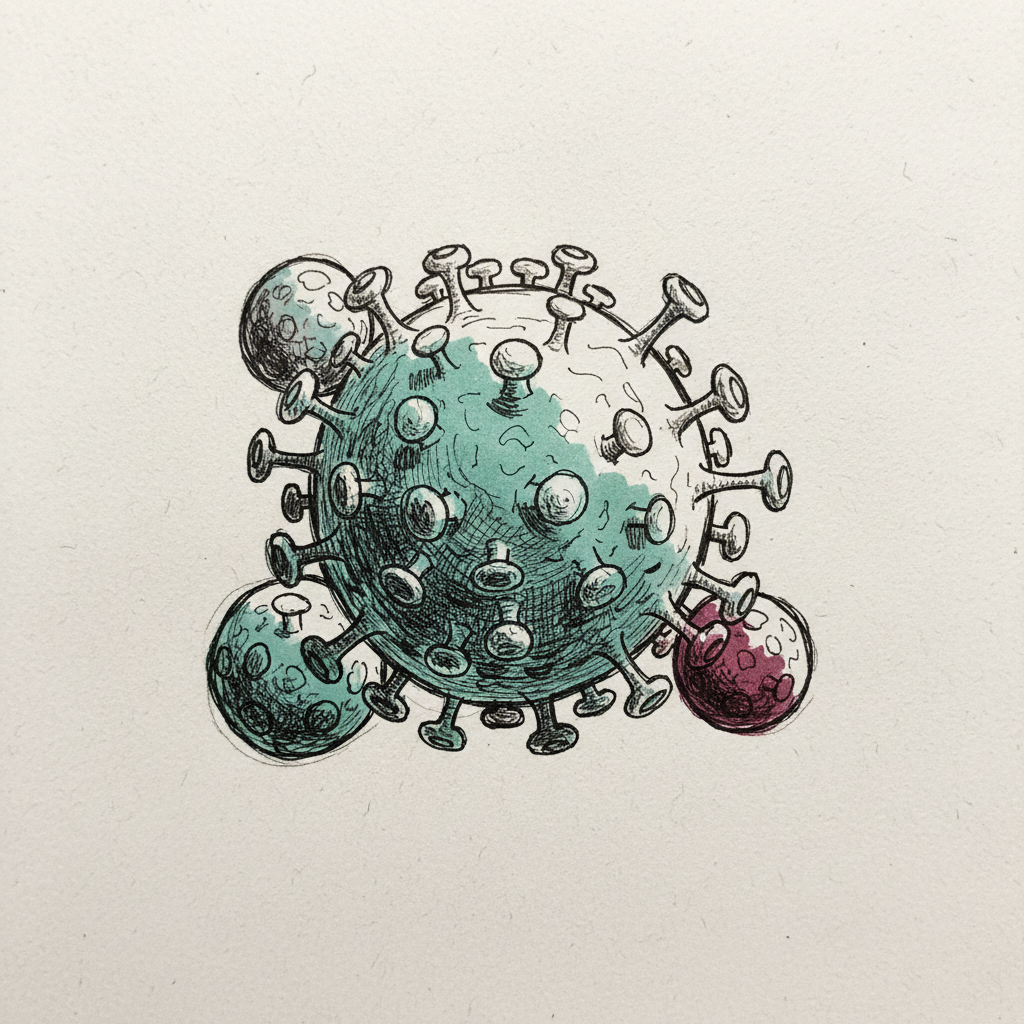
H5N1
Highly pathogenic avian influenza subtype capable of infecting birds, mammals and occasionally humans.
Between 16 February and 17 July, Cambodia accounted for four of seven newly confirmed human H5N1 cases worldwide, while the United States dairy-associated human count remained at 71.
Last refreshed: 22 September 2026 · Appears in 1 active topic
If H5N1 hides in cow udders rather than lungs, is all existing PPE guidance wrong?
Timeline for H5N1
Infected 11 people worldwide in 2026
Pandemics and Biosecurity: Cambodia confirms sixth human H5N1 caseMentioned in: WHO talks on pathogen sharing fail again
Pandemics and BiosecurityMentioned in: Australia releases its first H5N1 genome
Pandemics and BiosecurityMentioned in: MERS clade B found in Nile Basin camels
Pandemics and BiosecurityCambodia, not US herds, makes cases
Pandemics and BiosecurityBackground
H5N1 is a highly pathogenic avian influenza subtype that infects birds and mammals, with occasional human infection. Its broad animal host range and ability to cross species make it a continuing surveillance concern rather than a disease confined to one farm sector.
The subtype has followed more than one exposure route. In the United States dairy outbreak, research published on 20 June found that the virus targets receptors abundant in cow udder tissue, where infection presents as mastitis rather than respiratory illness.
This biology affects how cases are found and how workers are protected. A study reported on 1 May detected H5N1 in submicron aerosols in milking-parlour air before clinical signs appeared in cattle. Pasteurisation destroys the virus, so commercial dairy products are not a transmission route.
Cambodia drives its global case count
Between 16 February and 17 July, confirmed human H5N1 cases worldwide rose from 994 to 1,001. Cambodia accounted for four of the seven new cases, including an infant confirmed in early July.
On 1 February, a child in Bangladesh died after household poultry contact, while Cambodia recorded three human cases through the same route during 2026. This poultry-contact pathway is separate from the US dairy-cattle outbreak, so H5N1 surveillance must track distinct exposure patterns rather than treat all cases as one epidemic.
H5N1 gains a Phase 3 vaccine
On 22 April, Moderna began the first Phase 3 trial of an mRNA H5N1 vaccine candidate. The trial is the furthest an mRNA vaccine for this subtype has progressed, creating efficacy and safety evidence before any pandemic strain requires rapid authorisation.
In May, CEPI committed $54.3m after US federal health authorities withdrew support. The intervention kept the trial running and made CEPI the sole funder of the most advanced active mRNA vaccine programme directed at H5N1.
Cambodia drives its global case count
What is the global H5N1 human case count in 2026?
Can dairy workers catch H5N1 from breathing air on dairy farms?
Why did H5N1 hide in US dairy cattle for two years?
H5N1 gains a Phase 3 vaccine
Is there an H5N1 vaccine being developed in 2026?
How many US dairy farms have H5N1 in 2026?
Why does H5N1 spread so easily in dairy cows but not obviously make them sick?
What happened in Bangladesh and Cambodia with H5N1 in 2026?
How many people have caught H5N1 from cows in the US?
Is H5N1 bird flu spreading in US dairy farms in 2026?
Is H5N1 spreading between people?
How many H5N1 cases has Cambodia had in 2026?
Is H5N1 spreading from person to person in the US?
