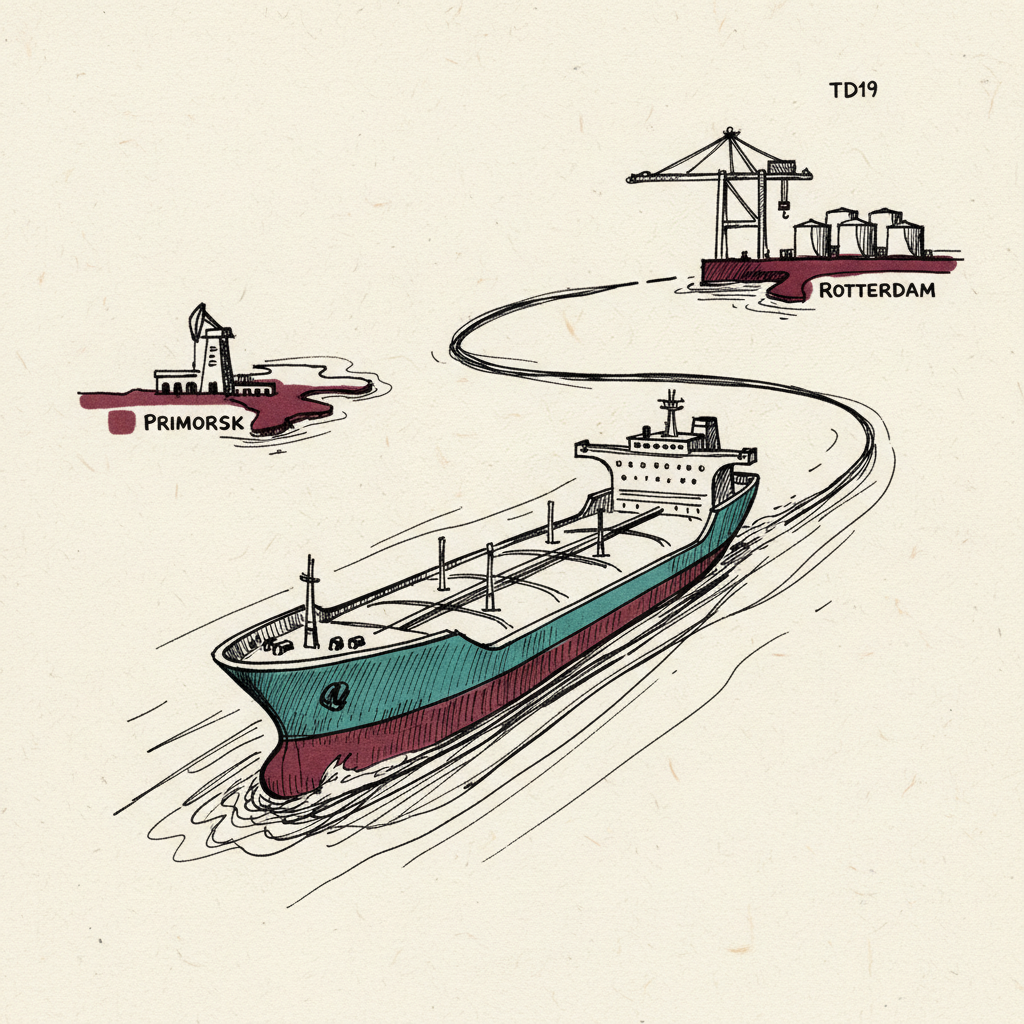
TD19
Baltic Exchange Aframax cross-Mediterranean benchmark route, Ceyhan (Turkey) to Lavera (France).
Last refreshed: 8 June 2026 · Appears in 1 active topic
Will the GL 134C expiry reimpose the compliance premium on Med Aframax freight?
Timeline for TD19
Med Aframax benchmark route; prior WS228 scramble provides causal context
European Oil Markets: Mentioned in: Freight prices Hormuz risk as permanentMentioned in: GL 134C lapsed clean, no successor
European Oil MarketsMed Aframax benchmark route that reflects the same routing scramble through Suez and the Med
European Oil Markets: Mentioned in: VLCC forward freight stays 2x AtlanticHeld at WS228 with no fresh print in 9-11 June window
European Oil Markets: Iraq's Ceyhan backstop stalls at 190kbdMed Aframax freight jumps as VLCCs hold
European Oil MarketsBackground
TD19 is the Baltic Exchange's benchmark freight route for dirty Aframax tankers of approximately 80,000 DWT, covering the cross-Mediterranean voyage from Ceyhan (Turkey's Mediterranean export terminal for the BTC pipeline and Iraqi Kirkuk crude) to Lavera (Marseille, France). TD19 is the primary published reference for Mediterranean Aframax crude freight and is a component of the Baltic Dirty Tanker Index (BDTI). The route reflects the economics of moving Caspian (Azeri Light, CPC Blend) and Iraqi crude to Southern European refiners, principally in France, Spain, and Italy. Because the Mediterranean is a semi-enclosed basin with distinct freight dynamics from the North Sea and Atlantic, TD19 often diverges from the North Sea equivalent TD7, with the spread between them indicating relative basin tightness.
GL 134C's reinstatement of Western vessel-services cover on 18 May 2026 affected both TD7 and TD19 simultaneously, since Aframax operators trade both basins opportunistically. The compliance bid that had pushed both routes to elevated levels eased following GL 134C, with the BDTI at 2,249 on 20 May still pricing residual uncertainty. The Ceyhan-Lavera leg is particularly sensitive to Hormuz disruption because Azeri Light supply routed via Turkey bypasses the strait entirely, making it a preferred alternative crude for Mediterranean refiners when Gulf supply is constrained.
OFAC's 28 May 2026 designation wave targeting Iran and Russia logistics, including the RISE GLORY tanker under SDGT authority, reinforced enforcement pressure on both Aframax basins ahead of the 17 June 2026 GL 134C expiry. A lapse without renewal would reimpose the compliance premium on Aframax tonnage across both the North Sea and Mediterranean. TD19 rates are used as a hedge reference in freight derivative markets (FFAs) alongside TD7. European refiners in Southern Europe, including plants run by TotalEnergies, Repsol, and Eni, use TD19 freight assessments to evaluate the landed cost of Azeri, Iraqi, and occasionally Libyan crudes. When TD19 tightens relative to TD7, it signals that Mediterranean supply is under greater strain than the North Sea.
What is TD19 in tanker shipping?
What is Ceyhan and why is it important for oil shipping?
How does TD7 differ from TD19?
Why does GL 134C matter for Mediterranean tanker rates?
What happens to European refinery costs when TD19 freight tightens?
What is the TD19 tanker route?
What crudes are shipped on TD19?
Why did TD19 freight rates spike in May 2026?
How is TD19 different from TD7?
Written with AI from Lowdown's published reporting. Not individually reviewed by an editor. Updated 8 June 2026. Editorial standards.