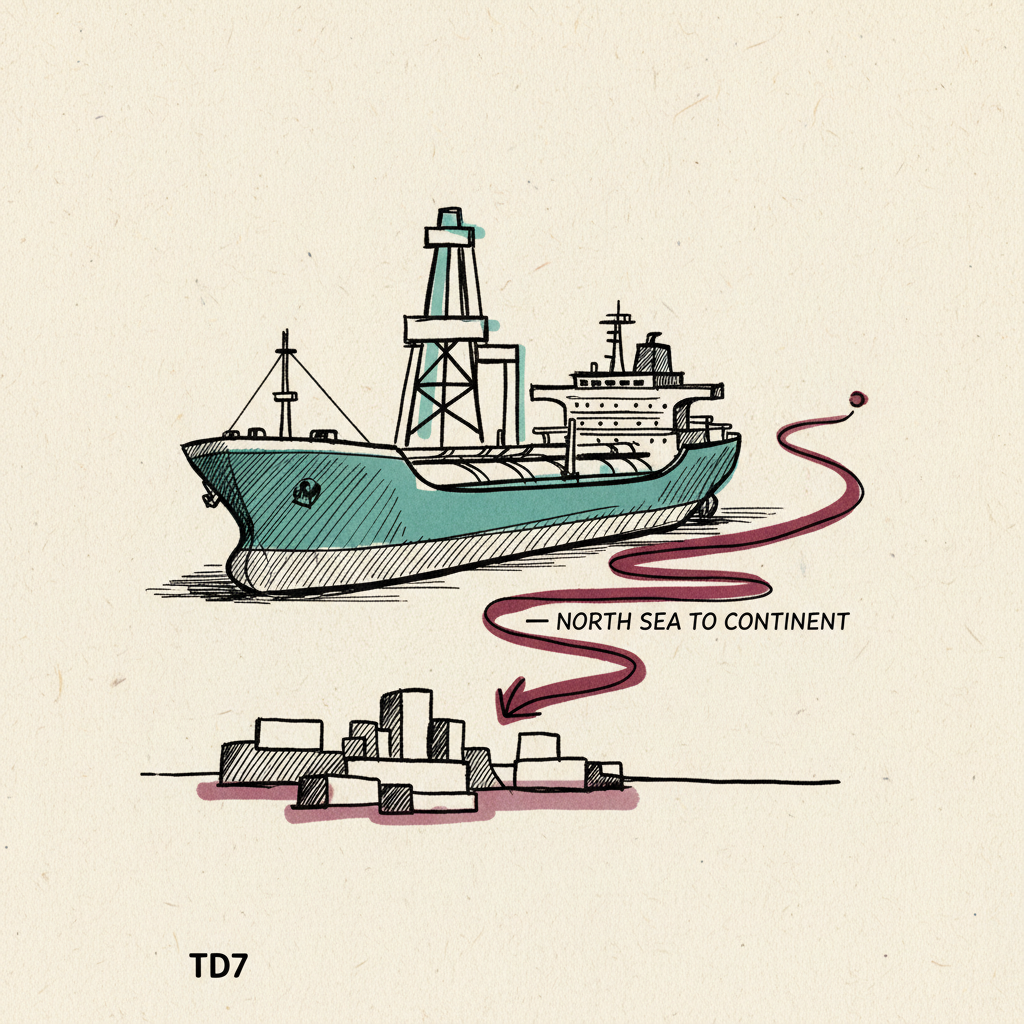
TD7
TD7 is the Baltic Exchange Aframax tanker freight route from the North Sea to Continent (typically Sullom Voe to Rotterdam), heavily used for Russian Baltic crude movements.
Last refreshed: 1 June 2026 · Appears in 1 active topic
How has GL 134C changed the compliance premium on Baltic Aframax freight routes?
Timeline for TD7
Mentioned in: GL 134C lapsed clean, no successor
European Oil MarketsMentioned in: OFAC lists RISE GLORY and Ivan Sechin
European Oil MarketsBaltic Aframax bid eases off the spike
European Oil MarketsBackground
TD7 is the Baltic Exchange's benchmark freight route for dirty (crude oil) Aframax tankers of approximately 80,000 DWT, covering the voyage from Hound Point, Scotland (the Forties crude loading terminal on the Firth of Forth) to the Continent, typically Wilhelmshaven or Rotterdam. The TD7 Worldscale (WS) rate is the primary published reference for the freight cost of moving North Sea crude to ARA-region refiners, and it forms part of the Baltic Dirty Tanker Index (BDTI). Aframax tankers (80-120,000 DWT) dominate North Sea crude export movements because the Hound Point Marine terminal, the Sullom Voe terminal in Shetland, and many UK Continental Shelf offtake points impose draught and beam restrictions that preclude VLCCs. TD7 therefore captures both the tightness of North Sea production and the compliance cost imposed by sanctions on Russian-origin Aframax movements.
The GL 134C general licence signed by OFAC on 18 May 2026 restored the vessel-services umbrella (insurance, crewing, classification, bunkering) for Russian crude cargoes loaded on or before 17 April 2026, directly affecting the compliance premium embedded in Aframax freight. Before GL 134C's signing, insurers refused cover for Aframax tankers touching Russian crude regardless of load date, forcing charterers to pay above-market rates to non-Western-insured vessels or to accept penalty clauses. GL 134C's reinstatement partially relieved that squeeze.
The next material event for TD7 is the 17 June 2026 expiry of GL 134C, after which the vessel-services umbrella again lapses for Russian-origin Aframax cargoes. Market participants were watching this date closely alongside OFAC's 28 May 2026 wave of Iran and Russia designation actions, which confirmed that enforcement pressure on both tracks remained active. Historically, GL 134C-type expiry dates have re-tightened the compliance bid on TD7 unless a renewal or permanent carve-out is announced beforehand.
TD7 rates are closely watched by North Sea crude producers, European refiners buying Forties and Ekofisk blends, and by traders positioning on the physical-futures spread. When TD7 rates are elevated, the effective cost of North Sea crude landed at ARA rises, supporting the ICE Brent futures premium and widening crack spreads for refiners WHO cannot source cheaper alternatives.