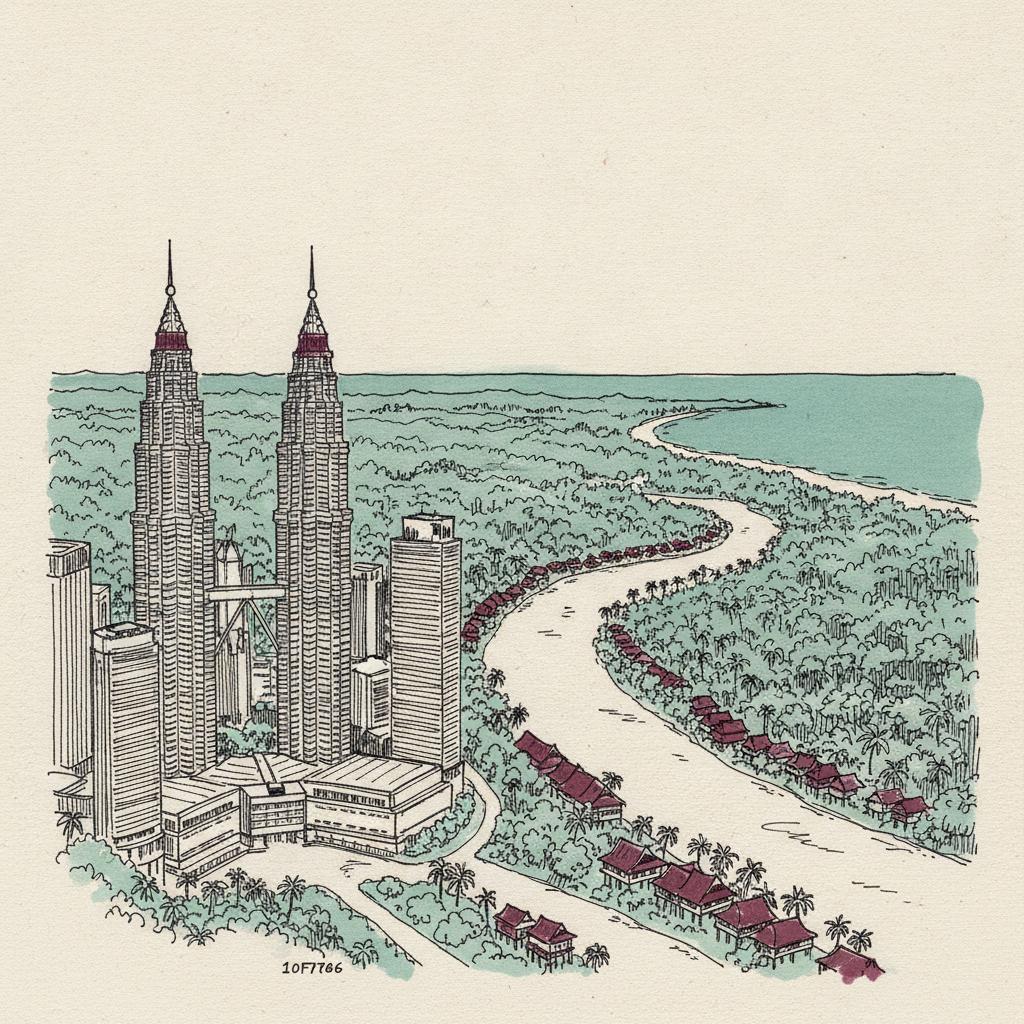
Malaysia
Muslim-majority Southeast Asian nation; home to DE Rantau (nomad Visa) and MM2H (second-home programme), distinct routes.
Data centres drew 9.3% of Malaysia's electricity during one August week, against 7% across the year to date, the Energy Commission said on 8 September, months after Johor paused approvals over water.
Last refreshed: 3 October 2026 · Appears in 3 active topics
Is Malaysia's DE Rantau the cheapest Southeast Asian nomad visa, and how does it differ from MM2H?
Timeline for Malaysia
Mentioned in: Treasury names 10 Iran missile suppliers
Iran Conflict 20269.3% of Malaysia's power, in one week
Data Centres: Boom and BacklashMentioned in: Thailand limits land border runs to two
Nomads & CommunitiesMentioned in: Iran counters Oman with a lane demand
Iran Conflict 2026Mentioned in: Johor operator says it uses no fresh water
Data Centres: Boom and BacklashBackground
Malaysia is a Muslim-majority Southeast Asian federation with two separate long-stay routes for foreigners: DE Rantau, its digital-nomad pass, and Malaysia My Second Home (MM2H), a residence programme with income and deposit tests aimed at wealthier long-stayers. Each route answers to a different kind of long-stayer, so neither substitutes for the other.
Johor, across the strait from Singapore, has become the centre of Malaysia's data-centre build-out, which makes the state's water and The National grid the limits on that growth. Petronas, the state energy company, gives the country weight in Asian gas markets.
Malaysians also hold a regional privilege in neighbouring Thailand. They are among the nationals exempt from the Thai CAP, effective 15 September 2026, that allows other visitors only two Visa-free overland arrivals per calendar year, so travel north by road stays open to them.
Data centres strain Malaysia's grid
On 27 April Johor halted Tier 1 and Tier 2 data-centre approvals after Malaysia's first water-rights protest at a data-centre site, and told applicants to wait until mid-2027 for connections. By 26 June Malaysian data centres held 5.9 GW of contracted grid capacity, 43% of everything committed by The National utility Tenaga Nasional Berhad, and the rights group Suaram called for a moratorium.
The strain has since reached the grid's weekly load. The Energy Commission reported on 8 September that data centres used 9.3% of national electricity in the second week of August, as hotter weather pushed demand up. On 24 July the Johor operator ZDATA said its 300 MW Iskandar Puteri site runs only on treated wastewater, the first named operator to answer the water complaint.
Malaysia negotiates its own Hormuz passage
Malaysia opened bilateral talks with Tehran for Hormuz transit on 22 March 2026, a day after Japan secured passage, and negotiated alone rather than in a bloc with India, Pakistan, Iraq or China. That placed Kuala Lumpur among the states outside the US-led coalition that sought commercial access under the Islamic Revolutionary Guard Corps toll system, which charged up to $2m a vessel and handled 89 to 90 ships a fortnight.
Malaysia's exposure ran both ways. Iranian shadow-fleet tankers used the Anchorage off Johor for ship-to-ship transfers through the spring, dispersing from late June as enforcement tightened, while Petronas, the state energy company and a leading LNG supplier to Japan and South Korea, stayed exposed to any Hormuz price spike.
Reference
How much do I need to earn to get Malaysia's digital nomad visa?
What is the difference between Malaysia's DE Rantau and MM2H programmes?
Is Malaysia part of the US-led coalition against Iran?
Why is Malaysia negotiating with Iran over the Strait of Hormuz?
How does Malaysia differ from India and China in the Hormuz talks?
What is Malaysia's Strait of Malacca role in the Iran conflict?
What is Malaysia's role in current events?
Why did Iranian tankers gather off Malaysia's Johor coast during the 2026 conflict?
Is Malaysia's Johor data centre moratorium still in effect?
What does Malaysia's maritime advisory on Iranian ship-to-ship transfers mean?


