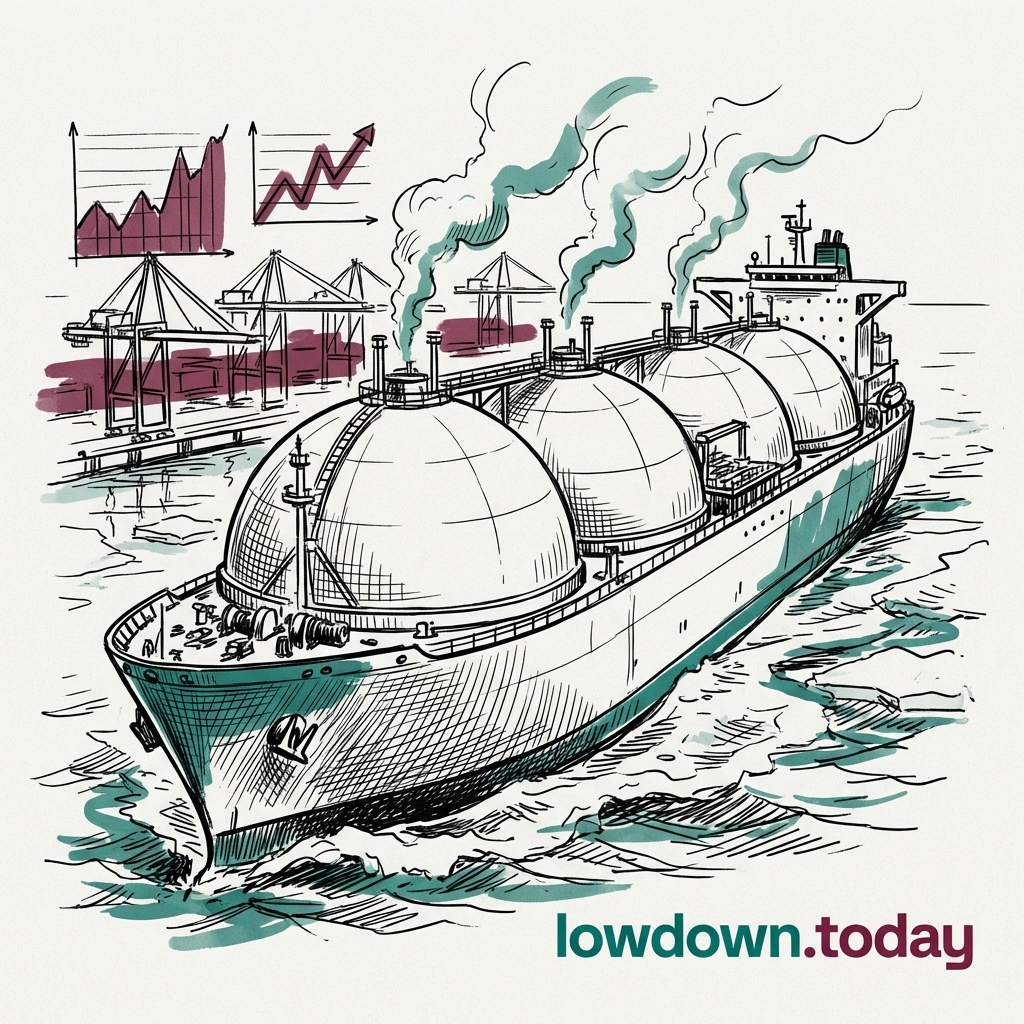
Liquefied Natural Gas
Natural gas chilled to -162°C for ship transport; global supply disrupted by Iranian strikes and EU Russian ban.
Last refreshed: 30 June 2026 · Appears in 2 active topics
With two supply crises running simultaneously, can Europe fill storage before winter 2026?
Timeline for Liquefied Natural Gas
Mentioned in: TTF round-trips on Hormuz, ends Q2 down
European Energy MarketsOIES base case becomes its stress case
European Energy MarketsLNG arb hits parity, Qatar trains dark
European Energy MarketsMentioned in: EU refill surges once the heat breaks
European Energy MarketsGoldman and OIES split the winter
European Energy MarketsBackground
Liquefied Natural Gas (LNG) is natural gas cooled to approximately -162°C for ship transport, enabling export to markets unreachable by pipeline. It sits at the centre of two concurrent crises in 2026: the EU's phased ban on Russian LNG (short-term contracts from 25 April, all Russian gas by year-end) and the Iran-war disruption at Ras Laffan that removed Qatar's ~20% of global supply simultaneously.
European governments turned to Qatari LNG as the primary replacement for Russian pipeline gas from 2022 onwards, transferring dependence from a pipeline monopoly to Gulf concentration risk. By late June 2026, the JKM-TTF arbitrage compressed to near-parity at roughly $11.1/MMBtu, briefly making TTF the dearer leg and eliminating Asia's pull on Atlantic cargoes; but QatarEnergy's two missile-destroyed LNG trains remain offline with no restart before mid-July, meaning the theoretical Atlantic cargo route cannot yet be filled.
The Oxford Institute for Energy Studies had modelled EU storage reaching 69.6% fill by 1 November on a mid-year Hormuz reopening; late-June Gulf escalation invalidated that base case, making OIES's own closed-through-October stress scenario the benchmark autumn trajectory. European storage at roughly 48.6% fill as of late June must bridge winter without confirmed Qatari volume; the autumn top-up window is now the binding supply constraint.
What is the EU ban on Russian LNG in 2026?
What is LNG and how is it different from pipeline gas?
Why did the EU continue importing Russian LNG after 2022?
Will the Russian LNG ban raise European energy prices?
Where does Russia export LNG?
Why is European gas briefly more expensive than Asian LNG in June 2026?
When will Qatar restart LNG exports after the 2026 strikes?
Why did the EU ban Russian LNG imports?
What happens to European gas storage if Hormuz stays closed through autumn 2026?
