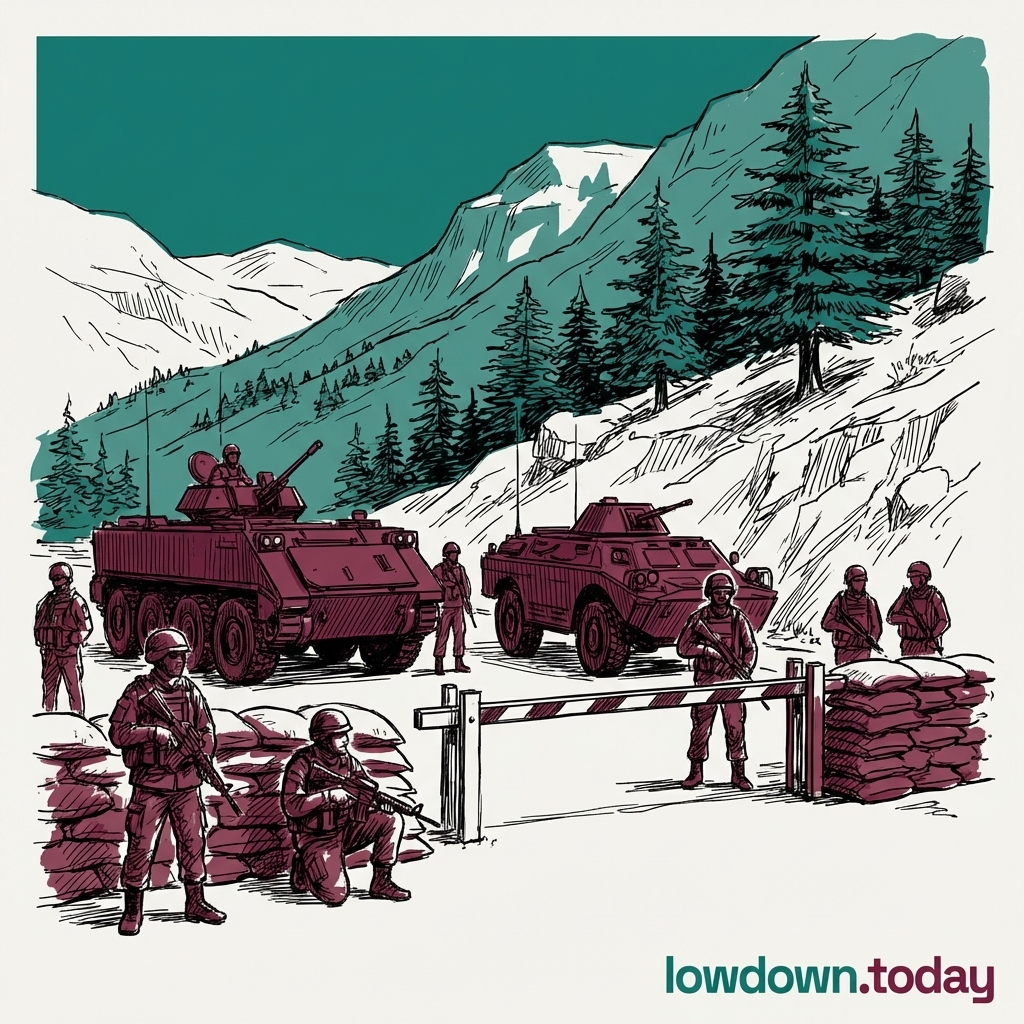
Lebanese Armed Forces (LAF)
Lebanon's national Army; now the designated deployment and handover force in the Israel-Lebanon de-escalation.
On 22 June, the Lebanese Armed Forces (LAF) entered Debbine with UN peacekeepers after an Israeli redeployment, testing its proposed role as the sole force in pilot zones south of the Litani.
Last refreshed: 22 September 2026 · Appears in 1 active topic
Can Lebanon's army actually disarm Hezbollah south of the Litani in the pilot zones?
Timeline for Lebanese Armed Forces (LAF)
Lebanon talks collapse, nuclear gate stays shut
Iran Conflict 2026Mentioned in: Lebanon talks stall on the Litani map
Iran Conflict 2026Lebanon opens a track in Washington
Iran Conflict 2026Mentioned in: Iran makes Lebanon the gate to talks
Iran Conflict 2026Israel hands back Debbine, keeps the zone
Iran Conflict 2026Background
The Lebanese Armed Forces (LAF) are Lebanon's national military and the state institution assigned to deploy in the south under UN Security Council Resolution 1701. They are distinct from Hezbollah, whose parallel armed structure has constrained the Army's ability to act as Lebanon's sole armed force.
Lebanon's confessional system shapes the force's leadership and officer corps. Its commander is constitutionally a Maronite Christian general, while its Army, navy and air force draw personnel from across the country's communities. The LAF's role has long depended on preserving institutional cohesion while avoiding a direct internal confrontation with Hezbollah's weapons.
The force matters because international Ceasefire plans rely on it as the Lebanese state presence in the south. On 17 April, it reported multiple Israeli Ceasefire violations within a day of a truce taking effect, illustrating the gap between its monitoring role and its ability to enforce security on the ground.
The LAF awaits a pilot handover
On 22 June, LAF engineers entered Debbine alongside UN peacekeepers after Israeli forces pulled back towards Khiam. The move reopened roads, but Israel retained its wider security zone, leaving the Army with a local deployment rather than control of southern Lebanon.
From 22 to 25 June, Lebanon-Israel talks considered pilot zones where the LAF would operate alone and Hezbollah would disarm south of the Litani. No confirmed handover emerged from the talks, so the Army's proposed role remained a diplomatic design rather than an established security arrangement.
The LAF faces direct battlefield risk
On 17 March, Israeli strikes killed three LAF soldiers and wounded five during the Lebanon conflict. The deaths placed Lebanon's state military directly in a war largely defined by Israel's confrontation with Hezbollah, whose forces remain separate from the national army.
On 6 June, an Israeli strike hit an LAF column on the Khardali-Nabatieh road, killing a colonel and other soldiers. The attack exposed the practical danger facing an Army expected to support Ceasefire arrangements while operating near an active Israeli military campaign.
What is the Lebanese Armed Forces?
Why didn't Lebanon's army stop Hezbollah?
Did Lebanon's army retreat from the border in 2026?
How much US aid has Lebanon's army received?
Is there a ceasefire in Lebanon and who is monitoring it?
What are the LAF pilot zones in south Lebanon?
Did Lebanon's army enter Debbine after Israel withdrew?
Was a Lebanese army officer killed by Israel in 2026?




Written with AI from Lowdown's published reporting. Not individually reviewed by an editor. Updated 22 September 2026. Editorial standards.