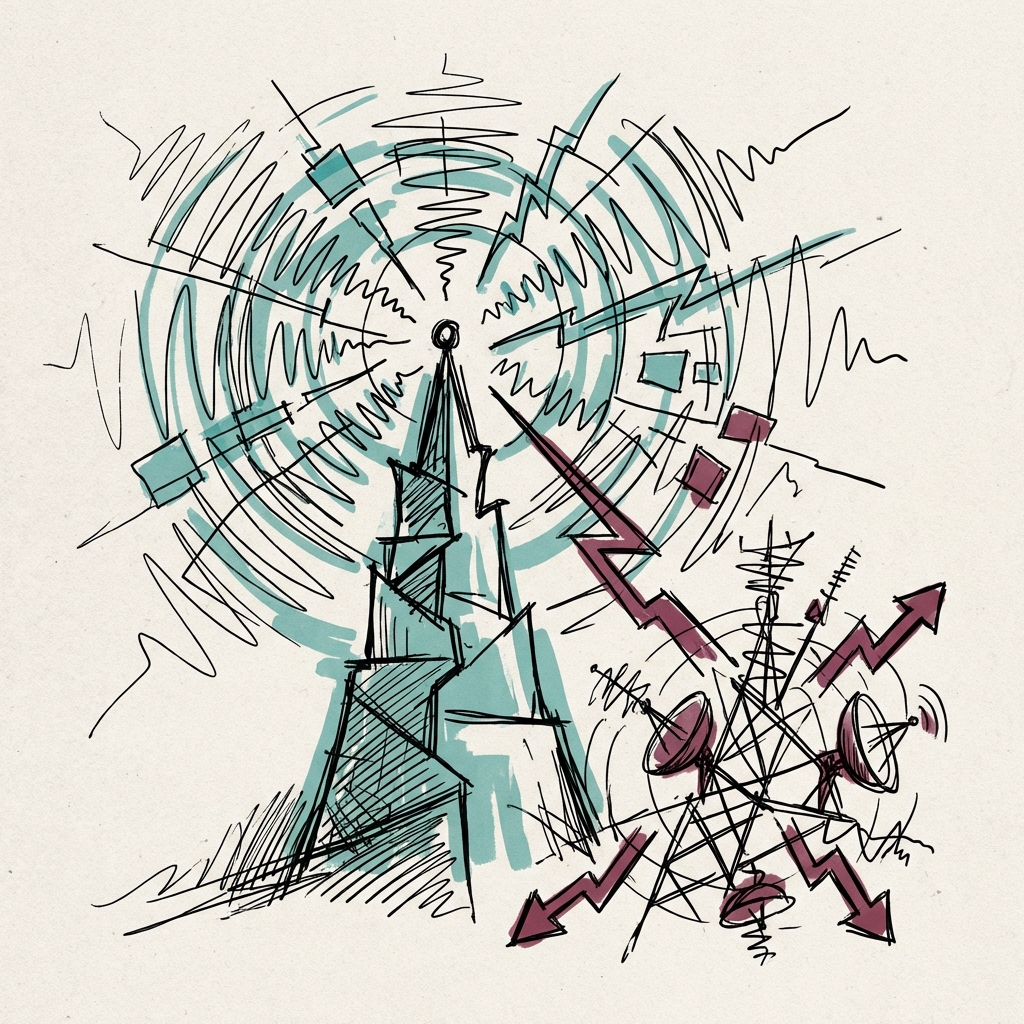
Electronic Warfare
Disrupting enemy communications and radar through jamming and signal interception.
electronic warfare's defining 2026 escalation: Russia's jam-resistant Izdeliye-30 cruise missile killed ten people in a Kharkiv apartment block on 7 March, the first confirmed strike proving Moscow had finally engineered around three years of Ukrainian jamming that had blunted GPS-guided munitions.
Last refreshed: 24 July 2026 · Appears in 1 active topic
Why did the US deploy an untested aircraft to replace a destroyed AWACS?
Timeline for electronic warfare
Assessed cause of drone diversion into NATO territory
Drones: Industry & Defence: NATO F-16 downs drone over Estonian soilMentioned in: Skydio opens GPS-denied lab in Zurich
Drones: Industry & DefenceMentioned in: UK concedes fibre drones beat its defences
Drones: Industry & DefenceMentioned in: A-10 crashed in rescue; SAR under fire
Iran Conflict 2026Mentioned in: First US jet downed; officer missing
Iran Conflict 2026Background
electronic warfare disrupts enemy communications, radar and navigation through jamming, spoofing and signal interception, and has become central to modern conflict: a jammed missile costs nothing to defeat against an interceptor that would otherwise be needed. Ukraine has spent three years jamming Russian cruise-missile guidance, while Russia has responded with the jam-resistant Izdeliye-30, first used against a residential target in Kharkiv on 7 March 2026.
That expertise has since moved with Ukrainian crews into Gulf air defence, where operators now work in Qatar, Saudi Arabia, the UAE and Jordan intercepting Iranian Shahed drones. GPS denial has also reshaped ground autonomy: Europe's 2026 uncrewed-convoy trials, including the InterRoC series at Switzerland's ELROB exhibition, now explicitly test whether autonomous vehicles can hold formation when satellite positioning is jammed, extending the same contest from missiles and drones into NATO's land-robotics programmes.
The same dynamics produced 2026's most consequential EW failure mode in the Baltic, where Russian jamming of Ukrainian drone navigation twice diverted strikes onto NATO territory, prompting the Alliance's first kinetic Intercept of a drone on allied soil.
Russia fields a jam-resistant missile
Ukraine's electronic warfare had deflected GPS-guided Russian munitions for three years, forcing Moscow to engineer around it. On 7 March the Kharkiv Regional Prosecutor's Office identified the weapon that struck a five-storey apartment block, killing ten people, as the Izdeliye-30, a subsonic cruise missile purpose-built with jam-resistant satellite navigation, its first confirmed use against a residential target.
The same fortnight showed the volume side of the contest: Russia flew 8,828 kamikaze drones in 24 hours on 2 March, roughly triple its 2025 daily average, then 9,616 on 17 March. Saturating jamming and interception at that scale, rather than defeating it outright, is now Russia's preferred route past Ukrainian electronic warfare.
Ukraine exports its jamming expertise
Ukrainian counter-drone crews, trained through three years of nightly Shahed barrages, deployed to Qatar, Saudi Arabia, the UAE and a US base in Jordan within a week of President Zelenskyy's 2 March offer to help any country facing Iranian drones.
The expertise travelled faster than any hardware sale: within days the UAE had requested 5,000 Ukrainian interceptor drones and Qatar 2,000, priced at $1,000-$2,000 each against roughly $13.5 million for a single Patriot round. electronic warfare know-how, not just drones, is now Ukraine's most exportable wartime asset.
Cheap jamming inverts interceptor economics
Ukraine builds interceptor drones for $1,000-$2,000 apiece against $4-6 million for a single Patriot round, a cost gap that only widens as saturation drone and missile tactics spread from the Russia-Ukraine front toward the Gulf.
By 8 March, mounting Gulf demand for cheap interceptors was pushing Kyiv to weigh lifting its 2022 arms-export ban altogether, arguing that export revenue would fund domestic air defence independent of Western aid. Whichever side wins the underlying jamming-and-interception cost race decides whether cheap defence or expensive precision sets the future price of war.
What is electronic warfare?
How does Ukraine jam Russian missiles?
Can Russia defeat Ukrainian electronic warfare?
How many drones does Russia launch per day?
Why are Gulf states buying Ukrainian drones?

