Skip to content
Briefings are running a touch slower this week while we rebuild the foundations.See roadmap
UK Startups and Innovation
22APR

Britain's innovation pipe leaks at both ends

5 min read
17:16UTC

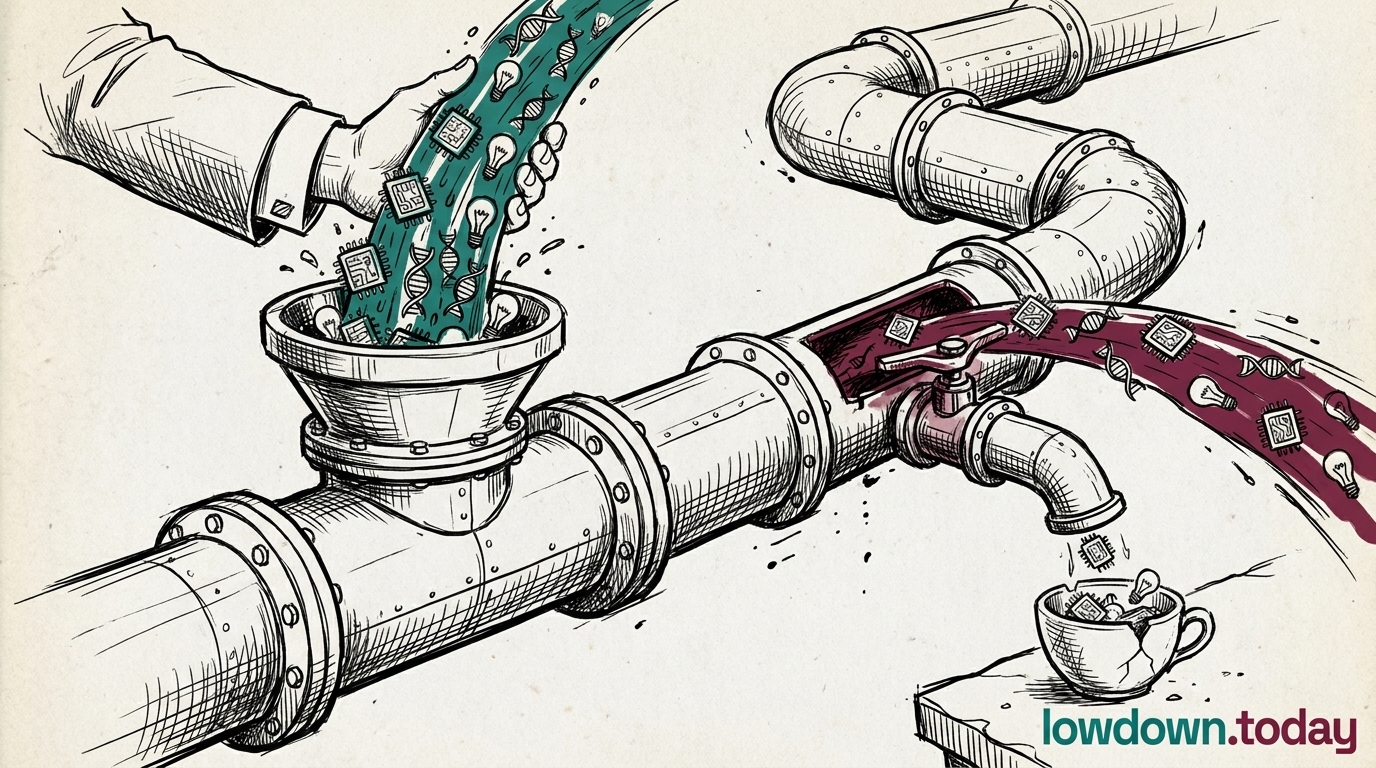
The innovation pipe leaks at both ends this week: Britain's state named winners across AI, quantum, life sciences and defence, while Venture Capital Trust (VCT) fundraising faces a projected 65% collapse and the biggest grant ever made to a University of Cambridge spinout will build its factory in Italy. Seven firms are backed by the Sovereign AI Unit (SAIU), four quantum startups at Harwell, over £80m to four life sciences sites.

Key takeaway

Britain has state-funded growth capital and named winners, but no bridge between the £100k and £5m cheque sizes and no vehicle to keep a factory close to the lab.

This briefing mapped
Loading map…
Regulatory
Economic
Infrastructure

Seven companies, one equity cheque, six allocations of state compute. The £500m Sovereign AI Unit stops being a press release and starts being a deal sheet.

Sources profile:This story draws on neutral-leaning sources
Sources:DSIT

Three chip architectures, one London autonomy startup, and an $8.6bn post-money valuation. The Series D extension is a commercial bet with a policy jacket.

Sources profile:This story draws on centre-left-leaning sources from United States
United States

Wayve, a London autonomous-driving startup, closed a $60m Series D extension on 15 April 2026 from AMD, Arm, and Qualcomm, the three chip architectures underpinning Nscale's $2bn build-out .

Wayve now has backing from all three major chip architectures at once, an unusual syndicate that positions the company as a reference customer validating automotive AI across competing silicon stacks. 

Sources:CNBC

Retail investors poured a third-highest-ever tally into Venture Capital Trusts ahead of a tax cliff on 6 April. The precedent from 2006 suggests the follow-on year lands near £320m.

Sources profile:This story draws on neutral-leaning sources

Wealth Club reported on 14 April 2026 that VCT fundraising reached £917.7m in 2025/26, the third-highest year on record, driven by a deadline rush before income-tax relief fell from 30% to 20% on 6 April 2026 ; analysts project a 65% decline to circa £320m in 2026/27.

The VCT record is a farewell spike driven by a tax deadline, not a durable trend; the projected collapse removes roughly £600m of early-stage UK capital at exactly the seed tier no state vehicle currently reaches. 

A University of Cambridge graphene photonics spinout just received the biggest industrial cheque ever written for one of its own, and the factory will open in Pisa.

Sources profile:This story draws on neutral-leaning sources

The European Commission approved €211m of Italian state aid for CamGraPhIC, a University of Cambridge graphene photonics spinout, on 15 April 2026; pilot manufacturing facilities will open in Pisa and Bergamo in 2028.

The CamGraPhIC approval exposes a specific vehicle gap in UK post-Brexit state-aid law: Britain has no mechanism to match EU-scale single-firm industrial subsidies, and commercialisation migrates accordingly. 

Barnstaple, Birmingham, Haverhill, Hengoed. Every Life Sciences Innovative Manufacturing Fund cheque this round landed outside the Golden Triangle, and the geography is the whole point.

Sources profile:This story draws on neutral-leaning sources
Sources:DSIT

Seven unicorns in three months, 41% of the European total, and $5.8bn of it pouring into AI. The headline is impressive; the distribution is brutal.

Sources profile:This story draws on neutral-leaning sources

UK venture capital reached $7.8bn in Q1 2026, up 60% year on year and representing 41% of the European total, with seven unicorns minted in three months; mega-rounds above $100m accounted for 65% of the total.

The Q1 2026 VC number confirms capital is abundant for UK startups at scale but structurally inaccessible below mega-round size, extending the concentration pattern already visible in the March 2026 London data. 

Sources:City AM

Gross-assets limit jumps from £30m to £120m. Employee headroom doubles from 250 to 500. The share-option pool doubles to £6m. Most of this unlocks at Series B and C, not seed.

Sources profile:This story draws on mixed-leaning sources from United Kingdom (includes United Kingdom state media)
United Kingdom

Enterprise Management Incentives reform effective 6 April 2026 raised the gross-assets test from £30m to £120m, doubled the employee limit from 250 to 500, doubled the share-option pool from £3m to £6m, and doubled EIS and VCT lifetime company investment limits to £24m.

The EMI reform and the simultaneous VCT cut together redistribute tax incentive away from pooled retail seed capital and toward scaleup employee compensation, with no bridging instrument for the £250k-£2m tier in between. 

Four quantum startups, £50k-£100k per cheque, 50 hours of business support each. A proof-of-concept gate rather than a runway.

Sources profile:This story draws on neutral-leaning sources

UKRI's STFC and NQCC named four quantum startups in the DeepTech Catalyst Quantum programme on 14 April 2026: Curenetics, Coherence Engine, AmorphiQ, and Qascade, each receiving £50,000–£100,000 plus 50 hours of business support.

The DTC Quantum cohort is the commercial startup layer the UK's £2bn ProQure commitment was designed to catalyse; its eighteen-month follow-on rate will be the first test of whether the money has reached deal-ready companies. 

Sources:UKRI / STFC

Eighty per cent of UK AI datacentre capacity sits in London, and West London's grid is full. Scotland and the north are being handed the next wave almost by default.

Sources profile:This story draws on neutral-leaning sources from United Kingdom
United Kingdom

On 20 April 2026, The Register reported that London hosts 80% of UK AI datacentre capacity but Slough has reached saturation with 35 datacentres and West London grid exhausted; UK electricity costs four times US equivalents per IEA data, with AI Growth Zones directing capacity north.

AI datacentre siting is becoming a grid-connection problem rather than a planning or policy problem, and whichever regulator unblocks the National Grid queue first will determine where the next £10bn of AI capex lands. 

A Wiltshire startup pulled IQ Capital, Plural, and a European founder-angel trio onto its cap table to build synthetic gas at 15MW scale.

Sources profile:This story draws on neutral-leaning sources

Rivan raised £25m on 20 April 2026, led by IQ Capital with Plural and angel investors Matt Clifford, Thomas Wolf, and Markus Villig, to build Project Steadfast: a 15MW synthetic natural gas plant in Wiltshire, Europe's largest SNG facility and the first SNG injection into the UK gas grid.

Rivan's syndicate pairs UK deep-tech VC with three European category-defining founders, a pattern that routes scale-up validation to UK cleantech without VCT dependency. 

Sources:City AM

Two startups, five incumbents, one Swiss bank, and one technical partner: the FCA's AI sandbox is starting to look like institutional infrastructure rather than a pilot.

Sources profile:This story draws on centre-left-leaning sources from United States
United States

The FCA named its second AI Live Testing cohort on 21 April 2026, comprising Aereve, Coadjute, Barclays, Experian, GoCardless, Lloyds/Scottish Widows, UBS, and Palindrome, with Advai as technical partner; FCA Regulatory Sandbox applications are up 49% year on year.

FCA Regulatory Sandbox applications are up 49% year on year, the clearest regulator-side signal yet that UK fintech formation is running hot into Q2 2026. 

Sources:CNBC

The MOD now has a permanent private-capital channel, and two new mechanisms borrowed straight from the DARPA-plus-In-Q-Tel playbook.

Sources profile:This story draws on centre-left-leaning sources from United States
United States

Defence Secretary John Healey and Chancellor Rachel Reeves made the Defence Investors' Advisory Group permanent on 22 April 2026, launching Sprint (private-investment leverage mechanisms) and Zig-Zag (private-finance secondments into MoD), targeting UK defence unicorns among startups with no prior MoD contracts.

The UK defence startup ecosystem gains its first permanent institutional architecture for private investment, advancing the £20m accelerated contracts fund from a project into a durable structure. 

Sources:CNBC

Phase one of a 50% reduction target. The single biggest regulatory overhead on small authorised fintechs has finally started to shrink.

Sources profile:This story draws on centre-left-leaning sources from United States
United States

The FCA and Prudential Regulation Authority cut certification roles under the Senior Managers and Certification Regime by 15% on 22 April 2026, phase one of a 50% reduction target, reducing the largest regulatory overhead for small authorised fintech firms.

The SM&CR 15% cut is the first material reduction in fintech compliance overhead since the regime was expanded in 2019, paired with a sandbox demand surge that suggests a deliberate regulatory-posture shift. 

Sources:CNBC

Plymouth battery recycling, London HR-tech, and a 45% weekly bounce in UK tech funding. The small-ticket pipeline is still flowing, just unevenly.

Sources profile:This story draws on neutral-leaning sources

Altilium (Plymouth EV battery recycling) received an £18.5m DBT grant on 16 April 2026; TraqCheck (London HR-tech) raised £5.9m Series A from IvyCap Ventures; UK tech funding rose 45% week on week to £76.7m in the seven days to 17 April.

The week's round flow shows UK early-stage capital remains available at sub-£20m ticket sizes, with regional deep-tech getting material DBT support alongside London software rounds. 

Sources:City AM
Closing comments

Policy intervention is accelerating across AI, life sciences, quantum and defence simultaneously; VCT fundraising is contracting and the seed cliff is structural rather than cyclical; commercialisation outflow to the EU is likely to grow without a UK state-aid vehicle equivalent to Italian or French bilateral industrial subsidy mechanisms.

Different Perspectives
HM Treasury
HM Treasury
Fiscal discipline plus targeted high-leverage public capital is the correct instrument for sovereign AI, life sciences and defence; VCT income tax relief had a visible Exchequer cost that additionality evidence did not support, and EMI reform at the scaleup tier replaces it with a more efficient mechanism.
Italian Ministry of Enterprises and Made in Italy
Italy's €211m state-aid award to CamGraPhIC confirms that EU industrial policy can attract world-leading deeptech manufacturing even when the underlying science was developed in Cambridge; the Pisa and Bergamo facilities represent a direct translation of EU state-aid clearance capability into high-value jobs.
BVCA (British Private Equity and Venture Capital Association)
The VCT collapse hits the Series Seed to Series A range specifically; EMI reform helps at Series B and above but does not replace the retail-investor seed capital that VCT-backed angel networks provide to companies raising below £2m.
Onward (centre-right think tank)
The Venturing Out thesis is confirmed by CamGraPhIC: the UK owns discovery and the university IP but loses commercialisation to jurisdictions willing to write industrial-scale cheques, and no current UK instrument can match a €211m bilateral state-aid notification.
Resolution Foundation
State-picking-winners at the SAIU concentrates capital with already-connected founders inside the AMD/Arm/Qualcomm hardware ecosystem; the equity-plus-visa-plus-procurement bundle is unavailable to most underrepresented founders, who typically raise below the SAIU's £1m floor.
Balderton Capital / Atomico / Index Ventures (UK growth-stage VCs)
At Series B and above, the UK ecosystem is in a strong position: $7.8bn in Q1 is 41% of European VC, seven unicorns were minted in three months, and London remains the deepest late-stage capital market outside the United States.

