Skip to content
Briefings are running a touch slower this week while we rebuild the foundations.See roadmap
Russia-Ukraine War 2026
27MAR

Three Iranian principals, three incompatible lines

2 min read
20:48UTC

Lowdown Analysis

ConflictDeveloping
Key takeaway

Vahidi, Araghchi and Ghalibaf's office published three incompatible positions on the extension on 21 April.

Ahmad Vahidi, commanding the Islamic Revolutionary Guard Corps (IRGC, Iran's parallel military), told deputies on 21 April that the IRGC opposes negotiation while the blockade stands 1. Foreign Minister Abbas Araghchi called the blockade 'an act of war and thus a violation of the ceasefire' to Farsi-language press the same day 2. A senior adviser to parliamentary speaker Mohammad Bagher Ghalibaf separately described the extension as 'a ploy to buy time for a surprise strike'.

The three lines landed on the same day President Masoud Pezeshkian, Ghalibaf and foreign ministry spokesman Esmaeil Baqaei had already hardened their rhetoric . This is the same civilian-IRGC deadlock that broke the Islamabad round on 12 April, when the IRGC's blockade-first condition held the door shut . Washington has now set an exit trigger whose fulfilment requires Tehran to resolve a split the Islamabad collapse proved it cannot resolve under pressure.


Deep Analysis

In plain English

Iran does not have a single government speaking with one voice. It has two parallel power structures: an elected civilian government, led by President Pezeshkian and Foreign Minister Araghchi, and the Islamic Revolutionary Guard Corps (IRGC), a powerful military and business organisation that answers to a different chain of command. On 21 April, IRGC commander Ahmad Vahidi said Iran would not negotiate while the US blockade continues. Foreign Minister Abbas Araghchi called the blockade 'an act of war and a violation of the ceasefire'. A third figure, the parliament speaker's adviser, called the ceasefire extension a trap for a surprise strike. All three statements came on the same day. Trump's extension requires Iran to deliver a single 'unified proposal'. But the three people who would need to agree on that proposal publicly disagreed about what was even happening. That is why the exit condition is, at present, unreachable.

Deep Analysis
Root Causes

Iran's civilian-IRGC split on negotiation has a structural origin that predates the 2026 war. The IRGC's economic empire , construction, energy, and banking conglomerates representing an estimated 10-20% of GDP , directly benefits from the blockade posture by controlling smuggling and alternative trade routes that replace sanctioned official channels. Vahidi's 'no negotiations while blockade stands' position protects IRGC economic interests as much as it expresses military doctrine.

The absence of a unifying supreme authority since Khamenei's death removes the one constitutional mechanism capable of overriding Vahidi. Mojtaba Khamenei was installed under IRGC pressure and has issued no directive forcing alignment. The civilian government cannot produce a unified proposal because the IRGC that would need to sign off on it is also the institution blocking access to Mojtaba Khamenei.

What could happen next?
  • Risk

    Vahidi's institutionally binding blockade-first veto means the exit condition cannot be met regardless of civilian diplomatic progress, leaving the extension as a mechanism for prolonging the status quo.

  • Consequence

    Three incompatible Iranian positions on one day confirm the Islamabad round's structural failure was not accidental, making a further Vance shuttle likely to produce the same outcome.

First Reported In

Update #76 · Trump posts an exit Iran can't reach

NBC News· 22 Apr 2026
Read original
Different Perspectives
North Korea / DPRK
North Korea / DPRK
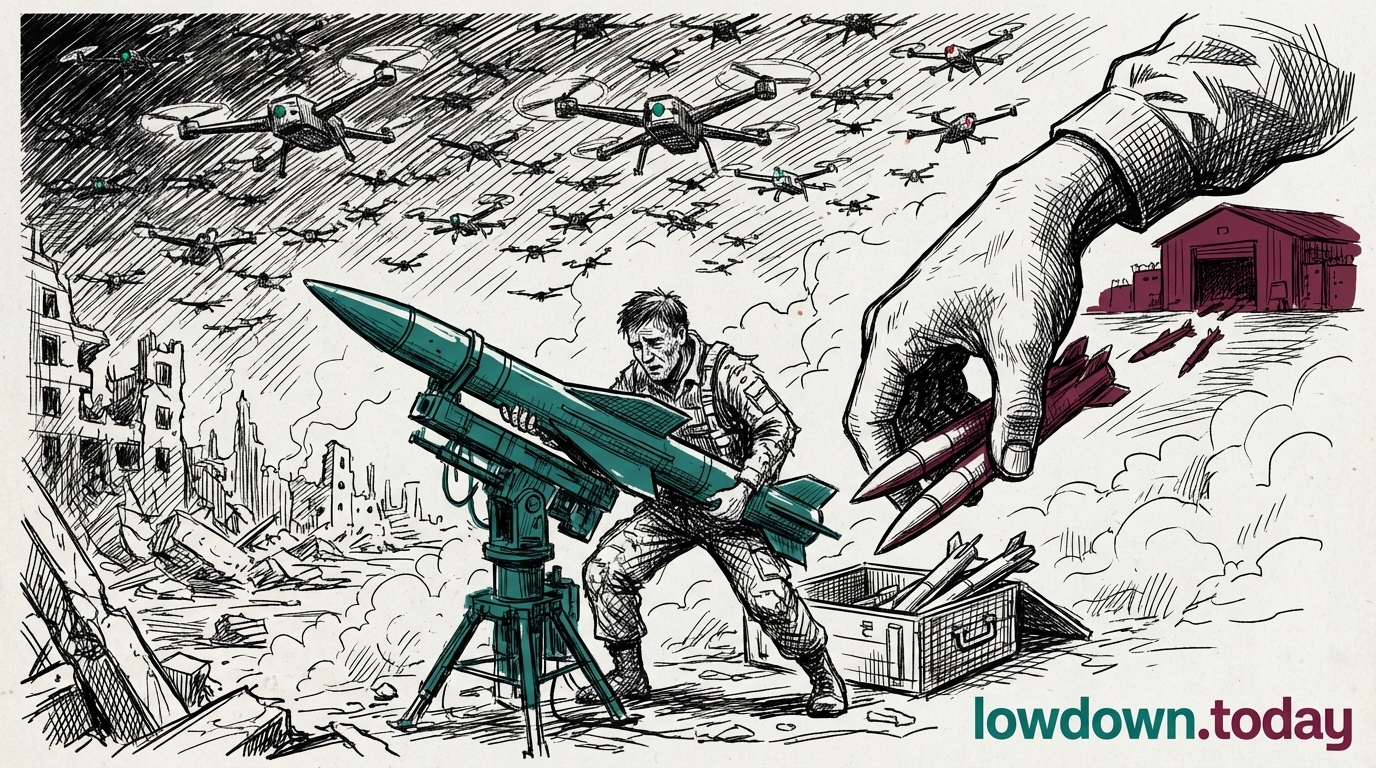
ISW confirmed the first mounting of DPRK Type-75 MLRS on Russian autonomous UGVs near Kharkiv on 7 June, the latest step in a supply axis that escalated from shells in 2023 to troops in 2024. Pyongyang gains live battlefield data on its ordnance and on Russia's uncrewed-systems programme.
IAEA / Rafael Grossi
Grossi confirmed Chornobyl structural damage with nuclear material metres away and could not attribute the ZNPP 15-hour blackout during the agreed repair window. Six ceasefires brokered and broken at ZNPP, compounded by Rosatom's May attack on IAEA neutrality, have eroded his ability to enforce the windows he negotiates.
Emmanuel Macron / France
Macron co-signed the E3 framework whose line-of-contact baseline marks Europe's first formal acceptance that 1991 borders are not the opening position. France's role carries weight because Macron had previously proposed a European force for Ukraine, and the framework's multinational force point is the vehicle for that.
Keir Starmer / E3
Keir Starmer / E3
Starmer, Macron and Merz met Zelenskyy on 7 June and backed a five-point framework taking the line of contact as the talks baseline, conceding roughly one fifth of Ukraine in exchange for a multinational force and frozen assets. With US mediation ended, the NATO Ankara summit on 7-8 July is the next test.
Vladimir Putin / Kremlin
Putin used SPIEF to reject Zelenskyy's summit letter, citing 'elements of rudeness', and repeated the pre-agreed treaty precondition that has frozen every diplomatic round since May. The SPIEF platform's message of investor confidence was punctured by naval fires visible from St Petersburg, which Moscow declined to dispute in scale.
Ukraine / Unmanned Systems Forces
Commander Brovdi confirmed USF units tracked and set fire to Boikyi at Kronstadt, while Code 9.2 struck the Chonhar Bridge the following day. Ukraine is sequencing strikes for rear-area interdiction and political timing rather than ground gains, trading the Baltic Fleet's home base for the logistics squeeze Russia cannot absorb without rationing its own occupied territory.



