Skip to content
Briefings are running a touch slower this week while we rebuild the foundations.See roadmap
Russia-Ukraine War 2026
27MAR

Pakistan Brokers First Ceasefire Framework of the War

3 min read
20:48UTC

The Islamabad Accord offers specific terms for the first time in six weeks of conflict, but Iran's military council holds the veto.

ConflictAssessed
Key takeaway

Pakistan produced the terms; Iran's military council holds the veto.

Pakistan has produced the first concrete ceasefire framework of the war . The two-tier plan, negotiated overnight by Field Marshal Asim Munir, calls for an immediate ceasefire followed by a 15-to-20-day comprehensive settlement period. Iran would commit to abandoning nuclear weapons pursuit. In return: sanctions relief, frozen asset releases, and immediate Strait of Hormuz reopening. The memorandum of understanding would be finalised electronically, with Pakistan as the sole channel.

The key players in the room: Vice President JD Vance, Special Envoy Steve Witkoff, and Foreign Minister Abbas Araghchi. Ynet News reported the ceasefire could take effect as early as Monday 7 April, though this is a single-source claim that should be treated with caution.

Iran's civilian government, which might accept terms, cannot reach the Supreme Leader . The IRGC military council that controls access to Mojtaba Khamenei benefits from continued conflict. The Islamabad Accord asks the IRGC to negotiate away its own wartime authority. No ceasefire framework in history has succeeded when the veto holders profit from the war it would end.

China pledged strategic coordination with Pakistan on the mediation effort. Beijing's backing gives the accord geopolitical weight that previous mediation attempts lacked. But weight is not leverage. The accord exists because five empty deadlines created a vacuum. Whether it can fill that vacuum depends on actors in Tehran who have spent six weeks proving they answer to no one.


Deep Analysis

In plain English

Pakistan put forward a peace plan with specific terms for the first time in six weeks of war. The plan says: stop fighting immediately, then negotiate a full deal over the next two to three weeks. Iran would give up its nuclear weapons programme and get sanctions lifted in return. The problem is that the people who would need to agree to it in Tehran are the same people whose power depends on the war continuing.

Deep Analysis
Root Causes

The ceasefire vacuum exists because US coercive diplomacy required credible escalation, which five deadline extensions destroyed.

Pakistan's mediation opportunity is a direct consequence of Washington's inability to enforce its own threats. The IRGC's wartime power consolidation means the actors who could accept peace are not the actors who hold the veto.

Escalation

De-escalatory in intent, but the framework's existence does not change structural barriers. Iran's non-response is itself an escalation indicator: silence preserves optionality for the IRGC while the civilian government lacks authority to commit. If the accord collapses, the diplomatic space it briefly opened closes harder than before.

What could happen next?
  • Pakistan-China axis becomes the primary mediation channel, displacing US bilateral leverage

    days · Assessed
  • Immediate Hormuz reopening, if achieved, could cut oil prices by $20 or more per barrel within a week

    weeks · Suggested
  • IRGC faces first external framework that offers Iran's civilian government a concrete alternative to war

    days · Assessed
First Reported In

Update #60 · Pakistan's Ceasefire Plan Fills the Vacuum

Al-Monitor / Reuters· 6 Apr 2026
Read original
Different Perspectives
North Korea / DPRK
North Korea / DPRK
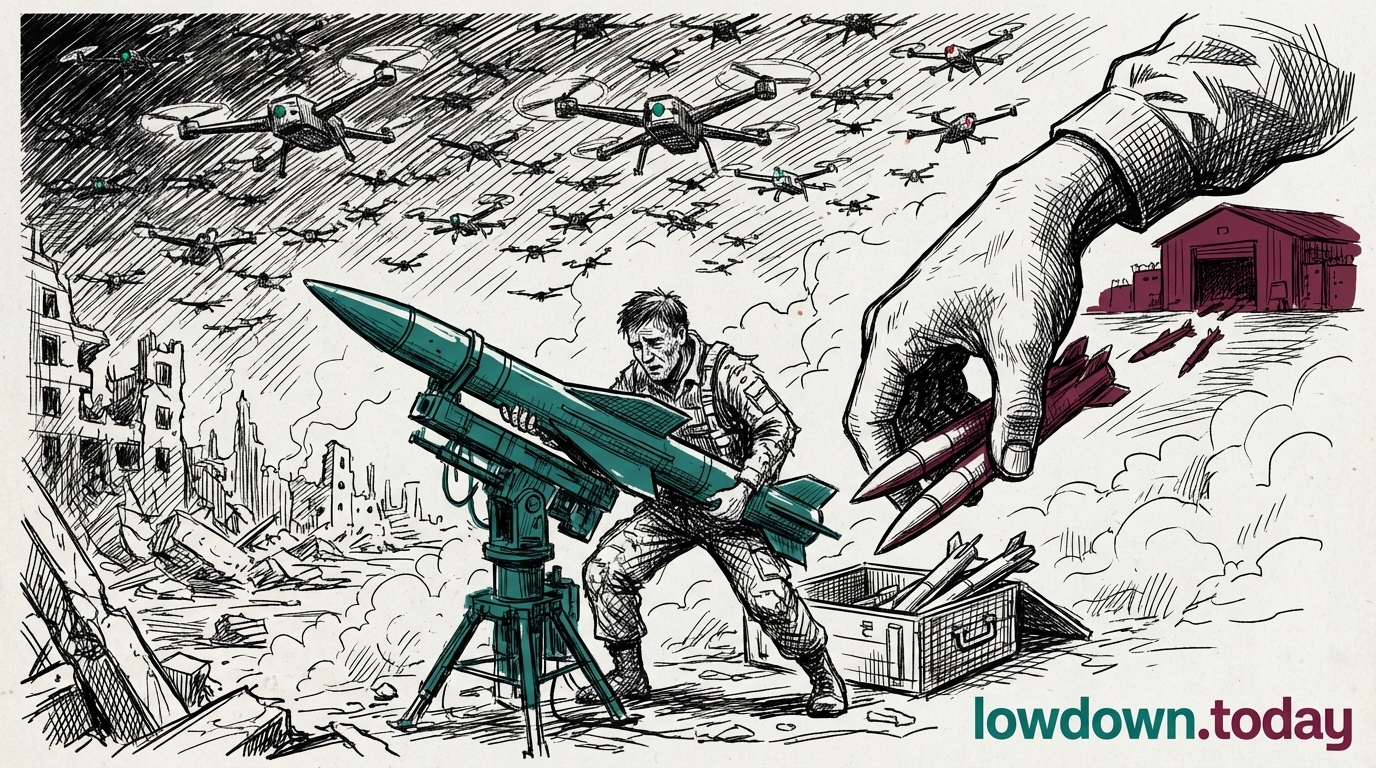
ISW confirmed the first mounting of DPRK Type-75 MLRS on Russian autonomous UGVs near Kharkiv on 7 June, the latest step in a supply axis that escalated from shells in 2023 to troops in 2024. Pyongyang gains live battlefield data on its ordnance and on Russia's uncrewed-systems programme.
IAEA / Rafael Grossi
Grossi confirmed Chornobyl structural damage with nuclear material metres away and could not attribute the ZNPP 15-hour blackout during the agreed repair window. Six ceasefires brokered and broken at ZNPP, compounded by Rosatom's May attack on IAEA neutrality, have eroded his ability to enforce the windows he negotiates.
Emmanuel Macron / France
Macron co-signed the E3 framework whose line-of-contact baseline marks Europe's first formal acceptance that 1991 borders are not the opening position. France's role carries weight because Macron had previously proposed a European force for Ukraine, and the framework's multinational force point is the vehicle for that.
Keir Starmer / E3
Keir Starmer / E3
Starmer, Macron and Merz met Zelenskyy on 7 June and backed a five-point framework taking the line of contact as the talks baseline, conceding roughly one fifth of Ukraine in exchange for a multinational force and frozen assets. With US mediation ended, the NATO Ankara summit on 7-8 July is the next test.
Vladimir Putin / Kremlin
Putin used SPIEF to reject Zelenskyy's summit letter, citing 'elements of rudeness', and repeated the pre-agreed treaty precondition that has frozen every diplomatic round since May. The SPIEF platform's message of investor confidence was punctured by naval fires visible from St Petersburg, which Moscow declined to dispute in scale.
Ukraine / Unmanned Systems Forces
Commander Brovdi confirmed USF units tracked and set fire to Boikyi at Kronstadt, while Code 9.2 struck the Chonhar Bridge the following day. Ukraine is sequencing strikes for rear-area interdiction and political timing rather than ground gains, trading the Baltic Fleet's home base for the logistics squeeze Russia cannot absorb without rationing its own occupied territory.



