Skip to content
You can now search across every topic, entity and event.What's new
Russia-Ukraine War 2026
15MAR

Russia loses net ground for first time

4 min read
06:46UTC

Harvard Belfer Center data shows Russia surrendered a net 33 square miles in a single month while its advance rate fell fivefold from mid-2025 peaks.

ConflictAssessed
Key takeaway

Russia is spending at Soviet-era budget proportions to achieve its slowest territorial gains since the invasion began.

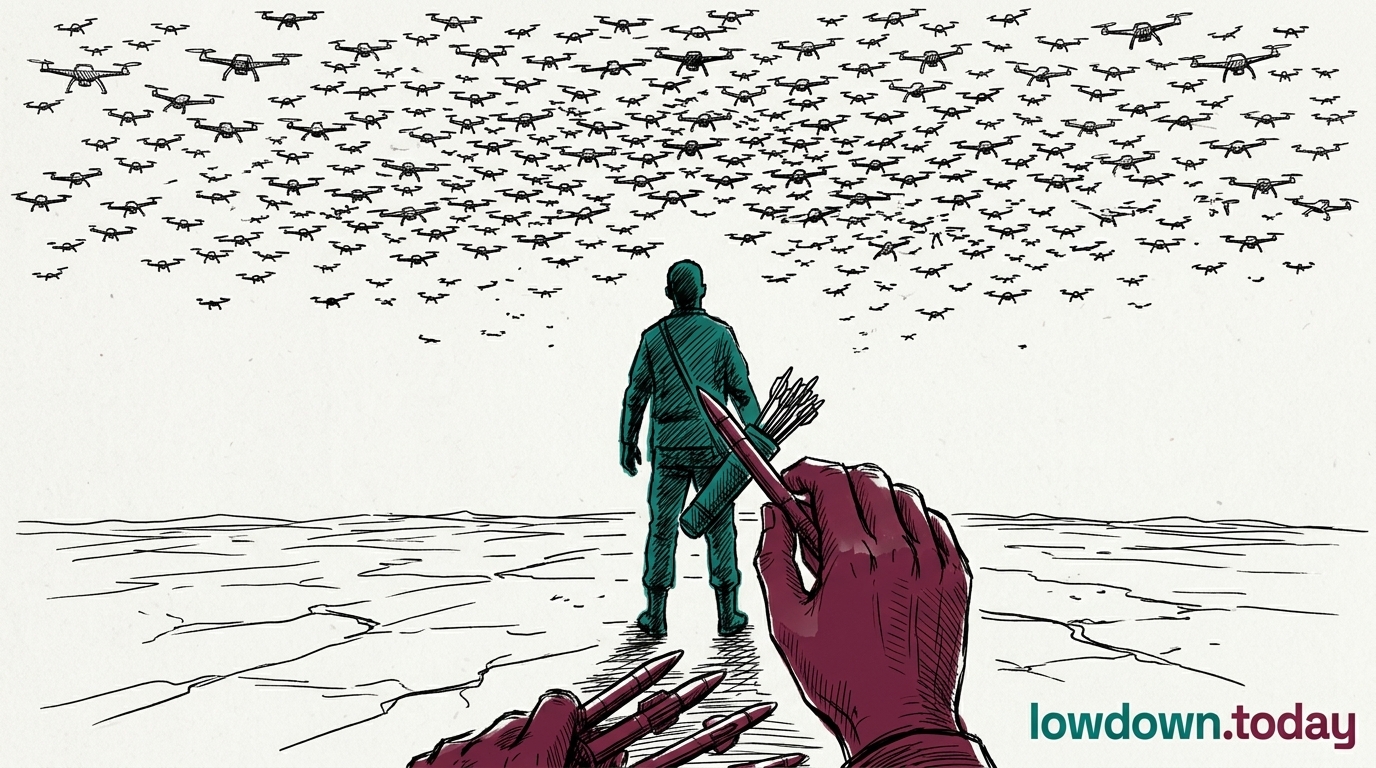
ISW data compiled by the Harvard Belfer Center's Russia Matters project shows Russia lost a net 33 square miles between 17 February and 17 March — the first sustained net Ukrainian territorial gain since the 2023 counteroffensive 1. Russia's advance rate has decelerated fivefold: from 130–150 sq km per week in mid-2025 to 33–50 sq km per week by February 2026. The reversal follows the Zaporizhzhia counteroffensive that reclaimed 460 sq km and eight settlements since late January , which the Institute for the Study of War assessed had 'significantly complicated Russia's plans' for a spring offensive toward Orikhiv.

The cost-exchange ratio compounds the territorial picture. Over twelve months, Russia captured approximately 1,977 square miles — 0.8% of Ukraine's territory — while sustaining an estimated 30,000–32,000 personnel losses per month 2. Mediazona's floor count stood at 203,300 by 13 March ; the Ukrainian General Staff's broader casualty estimate stood at 1,282,570 by 18 March. Syrskyi's January net deficit of 9,000 per monthRussia losing 31,700 against roughly 22,700 recruited — reflects the same structural imbalance.

The Zaporizhzhia sector is where the balance tipped. Syrskyi reported in mid-March that Russia had made it the primary axis of operations, concentrating 'large numbers of troops and resources' around Huliaipole . Zelenskyy stated on 16 March that Ukrainian forces had 'disrupted a Russian strategic offensive operation that the enemy had planned for this March,' crediting the southern counteroffensive . Ukraine's Air Assault Forces alone recaptured 285.6 sq km in February — more than double the roughly 120 sq km Russia seized that month. Russia redeployed elite airborne and naval infantry away from the eastern Donetsk axis to counter the advance .

Ukrainian military analyst Kyrylo Sazonov wrote on Telegram that Russian forces are 'now compelled to allocate resources to defensive stabilisation rather than offensive expansion' 3. That redeployment has not halted pressure around Pokrovsk — which fell in December 2025 — where 18 March saw the highest single-day assault total of the year . But Russia is now fighting on two major axes simultaneously with a force that loses more soldiers each month than it recruits.

Deep Analysis

In plain English

Imagine paying record-high prices for a product and receiving less and less of it each month. That is Russia's situation. Over the past year, it captured a piece of Ukraine smaller than the US state of Delaware — whilst losing the equivalent of a mid-sized city's population in soldiers every single month. Now, for the first time since Ukraine's 2023 counteroffensive, Russia is actually losing ground it had taken. This matters because wars often turn when the attacking side's costs start exceeding what it is gaining. Russia has not reached that turning point publicly, but the numbers are moving steadily in that direction.

Deep Analysis
Synthesis

The convergence of Russia's territorial deceleration with Washington diplomatic re-engagement suggests Ukraine is deliberately timing talks to coincide with demonstrated battlefield advantage — a classic application of Clausewitz's principle that war is politics continued by other means. Negotiating whilst gaining ground yields asymmetrically better terms than negotiating from stalemate. The Zaporizhzhia counteroffensive's 460 sq km gain also threatens Russian logistics routes toward Crimea, adding latent territorial leverage that Ukrainian negotiators have not yet publicly disclosed.

Root Causes

Three structural constraints are driving Russia's deceleration that the body does not name explicitly. First, Soviet-era tank and armoured vehicle reserves — the material basis for massed armour offensives — are approaching exhaustion, forcing reliance on more expensive domestically produced systems with slower delivery timelines. Second, the chronic loss of experienced non-commissioned officers at 30,000–32,000 casualties monthly strips the tactical cadre layer that translates strategic intent into battlefield execution; replacement cohorts are demonstrably less trained and less effective. Third, Ukrainian drone dominance in the zero-to-fifteen-kilometre contact zone has made massed armour advances prohibitively costly, effectively negating Russia's primary offensive instrument in open terrain.

Escalation

Russia's fivefold advance deceleration, combined with a war budget consuming 38–40% of federal spending, creates a fiscal-military trap with a finite horizon. Moscow must either accept diminishing territorial returns per rouble spent — politically difficult to justify domestically — or escalate to higher-risk conventional operations that carry broader escalation exposure. Neither trajectory is sustainable beyond 12–18 months at current burn rates without a significant external revenue windfall, which is precisely where the Iran conflict's energy price effect becomes strategically relevant to Russian calculations.

What could happen next?
1 meaning1 consequence1 risk1 opportunity1 precedent
  • Meaning

    For the first time since 2023, Ukraine holds demonstrable tactical momentum — shifting its negotiating posture from defensive attrition to one that can credibly threaten further Russian territorial losses.

    Short term · Assessed
  • Consequence

    Russian force reallocation to defensive stabilisation in Zaporizhzhia simultaneously relieves assault pressure on Pokrovsk and Kostiantynivka, giving Ukraine tactical relief on multiple axes at once.

    Short term · Assessed
  • Risk

    Overextension of the Zaporizhzhia counteroffensive could expose Ukrainian flanks if Russia reconstitutes armoured reserves and exploits a weakened line elsewhere on the contact line.

    Medium term · Suggested
  • Opportunity

    Sustained territorial gain in Zaporizhzhia could shift Western parliamentary opinion toward approving further advanced weapons transfers as success arguments become more politically viable domestically.

    Short term · Suggested
  • Precedent

    The first confirmed Ukrainian net territorial gain after years of Russian advances establishes that attritional warfare can be strategically reversed without conventional numerical superiority.

    Long term · Assessed
First Reported In

Update #6 · Ukraine sends negotiators as front reverses

Kyiv Independent· 20 Mar 2026
Read original
Causes and effects
This Event
Russia loses net ground for first time
The first sustained net Ukrainian territorial gain since the 2023 counteroffensive. Russia's offensive capacity is degrading faster than recruitment can replace losses, and the Zaporizhzhia counteroffensive has forced a structural reallocation from offence to defence across the front.
Different Perspectives
Turkey
Turkey
Turkey, a major buyer of Russian diesel cargoes, loses that access under Moscow's first producer-binding export ban, in force from 8 July to 31 July. Ankara hosted the same week's NATO summit pledging EUR 70bn to Ukraine, sitting on both sides of the fuel-and-alliance ledger.
NATO
NATO
NATO leaders meeting in Ankara on 7 and 8 July pledged EUR 70bn in equipment, assistance and training for Ukraine across 2026, with a 2027 sustainment commitment and a $40bn Drone Edge counter-drone initiative. European allies now fund the vast majority of that package, filling the gap left by Washington's idled crude waiver.
India
India
India's state refiners continued buying discounted Urals crude as June's price fell to $63.18 a barrel, insulating New Delhi from the OFAC waiver gap still constraining Western buyers. Indian refiners could pick up diesel-export share as Russia's producer-binding ban shuts out its former customers.
China
China
China's independent refiners kept importing discounted Urals crude through June as the price fell to $63.18 a barrel, down 26% month-on-month per CREA. Beijing has said nothing on Moscow's new diesel ban, leaving Chinese refiners a likely beneficiary if Turkish and Brazilian buyers seek replacement cargoes.
United States
United States
No successor licence has been issued since General License 134C lapsed on 17 June, leaving a 26-day gap, the longest of the war, in the Russian crude waiver. Washington's silence is tightening the channel without any stated decision, as Treasury weighs whether to let it die.
Ukraine
Ukraine
Ukraine's long-range strike campaign shifted from refineries to seaborne fuel tankers crossing the Sea of Azov, cutting tracked vessel traffic 55% between 30 June and 11 July, per Starboard Maritime Intelligence. The shift targets Russia's export revenue directly rather than just domestic supply, adding pressure alongside the collapsing Urals price.
