Skip to content
You can now search across every topic, entity and event.What's new
Russia-Ukraine War 2026
23JUL

Paris drafts the Hormuz passage mission

3 min read
20:33UTC

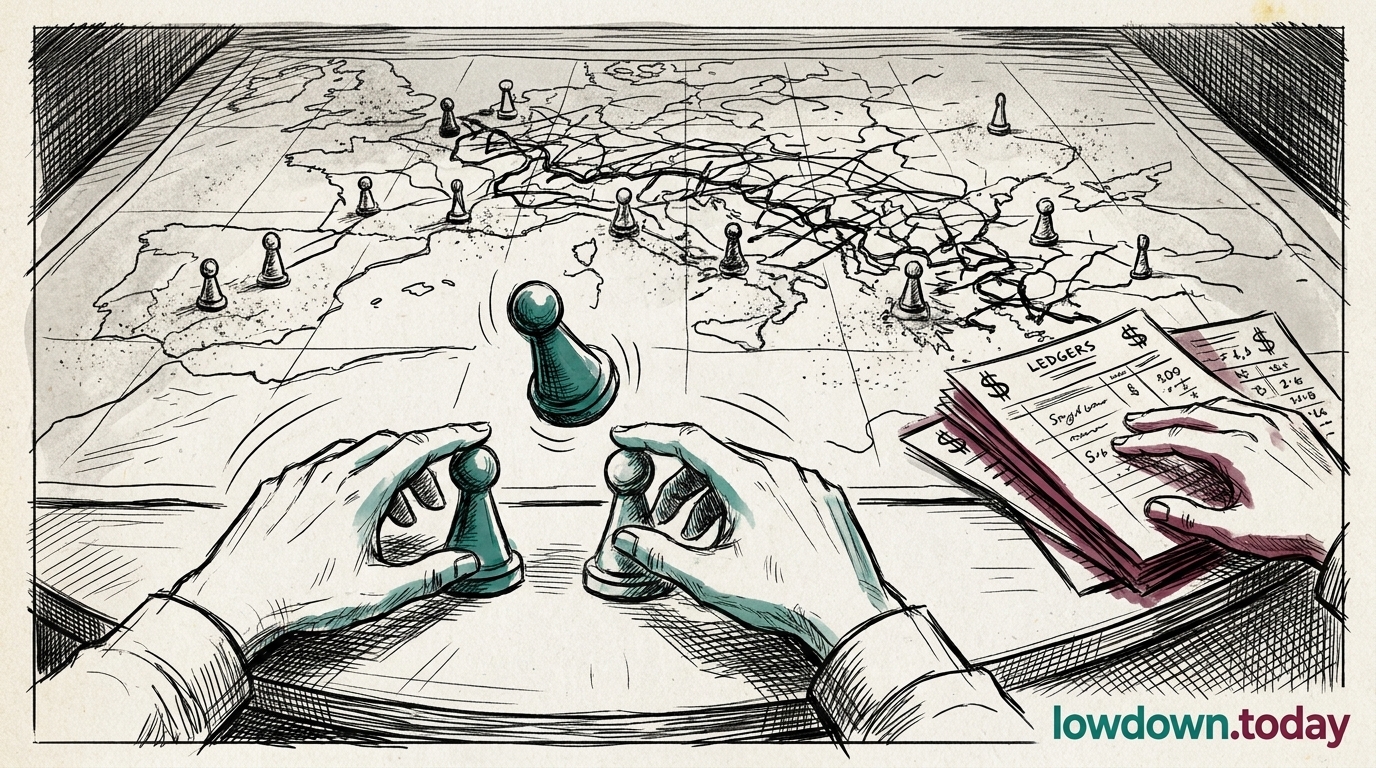
Forty nations meet in Paris on 17 April to convert the 8 April Élysée statement into a signed maritime mission with command structure and rules of engagement.

ConflictDeveloping
Key takeaway

Post-war Hormuz rules are being drafted in French and English, not in Washington.

Emmanuel Macron and Keir Starmer will chair a 40-nation leaders' video conference on 17 April to operationalise the Élysée joint statement of 8 April, which committed 21 governments and EU institutions to "ensure freedom of navigation in the Strait of Hormuz" and demanded a ceasefire "including in Lebanon". Signatories include France, the United Kingdom, Germany, Italy, Japan, Australia, Canada and EU institutions. A preparatory diplomatic call is scheduled for 16 April, and the Élysée agenda has added financial sanctions on Iran if Hormuz remains closed.

The Élysée, the French presidential palace, is the publisher of the only signed multilateral text to emerge from the post-war phase. It exists because the United States produced none: The White House presidential-actions page still records zero Iran instruments since 6 February . The 40-nation framework grew out of the UK-led Hormuz coordination coalition that Washington declined to anchor, and it sits on European legal ground the European Union laid down when it rejected Trump's Hormuz toll joint-venture on 12 April citing the UN Convention on the Law of the Sea (UNCLOS) .

In international maritime law the first credible multilateral framework usually holds. Subsequent arrangements adopt it, modify it, or negotiate against it, but rarely displace it outright. The Paris conference follows earlier joint statements that produced no ships , now backed by the Macron-Starmer announcement that convened it . Adding Iran sanctions to the Paris agenda narrows the gap between the European pressure track and the American one, this time executed under signed text rather than posted on a president's social-media account.

Flag-state politics carry the structural consequence. France and Japan have already lodged UNCLOS protests against the toll-interdiction list their vessels appeared on ; the Paris document gives those protests a multilateral spine. Once 40 nations sign a Hormuz passage framework, any subsequent US arrangement either reaches into that framework or argues round it. The former requires Washington to come to Paris; the latter requires a US instrument Washington has not written.


Deep Analysis

In plain English

The Strait of Hormuz is the narrow waterway between Iran and the Arabian Peninsula through which about 20 per cent of the world's oil and gas travels. Since the conflict began, the US military has been running a blockade there. On 8 April, France, the UK, Germany, Japan, Australia, and 16 other countries signed a statement at the Élysée Palace, France's equivalent of the White House, committing to keep that strait open for shipping. On 17 April, 40 countries are meeting by video conference, chaired by France's President Macron and UK Prime Minister Starmer, to turn that statement into an actual plan with ships, command structures, and rules. They are also discussing putting their own financial sanctions on Iran. The significance is that Europe is now building the post-war framework for Hormuz navigation without waiting for the US to lead it.

Deep Analysis
Root Causes

The Élysée statement exists because the US has produced no multilateral text. In international maritime law, the first credible signed framework tends to define the negotiating baseline for subsequent arrangements. European governments have a structural incentive to file that text before Washington does, because a US-authored framework would likely prioritise secondary-sanctions compliance over UNCLOS transit-passage rights, whereas a European-authored one can invert that priority.

A second cause is internal EU energy exposure. Germany, Italy, France, Japan, and Australia are all signatories with direct LNG and crude supply disruption. The statement is simultaneously a legal instrument and a pressure mechanism on Washington: by committing to a multilateral Hormuz mission without waiting for US leadership, Paris forces Washington to either join a European-designed framework or operate in parallel with a rival one.

Escalation

The Paris conference adding financial sanctions on Iran to its agenda represents an escalation of the European pressure track. Where the previous 40-nation coalition framework offered a diplomatic alternative to the US blockade, European-authored Iran sanctions would align the European and American pressure tracks, shrinking Tehran's diplomatic space. The conference outcome on 17 April is the most significant scheduled event of the week for the trajectory of negotiations.

What could happen next?
  • Precedent

    If Paris produces a signed communique with named command structure, it becomes the legal baseline for post-war Hormuz governance, displacing any US-authored framework that emerges later.

    Medium term · 0.8
  • Risk

    European financial sanctions on Iran, if agreed at Paris, risk fracturing the ceasefire extension Pakistan is brokering and accelerating the 22 April deadline without a replacement framework.

    Short term · 0.65
  • Opportunity

    A 40-nation Hormuz mission architecture provides the legal cover US allies need to contribute escort vessels without formally joining the US blockade, resolving the UK and German domestic political constraint.

    Medium term · 0.7
First Reported In

Update #70 · Europe signs what America won't

Élysée· 16 Apr 2026
Read original
Different Perspectives
IAEA (Rafael Grossi)
IAEA inspectors logged Zaporizhzhia's 22nd loss of off-site power, ten of them in the last three months, after a thunderstorm knocked out the plant's sole surviving backup line. Grossi reads the accelerating frequency, not any single outage, as the safety signal now that the plant's redundancy is exhausted.
United States (Treasury/OFAC)
Washington has let general licence 134C, its Russian crude waiver, lapse for 36 days with no successor, the longest gap of the war. Treasury has not said whether the non-renewal reflects deliberate policy or administrative delay, leaving buyers to price in compliance risk rather than wait for clarity.
Slovakia
Slovakia
Slovakia dropped its hold-out on the EU's 21st sanctions package only after winning a 2028 guarantee phasing out Russian gas, the exact pipeline dependency, roughly 80% of its crude supply, that gave it leverage. Bratislava's climbdown clears the package but leaves the same single-veto mechanism intact for the next round.
Russia (Kremlin and general staff)
General staff chief Gerasimov claimed Donetsk captures on 18 July that ISW says it cannot corroborate, extending a pattern ISW clocked at a 5:1 exaggeration ratio earlier this year. Moscow is conditioning its public for a possible autumn mobilisation after September's Duma elections rather than acknowledging the front has stalled.
Ukraine (Zelenskyy government)
Zelenskyy dismissed his commander-in-chief, defence minister and chief of general staff within eight days, replacing Syrskyi with Drapatyi and Hnatov with Skybiuk as protesters demanded Syrskyi go and Fedorov return. Kyiv frames the sweep as a bet on manoeuvre capacity ahead of a feared Russian autumn surge, not the disarray critics read into three changes in a week.
The United Kingdom
The United Kingdom
Starmer pledged £300 million in Kyiv on 16 July toward Ukraine's Gripen E squadron, adding to the PURL expansion Trump and Rutte had announced two days earlier. London is paying into a scheme built around a shortfall NATO's own published $4bn-plus pledge does not close against Zelenskyy's roughly $15bn stated need.



