Skip to content
Welcome, thoughtbot's Giant Robots listeners!Start here
Russia-Ukraine War 2026
5MAR

Mubaraz: first loaded LNG out of Hormuz

4 min read
04:57UTC

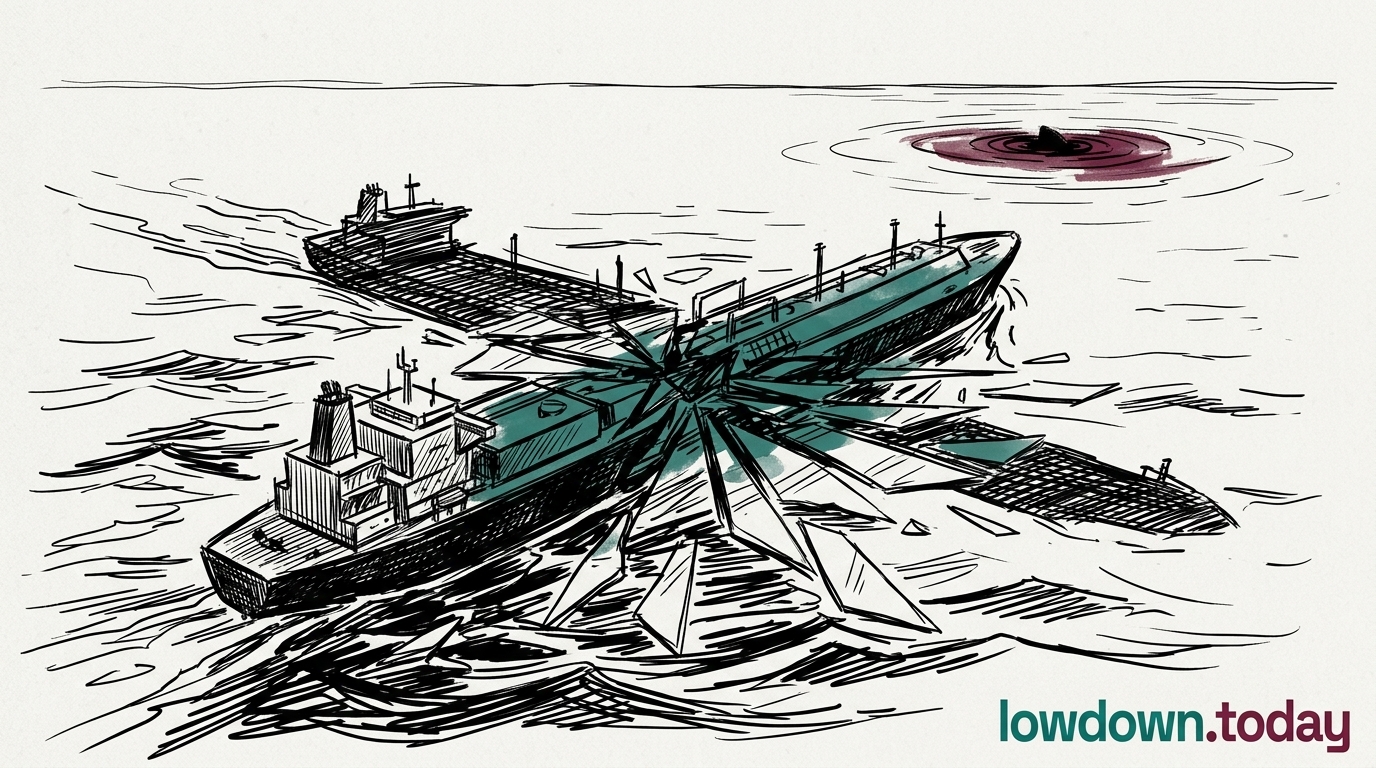
The Mubaraz, an LNG carrier loaded at ADNOC's Das Island in early March, reappeared west of India on 27 April after going dark around 31 March, completing the first confirmed loaded LNG transit through the Strait of Hormuz since the war began, with China the destination.

ConflictAssessed
Key takeaway

Hormuz is open for one cargo; the price spread keeps Atlantic cargoes pointed at Asia, not Europe.

The Mubaraz, an LNG carrier loaded at ADNOC's Das Island facility in early March, reappeared west of India on Monday 27 April after going dark around 31 March, completing the first confirmed loaded LNG transit through the Strait of Hormuz since the Iran conflict began⁠1. The cargo is destined for a terminal in China with estimated arrival 15 May. Before the conflict, roughly three loaded LNG carriers transited Hormuz daily; the Mubaraz crossing puts that count at one in roughly two months.

Das Island is the ADNOC-operated LNG facility off the UAE coast, the principal Gulf LNG export point routing through Hormuz. Hormuz had recorded 19 crossings on 25 April with no LNG transits; the Mubaraz crossing is the first loaded LNG passage of the post-war window. The IEA's Q2 Gas Market Report had already shifted the analytical baseline from a mid-year Hormuz LNG resumption to a multi-year delay; the Mubaraz transit is a single data point against that revised baseline rather than a framework change.

JKM, the Asian LNG benchmark, traded at $16.55/MMBtu front-month on 28 April against TTF equivalent near $14.80, a $1.75 spread that European buyers feel directly. That gap is enough to pull flexible Atlantic LNG cargoes east, not west. For European buyers running storage injection under the Bruegel-flagged refill pace, the practical implication is that partial Hormuz reopening does not automatically deliver cargoes to European terminals. The arbitrage routes them to Chinese, Japanese and Korean buyers first.

Iran-conflict-2026 owns the military and political framing of the Hormuz reopening; this topic owns the supply-routing implication. Whether the next Hormuz transit is a single LNG carrier or a sustained pattern matters less for European buyers than whether the JKM-TTF spread compresses below the level that pulls cargoes east. Through 2025 the spread had narrowed to $0.50-1.00; the current $1.75 keeps the eastern pull intact. Storage injection planners running scenarios past July need to assume Atlantic cargoes route east while the spread holds, regardless of how often Hormuz cracks open in the months ahead.

Deep Analysis

In plain English

the strait of Hormuz is a narrow waterway between Iran and Oman that almost all LNG tankers from the Middle East must pass through. Since the conflict began, it has been effectively closed to LNG traffic. On 27 April, the first LNG tanker in months was tracked passing through; the Mubaraz, heading to China. This sounds like good news for Europe, which is struggling to find gas for next winter. But there is a catch: gas prices in Asia are currently higher than in Europe, so the ship went east, not west. Until European gas prices rise enough to outbid Asian buyers, Middle East LNG reopening through Hormuz does not automatically mean more gas for Europe.

Deep Analysis
Root Causes

Das Island sits inside The Persian Gulf, making Hormuz the only viable exit route for ADNOC's LNG cargoes. ADNOC had approximately 14 LNG cargoes loaded or queued at Das Island when the conflict began, per IEA Oil Market Report (April) estimates.

The Mubaraz going dark around 31 March and reappearing on 27 April represents roughly 27 days of AIS silence; consistent with a vessel holding at anchor inside The Gulf, awaiting an Iranian clearance signal or military coordination window, before transiting when a passage was available.

The JKM premium above TTF has persisted since Hormuz closed, because reduced Middle East supply into Asian markets tightened JKM while European storage injectors, constrained by the Russian LNG ban, are absorbing Atlantic cargoes at current TTF levels without needing to bid above the Asian netback.

What could happen next?
  • Consequence

    Mubaraz transit to China confirms that Hormuz partial reopening does not automatically route cargoes to Europe; the JKM-TTF spread is the effective gate, currently below the threshold at which European buyers can outbid Asian netbacks.

    Immediate · 0.82
  • Risk

    If Hormuz reopens further but the JKM-TTF spread persists above USD 1.20/MMBtu, European storage refill faces a structural supply gap that Atlantic cargoes cannot fill at market prices; requiring either a TTF price rise or a policy intervention to redirect volumes westward.

    Medium term · 0.7
  • Opportunity

    Das Island's ability to transit cargoes through Hormuz, if it becomes a regular pattern, restores ADNOC as a Middle East LNG supply option for European term-contract buyers negotiating 2027-28 agreements.

    Long term · 0.5
First Reported In

Update #6 · REMIT II live; storage instrument absent

Bloomberg· 29 Apr 2026
Read original →
Different Perspectives
South Korean foreign ministry
Seoul said on 20 October it will withdraw some Kyiv embassy staff, citing no constructive steps from Kyiv since it recalled its ambassador over the disclosure of two North Korean prisoners. A chargé d'affaires and consular staff stay, and Seoul says its aid continues.
Alexander Lukashenko
Lukashenko said on 22 October that talks with the US show progress despite problems, which he said were highlighted with the exchange of political prisoners for the lifting of sanctions. He said Minsk keeps its promises and wants the US to deliver its side in full.
Moldovan government (Daniella Misail-Nichitin)
Moldova has pulled its border guards and customs officers from four crossings on Ukrainian soil after Russian strikes near the border. Interior Minister Daniella Misail-Nichitin said Chisinau is weighing moving Ukrainian checkpoints onto Moldovan territory.
Péter Magyar
Péter Magyar
Magyar told RTL that Ukrainian maize may cross Hungary in sealed trains bound for Western Europe. He set one condition: the cargo must only transit the country.
Donald Tusk
Donald Tusk
Tusk said Warsaw would seek an explanation from Kyiv for the drone's route across Poland. He said Poland allows no operations over its territory without its explicit consent.
Mindaugas Sinkevičius
Lithuania's prime minister said the Ukrainian drone that exploded in Pasvalys district on 18 October carried explosives and entered from Poland through the Schengen zone. Earlier drones over Lithuania had come from Belarus, not through allied airspace.

Written with AI from Lowdown's published reporting. Not individually reviewed by an editor. Editorial standards.