Skip to content
You can now search across every topic, entity and event.What's new
Russia-Ukraine War 2026
9JUN

US strike kills three Indian sailors

4 min read
11:54UTC

US forces fired into the engine room of the tanker MT Settebello, killing three Indian crew. India summoned the US Deputy Chief of Mission and lodged a strong protest.

ConflictDeveloping
Key takeaway

Three Indian sailors died inside the strait both Washington and Tehran are trying to control.

US forces fired munitions into the engine room of the Palau-flagged tanker MT Settebello after it "repeatedly failed to comply", killing three Indian sailors: Aditya Sharma, Shivanand Chaurasiya and Patnala Suresh 1. Of the 24 crew, 21 were rescued. Settebello was one of at least three tankers US forces disabled in the Gulf of Oman that week 2, extending a blockade whose running tally had reached 127 vessels redirected and six disabled .

India summoned the US DCM (Deputy Chief of Mission) and lodged a strong protest; Shipping Minister Sarbananda Sonowal called the deaths "deeply unfortunate" 3. Delhi has stayed out of the war itself, but India is among the largest users of Iran-routed crude, so its crews and hulls sit inside the strait Washington is throttling. That is the mechanism behind the grievance: the enforcement campaign Trump is now trying to trade away is the same one killing third-country sailors.

the strait closes from both sides at once. The IRGC (Islamic Revolutionary Guard Corps) declared all Hormuz shipping barred on 11 June ; CENTCOM (US Central Command) rejected the order as ineffective and kept firing. A Palau-flagged hull with an Indian crew ended up dead in the gap between two enforcement regimes. The IRGC separately claimed two more ships hit in the strait, a figure that remains unverified by any independent source 4.


Deep Analysis

In plain English

Three Indian sailors, Aditya Sharma, Shivanand Chaurasiya and Patnala Suresh, died on 11 June when US forces fired on the oil tanker MT Settebello in the Gulf of Oman. The tanker was registered in Palau, a small Pacific island nation, but most of its crew were from India. US forces said the ship refused their orders to stop, and 21 of the 24 crew were rescued. India's government formally protested to the United States and called the deaths deeply unfortunate. India is not involved in the war between the US and Iran, but many Indian sailors work on tankers that try to pass through the strait, because seafaring is a major employer for Indian maritime workers. The US is trying to block certain ships from using the Strait of Hormuz as part of its campaign against Iran, and India is caught in the middle: not at war, but losing its own people to it.

Deep Analysis
Root Causes

India's exposure in this incident traces to a structural contradiction in its Gulf policy since April 2026: India lost its Iran crude General License U waiver on 15 April , forcing its tanker operators onto third-flag vessels still attempting to transit a blockade Washington has not legally authorised under an AUMF (authorisation for use of military force).

Indian seafarers continue to crew those hulls because Indian maritime labour markets supply roughly 12 per cent of the global seafarer workforce, making Indian crew presence on third-flag Gulf tankers structurally inevitable regardless of bilateral diplomatic positioning.

The two-sided enforcement context makes crew casualty risk systemic rather than incidental. On 11 June the IRGC declared all Hormuz traffic barred while CENTCOM kept enforcing its own blockade, both citing authority the other rejects. A commercial hull attempting transit faces fire risk from two directions simultaneously, with neither authority accepting responsibility for the gap between their competing claims.

What could happen next?
  • Consequence

    India's DCM summons converts a bilateral US-Iran enforcement action into a multilateral diplomatic cost. If India tables an IMO complaint, it forces other non-belligerent flag states, including the Philippines, Bangladesh and Sri Lanka, to formally declare a position on CENTCOM's authority to fire on their nationals.

    Short term · Assessed
  • Risk

    Continued CENTCOM tanker strikes during the MoU negotiation window undermine the de-escalation signal Trump is sending simultaneously. Each disabled tanker makes the blockade harder for Washington to trade away credibly, because it re-establishes the enforcement cost as ongoing rather than receding.

    Immediate · Assessed
  • Precedent

    If the Settebello deaths produce no legal accountability, following the USS Vincennes precedent, it establishes a working norm that commercial crew casualties from US naval enforcement do not trigger prosecution, only compensation diplomacy.

    Long term · Suggested
First Reported In

Update #125 · Trump halts strikes, touts deal Iran denies

CBS News· 12 Jun 2026
Read original
Different Perspectives
North Korea / DPRK
North Korea / DPRK
ISW confirmed the first mounting of DPRK Type-75 MLRS on Russian autonomous UGVs near Kharkiv on 7 June, the latest step in a supply axis that escalated from shells in 2023 to troops in 2024. Pyongyang gains live battlefield data on its ordnance and on Russia's uncrewed-systems programme.
IAEA / Rafael Grossi
Grossi confirmed Chornobyl structural damage with nuclear material metres away and could not attribute the ZNPP 15-hour blackout during the agreed repair window. Six ceasefires brokered and broken at ZNPP, compounded by Rosatom's May attack on IAEA neutrality, have eroded his ability to enforce the windows he negotiates.
Emmanuel Macron / France
Macron co-signed the E3 framework whose line-of-contact baseline marks Europe's first formal acceptance that 1991 borders are not the opening position. France's role carries weight because Macron had previously proposed a European force for Ukraine, and the framework's multinational force point is the vehicle for that.
Keir Starmer / E3
Keir Starmer / E3
Starmer, Macron and Merz met Zelenskyy on 7 June and backed a five-point framework taking the line of contact as the talks baseline, conceding roughly one fifth of Ukraine in exchange for a multinational force and frozen assets. With US mediation ended, the NATO Ankara summit on 7-8 July is the next test.
Vladimir Putin / Kremlin
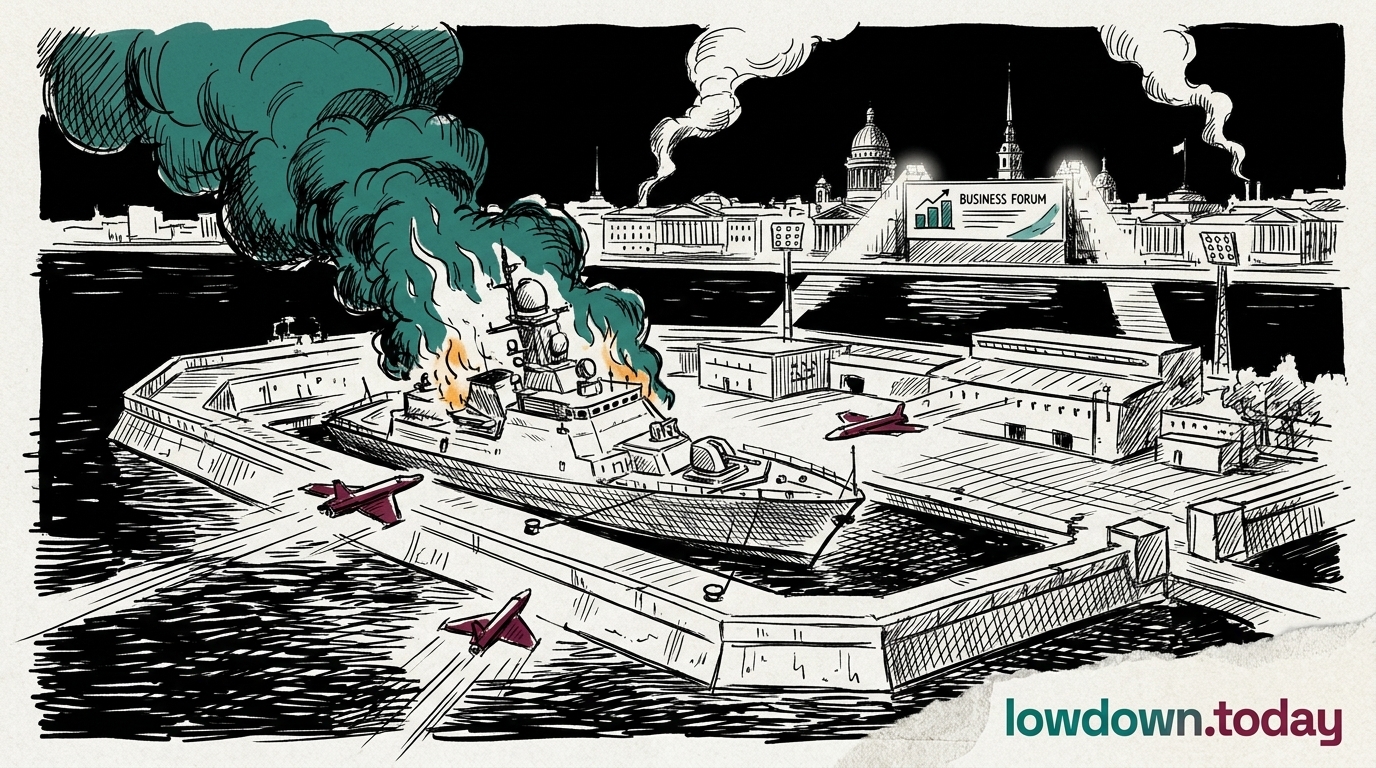
Putin used SPIEF to reject Zelenskyy's summit letter, citing 'elements of rudeness', and repeated the pre-agreed treaty precondition that has frozen every diplomatic round since May. The SPIEF platform's message of investor confidence was punctured by naval fires visible from St Petersburg, which Moscow declined to dispute in scale.
Ukraine / Unmanned Systems Forces
Commander Brovdi confirmed USF units tracked and set fire to Boikyi at Kronstadt, while Code 9.2 struck the Chonhar Bridge the following day. Ukraine is sequencing strikes for rear-area interdiction and political timing rather than ground gains, trading the Baltic Fleet's home base for the logistics squeeze Russia cannot absorb without rationing its own occupied territory.



