Skip to content
Briefings are running a touch slower this week while we rebuild the foundations.See roadmap
Russia-Ukraine War 2026
9JUN

Putin asks Trump for parade-day truce

3 min read
11:54UTC

Putin spent 90 minutes on the phone to Trump on 29 April and proposed a Victory Day ceasefire; Trump told reporters Putin 'might announce something, a little bit of a ceasefire'.

ConflictDeveloping
Key takeaway

Putin is again offering a Russian-anniversary truce through the White House rather than negotiating with Kyiv.

Vladimir Putin called Donald Trump on 29 April for a 90-minute conversation and proposed a Victory Day ceasefire around the 9 May parade. Kremlin foreign-policy aide Yuri Ushakov told reporters Trump 'actively supported' the proposal. Trump, asked outside the Oval Office, said Putin 'might announce something, a little bit of a ceasefire'. The White House issued no signed instrument during the gap window.

Putin did not contact Volodymyr Zelenskyy. He contacted Trump, framed the request as a calendar gesture rather than a negotiating step, and offered no reciprocal hold on Russian deep strikes inside Ukraine. Russia's later messaging floated a revised three-day window covering 7 to 9 May, then retracted it pending what Kremlin spokesman Dmitry Peskov called concrete decisions still to be made.

The pattern matches Putin's 32-hour Easter decree , which was issued without prior US contact and expired with 10,721 Russian violations on Ukraine's count . Both proposals share the same architecture: Russia announces a window pegged to a domestic anniversary, Western governments are asked to validate it, and Ukraine is presented with a finished offer rather than a negotiating draft. The Easter decree gave Putin 32 hours of Russian-controlled optics; the Victory Day proposal asks for the same arrangement around the security perimeter the Kremlin needs for its own parade.

The Trump channel substitutes for direct Russia-Ukraine contact that Moscow has avoided since the 2022 Istanbul talks collapsed. For the Kremlin, a Western-validated truce produced through the White House is preferable to a bilateral negotiation that would treat Kyiv as the primary counterparty.

Deep Analysis

In plain English

Vladimir Putin called Donald Trump on 29 April 2026 and proposed a temporary ceasefire around Russia's 9 May Victory Day celebrations. Trump reportedly told the Russian side he 'actively supported' the idea, and told reporters that Putin 'might announce something, a little bit of a ceasefire'. The two sides have not agreed on the length of any pause, the monitoring arrangements, or what happens on 10 May when it ends. Ukraine's President Zelenskyy, who was not part of the call, said the proposal sounded like 'a few hours of security for a parade in Moscow' rather than a genuine step toward peace.

Deep Analysis
Root Causes

The structural reason the Putin-Trump call followed the Easter ceasefire template rather than producing anything new is that Russia and the United States have no functioning bilateral working group on Ukraine.

The Witkoff-Kushner channel is a personal envoy operation, not an institutional mechanism; it has no permanent staff, no shared document platform, and no Ukrainian counterpart embedded in it. Every Putin-Trump agreement therefore lands in a procedural vacuum where it can be claimed by both sides as endorsed and by neither side as binding.

Kirill Dmitriev's 9-10 April Washington meetings established Russia's preferred format: a US-Russia bilateral that Ukraine joins as a third party rather than a co-principal. Ukraine's insistence on being a co-principal from the start means the two sides' procedural preconditions for even beginning formal talks have not been met after fourteen months of the Trump administration.

The ceasefire proposal's positioning around 9 May also reflects Moscow's domestic clock. The parade requires a security perimeter; the ceasefire functions as the diplomatic frame for that perimeter. Putin is asking Washington to enforce a 24-to-72-hour pause that solves a logistics problem Moscow cannot solve militarily.

What could happen next?
  • Risk

    If the Victory Day ceasefire proposal follows the Easter pattern, a 72-hour pause followed by resumption at elevated tempo would set a precedent that ceremonial ceasefires serve Russian operational interests without advancing durable peace.

    Short term · 0.82
  • Opportunity

    A successful 72-hour pause with verifiable compliance would give the Witkoff-Kushner channel a working template for a longer monitored ceasefire, the first one in the conflict's history.

    Medium term · 0.55
  • Consequence

    Trump's verbal endorsement without a signed instrument creates a pattern in which Moscow can claim US backing for any Russian-initiated pause while Kyiv has no institutional mechanism to challenge that characterisation.

    Medium term · 0.78
First Reported In

Update #15 · Hardware-free parade; crude waiver lives on

KTEP / Associated Press· 3 May 2026
Read original
Different Perspectives
North Korea / DPRK
North Korea / DPRK
ISW confirmed the first mounting of DPRK Type-75 MLRS on Russian autonomous UGVs near Kharkiv on 7 June, the latest step in a supply axis that escalated from shells in 2023 to troops in 2024. Pyongyang gains live battlefield data on its ordnance and on Russia's uncrewed-systems programme.
IAEA / Rafael Grossi
Grossi confirmed Chornobyl structural damage with nuclear material metres away and could not attribute the ZNPP 15-hour blackout during the agreed repair window. Six ceasefires brokered and broken at ZNPP, compounded by Rosatom's May attack on IAEA neutrality, have eroded his ability to enforce the windows he negotiates.
Emmanuel Macron / France
Macron co-signed the E3 framework whose line-of-contact baseline marks Europe's first formal acceptance that 1991 borders are not the opening position. France's role carries weight because Macron had previously proposed a European force for Ukraine, and the framework's multinational force point is the vehicle for that.
Keir Starmer / E3
Keir Starmer / E3
Starmer, Macron and Merz met Zelenskyy on 7 June and backed a five-point framework taking the line of contact as the talks baseline, conceding roughly one fifth of Ukraine in exchange for a multinational force and frozen assets. With US mediation ended, the NATO Ankara summit on 7-8 July is the next test.
Vladimir Putin / Kremlin
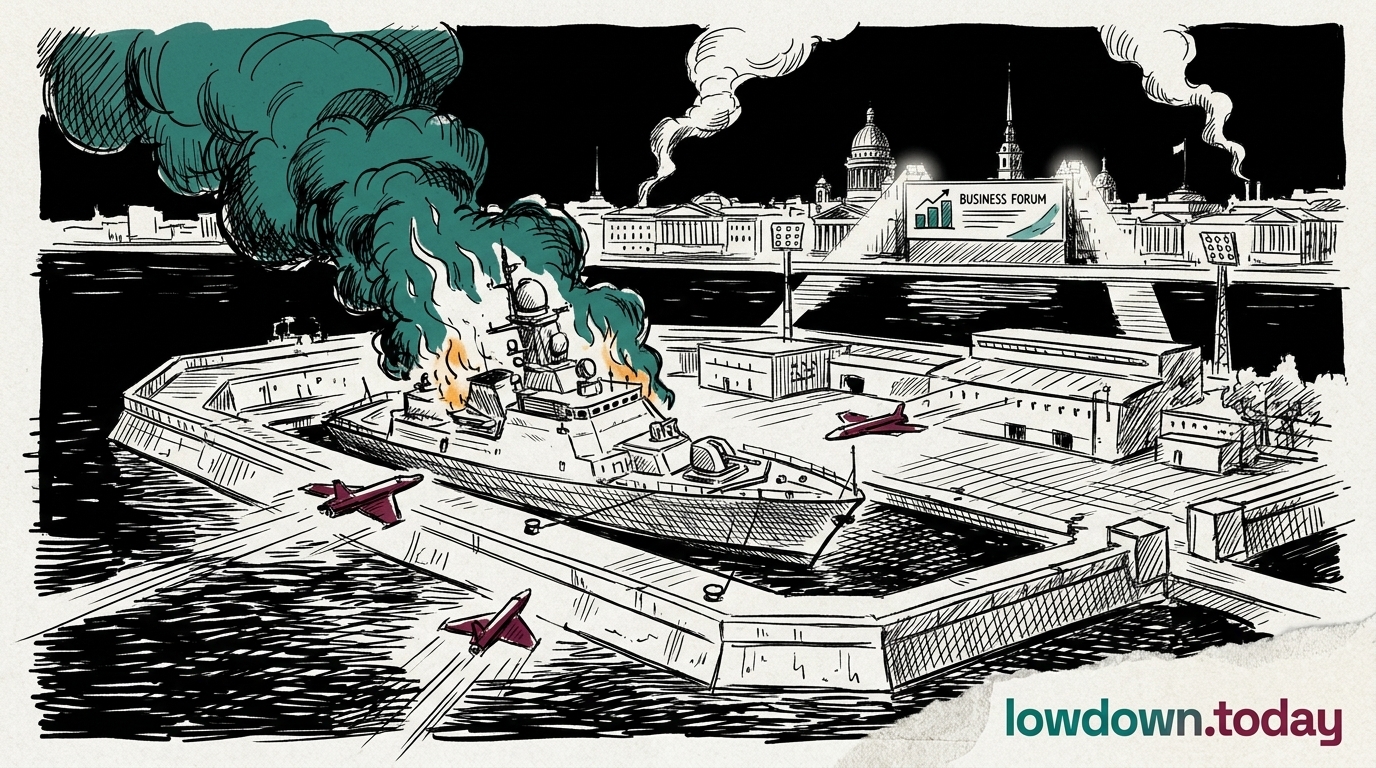
Putin used SPIEF to reject Zelenskyy's summit letter, citing 'elements of rudeness', and repeated the pre-agreed treaty precondition that has frozen every diplomatic round since May. The SPIEF platform's message of investor confidence was punctured by naval fires visible from St Petersburg, which Moscow declined to dispute in scale.
Ukraine / Unmanned Systems Forces
Commander Brovdi confirmed USF units tracked and set fire to Boikyi at Kronstadt, while Code 9.2 struck the Chonhar Bridge the following day. Ukraine is sequencing strikes for rear-area interdiction and political timing rather than ground gains, trading the Baltic Fleet's home base for the logistics squeeze Russia cannot absorb without rationing its own occupied territory.