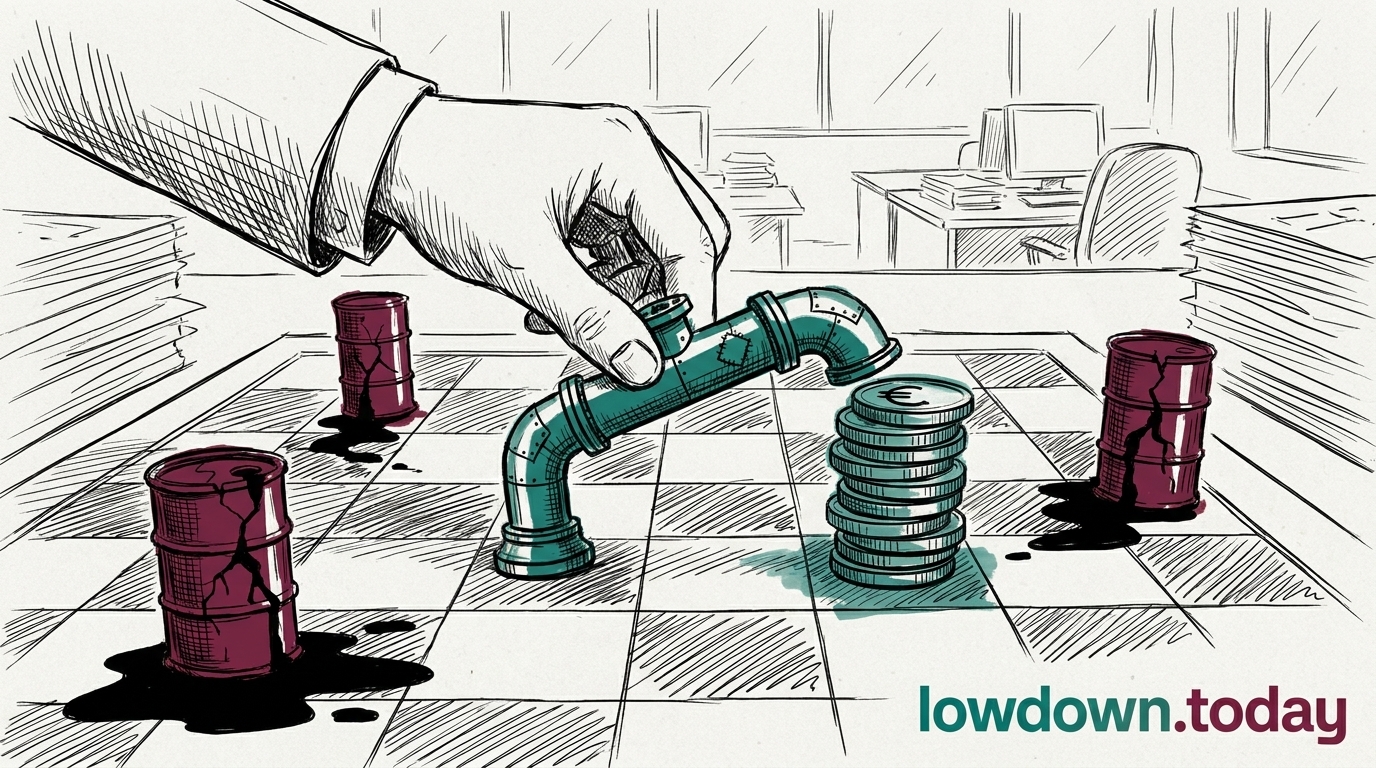
Analysts at the Carnegie Endowment for International Peace, a Washington-based non-partisan think tank, published a quantification in April showing that Ukrainian strikes cut Russian crude exports from 5.2 million to 3.5 million barrels per day between 25 March and 11 April, a 33% volume cut1. Over the same period the Iran conflict drove global prices higher. Post-attack weekly revenues ran 17% below the preceding two weeks but 62% above late February. Carnegie's figures place the price offset above the volume loss on a common ledger for the first time.
Ukraine's oil strike campaign has been scaling since the Baltic terminal hits in late March, and Urals crude spiked through the Iran war's early-April phase. With Russian barrels displaced from the market and global demand elevated by Hormuz risk, the residual barrels Moscow sells clear at a premium that covers most of the shortfall. Tehran's war is functioning as Moscow's revenue insurance.
That subsidy is contingent. If the strait of Hormuz reopens and global prices fall, the fiscal squeeze Reshetnikov named in the same fortnight tightens directly. The UK-France planning conference at Northwood on 22 April is aimed at exactly that reopening, which means the same week's institutional calendar contains both the lever that keeps Russia's revenue high and the lever that would pull it down. Carnegie's quantification is the first analytical frame to price the link between the two theatres on a common ledger, and it positions Moscow's fiscal stability on an axis Moscow does not control at either end.




